
As smoke from warehouse fire clears, smoke from Canadian wildfires move in
Trending
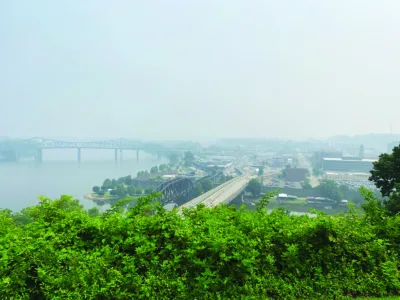
PARKERSBURG - As the area gets over smoke from the recent Peoples Cartage warehouse fire, smoke has moved in from wildfires in Canada, which now impacting Mid-Ohio Valley air quality.
Officials in both West Virginia and Ohio are warning people to take precautions as the effects can be seen and felt throughout the area.
The West Virginia Department of Environmental Protection issued a Code Red for Friday due to smoke from Canadian wildfires for northern and central West Virginia, according to an Air Quality Alert issued by the National Weather Service in Charleston.
"Elevated fine particulate matter levels due to the smoke will continue through (Friday) and Saturday," the post said. "The entire state will experience hazy air."
The air quality alert was issued Friday for Cabell, Mason, Jackson, Wood, Pleasants, Tyler, Putnam, Kanawha, Roane, Wirt, Calhoun, Ritchie, Doddridge, Clay, Braxton, Gilmer, Lewis, Harrison, Taylor, Upshur, Barbour, northwest Randolph and southeast Randolph counties.
A Code Red air quality alert means that air pollution concentrations within the local region are unhealthy for the general population. The effects of air pollution can be minimized by avoiding outdoor exercise or strenuous activity. Sensitive groups should take additional precautions. These groups include children, the elderly, and people suffering from asthma, heart disease, or other lung diseases.
The Ohio Environmental Protection Agency issued a statewide Air Quality Advisory and warned that pollution could temporarily reach hazardous levels. Ohio EPA said air quality in southeastern Ohio was expected to reach the "unhealthy for sensitive groups" category. Marietta and the remainder of the state were expected to experience "unhealthy" conditions, with hourly pollution concentrations potentially reaching "very unhealthy" or "hazardous" levels at times.
The agency did not set an expiration time for the advisory. It said a notice would be issued when air quality improves and the wildfire smoke leaves the region.
Brian Scharfenberg, an emergency medicine physician with Memorial Health System, recommended that residents monitor their local Air Quality Index before spending time outdoors and to limit outdoor exposure, particularly during strenuous activities. He also stated people with asthma or chronic obstructive pulmonary disease should keep rescue inhalers and other prescribed medications readily available.
"Even though these fires are happening hundreds of miles away, the smoke can still affect air quality here," Scharfenberg said. "The unpleasant smell and haze we are seeing contains small particles that can affect the lungs, particularly with prolonged exposure or strenuous activity outdoors."
Scharfenberg said reducing outdoor exposure is especially important for people with asthma, COPD, heart disease or other chronic health conditions.
The Mid-Ohio Valley Health Department is also advising people with breathing issues to take it easy, said Public Information Officer Amy Phelps.
Being mindful of how one feels when doing activities outside and if one notices an issue with breathing consistently, they are advised to bring themselves inside, she said.
People are advised to limit smoking and vaping inside their homes and other activities that might irritate their respiratory system, the health department is recommending. Also, people should stay inside as much as possible, keep windows/doors closed, turn on HVAC system with filter or use portable air filter. If somebody abruptly becomes short of breath, get them inside, see if you can get them to calm down, and if not, contact 9-1-1, the department said. People should speak to their doctor if they have breathing issues to make an action plan.
According to the federal AirNow Air Quality Index, readings from 151 to 200 are considered unhealthy, readings from 201 to 300 are very unhealthy and readings above 300 are hazardous.
Ohio EPA recommended avoiding strenuous outdoor activities when possible, particularly for people with heart disease or respiratory conditions such as asthma. Symptoms of smoke exposure can include wheezing, coughing, chest tightness, dizziness and burning in the nose, throat or eyes.
Residents were advised to keep windows closed overnight and, if possible, operate central air-conditioning systems with MERV-13 or higher-rated filters. The agency also recommended avoiding outdoor burning and limiting indoor sources of smoke, including gas or wood stoves, fireplaces and candles.
The advisory comes amid a worsening Canadian wildfire situation. As of July 9, Canada had 796 active wildfires, including 60 out-of-control fires receiving a full response, according to a Canadian government update. Canada had recorded 3,137 fires during the 2026 season, burning about 1.4 million hectares, or nearly 3.5 million acres.
Canadian officials said overall wildfire activity remained below the five-year average, but fire danger was increasing as summer progressed. The government forecast elevated fire potential during July in northern Ontario and Quebec.
The National Weather Service in Charleston said smoke from distant wildfires would keep skies across the region hazy at times.
Residents can monitor conditions in Marietta and Parkersburg through the federal AirNow website, www.airnow.gov.
In a press release, U.S. Environmental Protection Agency (EPA) Administrator Lee Zeldin said Friday the impacts of the Canadian wildfires are causing great concern and harm across the United States and officials are working around the clock to assist impacted Americans. They are in direct communication with the Canadian government, as well as federal, state, local, and Tribal partners
"The agency is using our resources to monitor air quality and provide the public with timely access to our data," said Zeldin. "We are going to remain continuously engaged with Canadian leadership at the highest levels of their government and strongly encourage them to do everything in their power to extinguish these fires as fast as possible.
“EPA will do everything in the agency's authority to continue to protect human health and the environment throughout this event."
Meanwhile, there have been no new incidents since the fire at the Peoples Cartage warehouse reignited last Saturday, July 11, after the EPA air quality report had been released on July 9.
Wood County 911 Director Dale McEwuen said that crews responded last weekend to the site after it had reignited after being put out a few days before.
The Mineral Wells Volunteer Fire Department, the Eastwood Volunteer Fire Department, the Lubeck Volunteer Fire Department fought the fire, which took around 1½ hours to put out, McEwuen said.
"There have been no new calls or reports fires since," he said. "The rain, since the last fire call, possibly assisted."
Tankers were brought in from the Waverly VFD, the Deerwalk VFD, the Pond Creek VFD, the Blennerhassett VFD and the Williamstown VFD to help with efforts, McEwuen said.
The EPA prepared a the July 9 report of the air monitoring data collected in the area during the initial fire that was fully engulfed on July 5 and lasted until around July 8 before the blaze reignited last Saturday.
EPA's Environmental Response Team (ERT) also conducted air monitoring during that time with air monitoring locations around the area and close to the work site.
The systems monitored for analytes of volatile organic compounds (VOCs), carbon monoxide, hydrogen cyanide, and hydrogen sulfide, and particulate matter (PM-2.5 and PM-10). The monitors provided remote readings to the EPA OSC every 15 minutes.
"Detecting a pollutant does not necessarily mean it poses a health risk," said EPA spokesperson for the Mid-Atlantic Region Kelly Offner. "EPA provided the monitoring results and health-based benchmarks to state and county officials, who determined when protective actions may be needed."
During the active fire, elevated smoke (PM2.5) exceeded EPA's health-based action level of 0.035 mg/m³ at several monitoring locations, she said.
"Those results, along with ongoing fire conditions, supported Wood County's decision to issue a temporary shelter-in-place order for residents within a one-half-mile radius of one monitoring location north of the facility on July 6," Offner said. "The monitoring also detected elevated hydrogen cyanide and, at one location, carbon monoxide above their screening action levels during portions of the response. VOCs and hydrogen sulfide remained below their health-based action levels throughout monitoring.
"As the fire came under control, pollutant concentrations declined and monitoring results returned to background levels with no further exceedances of the applicable health-based standards. Based on those sustained improvements, Wood County officials lifted the shelter-in-place order on July 7."
After monitoring throughout the affected area continued to show no exceedances, EPA demobilized its air monitoring equipment on July 8, she said.