W.Va. Educational Broadcasting Commission thankful for flat budget for next fiscal year
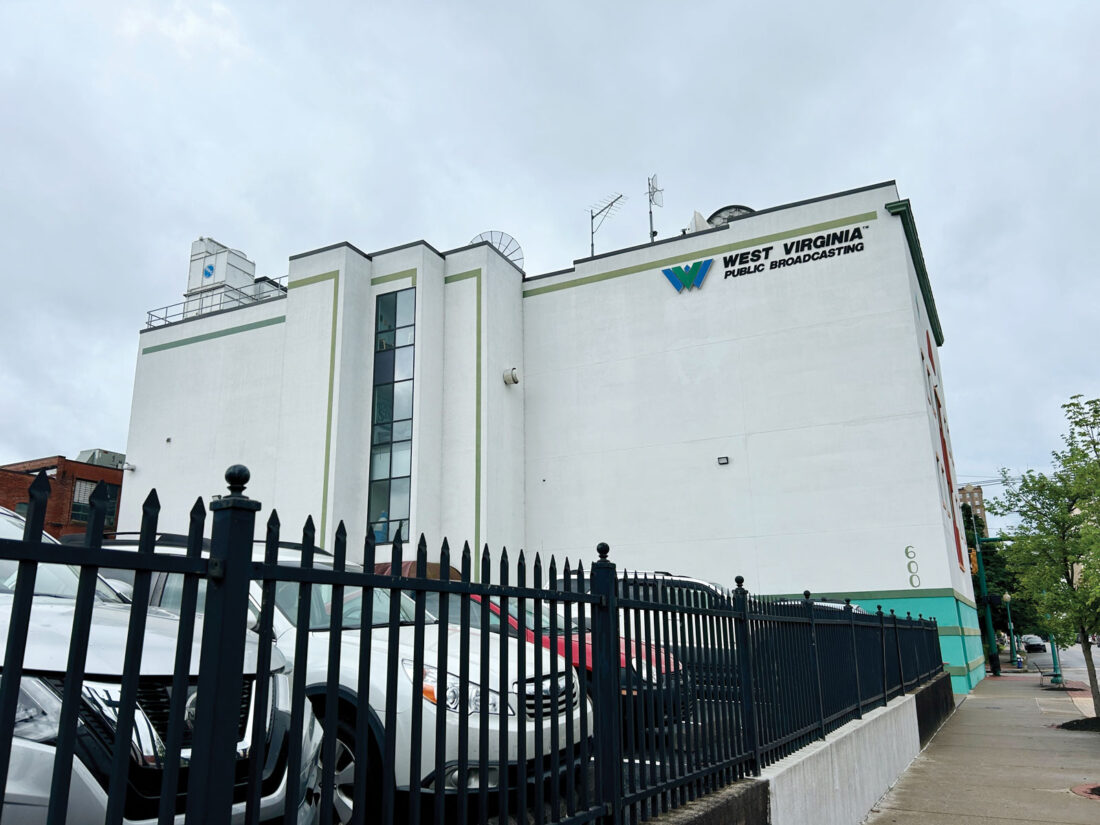
West Virginia Public Broadcasting’s headquarters in downtown Charleston. (File photo)
CHARLESTON – After seeing a nearly 11% cut to its general revenue budget after Gov. Patrick Morrisey took office last year, the Educational Broadcasting Commission celebrated entering the next fiscal year with a nearly flat budget.
The Educational Broadcasting Commission held its quarterly meeting Wednesday at the headquarters of West Virginia Public Broadcasting in downtown Charleston.
In the final version of Senate Bill 250, which establishes the $5.485 billion general revenue budget for fiscal year 2027 beginning in July, the commission’s funding was set at more than $3.859 million, which was $12,596 less than this fiscal year’s $3.872 million.
That’s a just over 0.3% decrease compared to the 10.7% cut the commission was dealt between FY25 and Morrisey’s first budget bill for FY26 when he took office in January 2025. It was also less than the 2% cut many state departments and agencies were asked to submit for the FY27 budget bill heading into the most recent legislative session.
“It was a flat budget for us, which is very optimistic from my perspective,” said West Virginia Public Broadcasting Interim Executive Director Kathleen Brady.
EBC Chairman William File III expressed his appreciation for the Legislature and Morrisey on behalf of the commission, WVPB staff and the network’s viewers and listeners for not cutting the commission’s budget, which partially funds WVPB’s work.
“We need to thank the Legislature and the governor,” File said. “They stepped up this year. They supported us. I think it’s a very encouraging move on their part. We’ll certainly do our best to be the best stewards we can of the funds that they are providing to help keep us going.”
Brady told commission members that the WVPB gained more than 2,000 first-time members so far three-quarters of the way through the current fiscal year compared to only 1,460 first-time members for the entirety of fiscal year 2025.
The Friends of West Virginia Public Broadcasting, one of two nonprofits that support the work of WVPB, is ahead of last year’s total fundraising by more than $474,000 and crossed the $3 million threshold for pledges paid to date.
“We’ve been very blessed to have our generous donors step up,” Brady said.
“You guys have risen from the ashes of what we thought was happening federally to really make a difference, and that entire Friends organization needs to be applauded,” said Michael J. Farrell, EBC vice chairman and chairman of the West Virginia Public Broadcasting Foundation which solicits major grants bequests for WVPB.
According to the WVPB fiscal year 2025 report, general revenue from the state budget makes up 39.9% WVPB’s funding, followed by 42.3% in private donations and 17.8% in federal funding through the Corporation for Public Broadcasting, which ceased functions earlier this year following the end of federal funding. WVPB received $1.7 million in federal funding in the previous fiscal year.
The July 2025 recissions package passed by Congress and signed into law by President Donald Trump clawed back more than $1.1 billion in direct funding for CPB that was already appropriated for the federal fiscal year that ended in October. The cuts to CPB left it with barely $30 million, causing the corporation to announce in August it was shutting down its operations.
The recissions package came after Trump’s May 2025 executive order calling for the CPB — the nonprofit founded by Congress in 1967 — to cease all direct and indirect funding of National Public Radio and the Public Broadcasting Service. A federal judge blocked Trump’s executive order in a ruling Tuesday, though the ruling was expected to have little effect at reversing funding decisions.
While West Virginia Public Broadcasting is weathering federal funding uncertainty, it continues to operate under a hiring freeze except for positions funded through private grants and philanthropy. But federal funding issues are causing NPR member stations in other parts of the nation to drop certain programs, such as WVPB’s “Mountain Stage.”
“Mountain Stage” Executive Producer Adam Harris told commission members that station carriage is down 13%, or a loss of approximately 38 stations. Harris estimated the loss in audience amounted to a 3% decrease, though that number may be skewed by changes in how Nielsen does its rating. NPR is responsible for selling “Mountain Stage” to member stations.
“In the grand scheme of things, it’s not a huge loss, certainly compared to what it could have been,” Harris said. “NPR offered rescission package pricing. In other words, they lowered the rates proportionately to the stations that subscribe to ‘Mountain Stage.’
“My understanding of those offers is that they were offering those rates for those who maintained their current programming,” he said. “In other words, no drops, no changes if you kept the exact same program. And so obviously there were some of those (stations) who still weren’t able to make that.”
Steven Allen Adams can be reached at sadams@newsandsentinel.com.
Local News
No Joke: Personal income tax collections down in March but W.Va. revenues remain in black
Capito speaks at final day of W.Va. Coal Association Mining Symposium
Parkersburg mayor offers way for petitioners to remove signatures
PARKERSBURG – As a committee seeking to repeal or place on the ballot an ordinance authorizing a trash service ...
Multiple fire departments respond to two fires Tuesday
PARKERSBURG – Multiple local fire departments responded to a brush fire and structure fire Tuesday evening. The ...

W.Va. Educational Broadcasting Commission thankful for flat budget for next fiscal year