Wood County Schools proposes changes to support literacy and numeracy skills
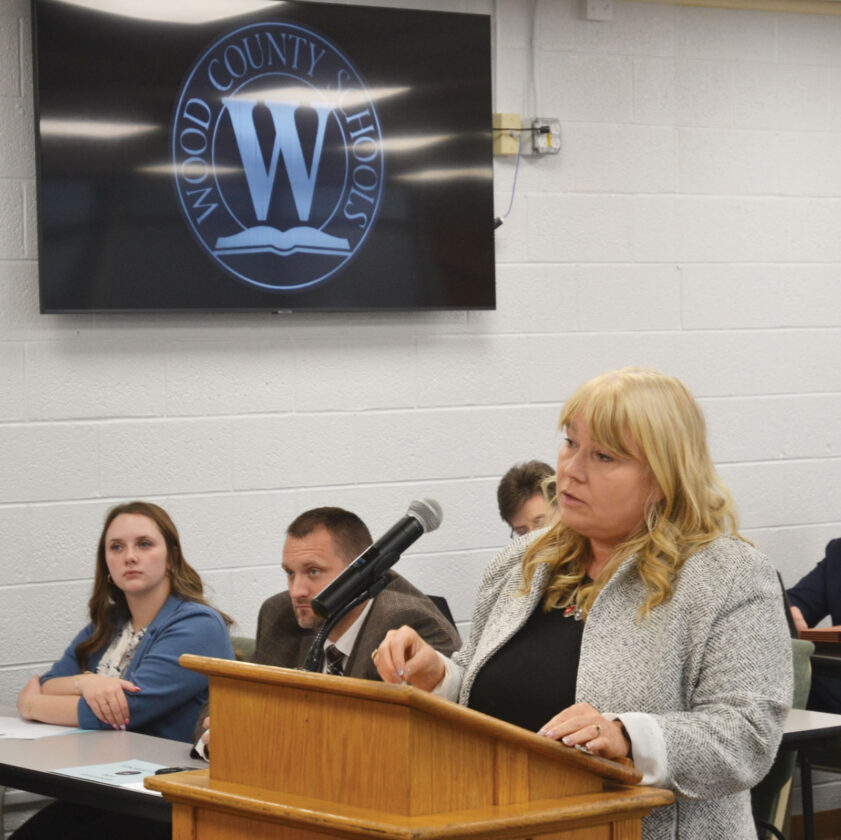
Heather Grant, director of elementary education, presented a proposal to the Wood County Board of Education Tuesday to restructure the classroom aide model to an academic support interventionist model aligned with the West Virginia Third Grade Success Act. (Photo by Douglass Huxley)
PARKERSBURG – Ashlee Beatty, director of curriculum and instruction and Heather Grant, director of elementary education, presented a proposal to the Wood County Board of Education Tuesday night that they say will strengthen early literacy and numeracy outcomes for grades two and three by shifting from a classroom aide model to an academic support interventionist model aligned with the West Virginia Third Grade Success Act and Wood County Schools’ support framework.
“Our focus is ensuring that every student leaves third grade with the foundational skills for long-term academic success,” Beatty said.
Grant said the proposal would convert existing third-grade classroom aide positions into approximately 18.5 academic support interventionist positions across the district. Additionally, selected second-grade aide positions would be transitioned to three interventionists to support both second and third grade where needed.
She said the academic support interventionists would be certified teachers trained to identify learning gaps and deliver intensive interventions aligned with the science of reading and the multi-tiered systems of support guidelines the district uses.
She said the key responsibilities of the positions would be:
* Deliver small-group literacy and numeracy interventions
* Provide “push-in” instructional support during core classroom instruction.
* Collaborate with classroom teachers to align interventions with grade-level work.
* Monitor student progress using district assessments and multi-tiered systems of support guidelines.
* Participate in student assistance teams.
* Communicate with families about progress and strategies to support learning at home.
Grant said to also expand learning time for students who are struggling, interventionists’ work schedules will be shifted later into the day.
“They will start a little bit later than our normal start time,” she said. “And they will be able to provide extended-day (support) for our third-graders struggling in math or reading. And this will allow us to expand our instructional time for students who need it most.”
Beatty said the proposal aligns with both the West Virginia Third Grade Success Act and the district’s multi-tiered systems of support framework. Under the law, beginning next school year, third-grade students who do not meet standards on the state’s General Summative Assessment (GSA) in English language arts or mathematics will be retained, with some exemptions.
Beatty said those possible exemptions and supports for students who initially do not meet standards could be:
* Retaking the GSA within a limited window for some students
* Elementary summer learning programs with another chance to take the GSA at the end of summer
* A “good cause” exemption process, where parents can submit documentation and a team makes a recommendation to the superintendent, who renders the final decision based on what is best for the student.
She said despite the law’s focus on retention, the district’s real goal is prevention, through early identification and sustained intervention.
“I just want to address one really quick thing regarding the retention… That is absolutely not our goal in Wood County Schools,” Beatty said. “It is not acceptable for us to have a large amount of students (retained) … we are working incredibly hard (to meet standards). And if (students) are not meeting standards, we want to ensure that we have things in place to support them. My thought is that this will not be a surprise. We are identifying these students. We’re meeting regularly, we’re writing improvement plans, and we’re doing all of these things to where in third grade we should know.”
Board member Ron Tice and President Justin Raber brought up concerns about how retention will work if a parent decides to pull their student after realizing they may be held back. Tice asked if that student could then return the next year and be considered a fourth-grader. Beatty said the district must follow state procedures regarding homeschool re-enrollment and grade placement.
“We are learning together, along with the State Department, who has been great,” Beatty said. “They give us technical assistance calls regularly. We’re on version 2.0 of their guidance, and we’re following that.”
While acknowledging the difficulty of cutting aide and specialist positions, board member Judy Johnson voiced strong support for the focus on specialized instruction and extended learning time.
“We think ahead for the students. And I think it was very progressive thinking that you’re going to implement a flex time so that those teachers start maybe 30 minutes later, but they teach 30 minutes later during the day, so that you can give the students what they need. I think that’s a very good idea,” Johnson said.
Beatty said the district’s goals are to ensure that students receive the instruction and intervention they need throughout the school year so that retention becomes a rare outcome rather than a common one.
Amber Hardman, director of federal programs, also talked to the board about the restructuring of some federally funded positions, such as Assistant Principal of Teaching, Learning, and Student Success (Title I), Youth Reporting Center Summer Academic Program (Title I, Part D) and Special Education Instructional Support (Title II Reinstatement).
Hardman said despite Title II cuts, the need for Special Education Instructional Support positions is too great to ignore. She said this position aims to strengthen special education instructional practices by supporting teacher collaboration, IEP development, and effective strategies.
“Yes, our Title II budget has declined. However, the need for this position is significant, and we are willing to adjust our needs in order to fund this position,” she said. “There is a great need for this role, as many of our educators are new to special ed or are working outside of their primary certification area.”
Hardman said the Assistant Principal of Teaching, Learning, and Student Success expands an existing assistant principal role in Title I elementary schools. She said the role is designed to coordinate attendance, behavior, and academics under one administrator.
“While this is a new job description and a slightly different name, it is a modification of a role that already exists,” she said. “Attendance behavior and academic performance are closely connected indicators of student success and are most effective when intentionally coordinated… Housing these responsibilities within this position ensures that attendance trends, behavioral support and academic interventions are reviewed all together.”
Hardman said the Youth Reporting Center Summer Academic Program position would use Title I, Part D — a grant limited to specific court-involved facilities — to provide summer academics at the Wood County Youth Reporting Center (YRC) to better support at-risk students. She said this would support the academic void for those students by providing three days of instruction throughout a five week summer program, totalling 15 sessions of academic instruction.
“Students will be offered remediation, credit recovery and support for those who are in the Options Program,” Hardman said. “It’s a very unique, sometimes challenging partnership (with the YRC) because there’s so many entities involved, but it operates beautifully. The staff over there is fantastic. They work with us very well, and they do great work supporting our students. We’re the only YRC of its kind in the whole state.”
Douglass Huxley can be reached at dhuxley@newsandsentinel.com
Local News
Wood County BOE hears presentations on federal funding and i-Ready data

Parkersburg City Council amends budget items to boost Holiday in the Park

Former president files lawsuit against Marietta College

Clutch Collective hosting Adult Book Fair with The Novel Notion
Wood County Schools proposes changes to support literacy and numeracy skills