Wood County BOE hears presentations on federal funding and i-Ready data
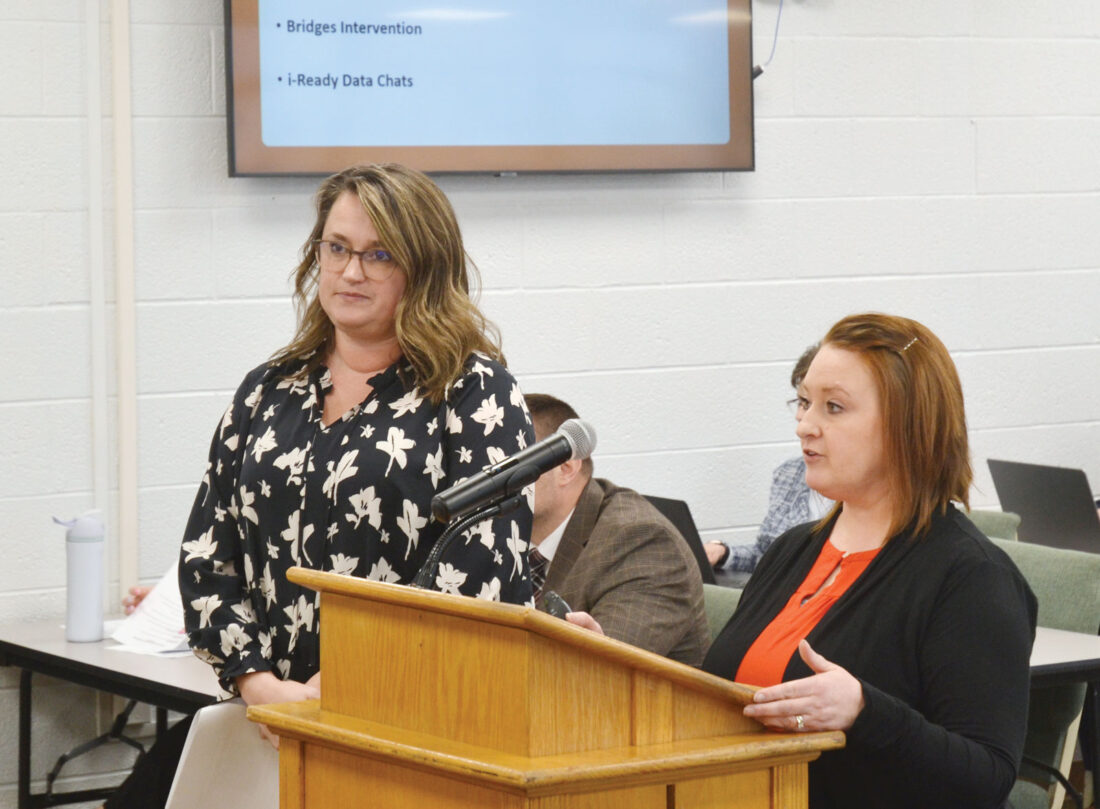
Ashlee Beatty and Candace Lewis, directors of curriculum and instruction, presented the Wood County Board of Education with the middle-of-year i-Ready benchmark data Tuesday, saying 46% of K–8 students are now on or above grade level in math, up from 23% at the beginning of the year. The pair also reported a drop in the number of students reading below grade level from 28% to 20%. (Photo by Douglass Huxley)
PARKERSBURG — Amber Hardman, director of federal programs, gave the Wood County Board of Education an in-depth overview of what federal education dollars can and cannot fund Tuesday, and “how the district plans to use those funds to sustain and strengthen student support programs.”
Hardman presented a slideshow saying Wood County Schools operates on two primary funding sources: state and local funds and federal funds.
“You can see that the state and local funds are for the general operations of the county, the core salaries, facilities, maintenance, basically everything that we need in order for our schools to operate,” Hardman said. “Federal funds are very targeted. They are for extra student support. They have very strong regulations. The use is restricted, so we have to follow those rules. We have to follow those guidelines.
“The basic rules of federal grants, everything has to be supplemental, it has to add, to not replace local funding. So we cannot use our federal money for anything that is required. … It has to be targeted … and it’s highly regulated, governed by federal law, subject to annual auditing requirements.”
She said that auditing and monitoring have become more stringent in recent years, with annual reviews and specialized reporting required.
The four primary federal grants Hardman said the district operates on were:
* Title I, Part A – supports economically disadvantaged students
* Title II – teacher and leader development
* Title III – English learners
* Title IV – academic enrichment and student support
She said that Title I, Part D and school improvement funds fall under the broader Title I umbrella.
Hardman said it was important to remember that federal grants are fixed, capped pots of money.
“So whatever it is that is allocated nationwide, that’s the amount of money that’s being disseminated across the country,” she said. “Federal funding is calculated using national formulas, meaning that our allocation depends on how our data compares to districts across the country.”
She said because of this, increases in poverty do not automatically translate into more Title I funds.
For the fiscal year 2026 outlook, she reported mixed changes in funding levels.
“We have had a bit of a decrease in our Title I, Part A, compared to FY 25… Title II, Part A, that’s where we saw our largest loss, with 30% between FY 25 and 26… and we actually saw an increase in our Title III funds for this year, and that’s primarily because our population of English learners continues to grow.”
She said there are many things the district cannot use federal funding for that includes: required core instructional personnel or materials, general operating costs, to pay for utilities, construction of capital projects and on expenses that have already been funded by state or local dollars.
“It doesn’t work that way,” Hardman said. “We have very specific rules.”
She said while the district doesn’t know what funding they will receive yet in 2027 she doesn’t expect a significant decrease. She did caution, however, that the district must plan carefully for the future knowing that enrollment is declining.
“We know that funding increases are unlikely, and we know that whatever we’re doing sustainability matters,” she said. “Of course, we don’t know what policy changes are going to be. So sustaining programs, again, that’s very important to us as we think about the future of these programs. Sustainability must remain a priority.”
Candace Lewis and Ashlee Beatty, directors of curriculum and instruction, presented the board with the middle of year i-Ready benchmark data, saying 46% of K-8 students are now on or above grade level in math, up from 23% at the beginning of the year.
“With our annual goal being to double the number of students in green (above proficient), we have already achieved that,” Lewis said. “So we’re looking for great things in the spring benchmark to happen.”
Beatty reported the district also saw a significant reduction in the number of students reading far below grade level.
“From fall to winter, students performing two or more grade levels below dropped from 28% to 20% out of everybody K-8,” Beatty said. “Our strategic plan goal is to cut the number of students in the red by half. So the goal would be 14% total. And this is an 8% drop. So we’re approaching that.”
She said Wood County students are outperforming national and state benchmarks in English Language Arts.
“9.1 million students took the i-Ready diagnostic for reading this year in the nation, and over 100,000 took it in West Virginia,” Beatty said. “We outperformed both the national norm, the national year to date, and the West Virginia year to date.”
The board also recognized students from the carpentry program at the Wood County Technical Center for their work on a new ticket booth for the Erickson All-Sports Facility’s softball and baseball complex.
“It was not an easy process to build it, but it is beautiful,” Superintendent Christie Willis said.
Douglass Huxley can be reached at dhuxley@newsandsentinel.com
Local News
Wood County BOE hears presentations on federal funding and i-Ready data
Parkersburg City Council amends budget items to boost Holiday in the Park

Former president files lawsuit against Marietta College

Clutch Collective hosting Adult Book Fair with The Novel Notion
Wood County Schools proposes changes to support literacy and numeracy skills