West Virginia, local education officials lay out case for appeal of religious vaccine exemption ruling
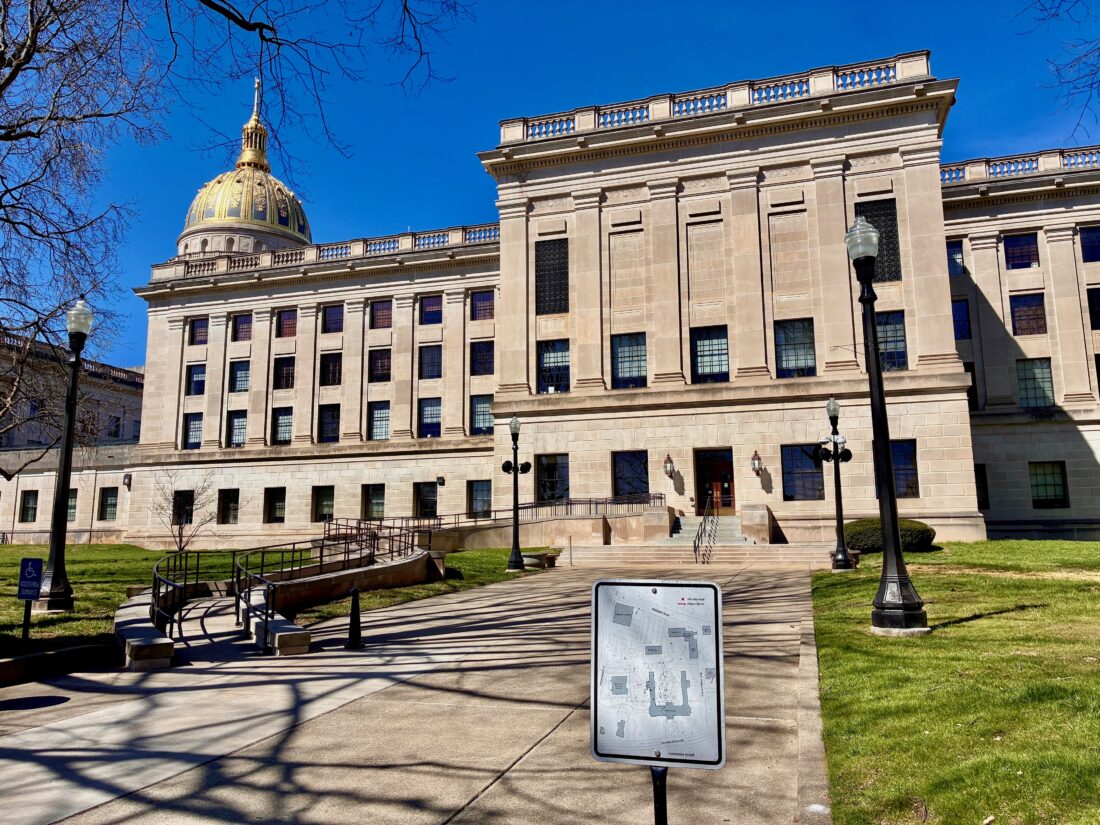
The West Virginia Supreme Court of Appeals chamber of located on the third floor of the East Wing of the State Capitol Building. (Photo by Steven Allen Adams)
CHARLESTON – Months after West Virginia’s highest court stayed a ruling by a Raleigh County circuit judge allowing for religious exemptions to the state’s compulsory vaccination law for school-age children, parties in the case are making their case for the lower court ruling to be overturned. Attorneys representing the West Virginia Board of Education, State Superintendent of Schools Michele Blatt, Raleigh County Schools Superintendent Serena Starcher and the Raleigh County Board of Education filed an appeal Thursday with the West Virginia Supreme Court of a Nov. 26 written ruling by 14th Judicial Circuit Judge Michael Froble in Guzman v. West Virginia Board of Education. Froble’s order granted permanent injunctive and declaratory relief to Raleigh County parent Miranda Guzman and other families with children in Raleigh County Schools, requiring state and county education officials to accept their religious vaccine exemptions granted by the state Department of Health issued through a January 2025 executive order issued by Gov. Patrick Morrisey. Froble previously granted a preliminary injunction in the summer of 2025 in the Raleigh County case after Guzman filed suit against state and local education officials in June following guidance issued by the state Board of Education requiring county school systems to disregard Morrisey’s executive order and follow existing law. State Code requires children be vaccinated against diphtheria, pertussis, tetanus, polio, measles, mumps, rubella, varicella and hepatitis B unless they have been granted a medical exemption. But attorneys for Guzman and her co-plaintiffs argued that the Equal Protection for Religion Act created by House Bill 2042 in 2023 prohibiting excessive government limitations on the exercise of religious faith allowed Morrisey to use his executive order authority to create a religious vaccine exemption. Christopher Smith, one of several attorneys representing state education officials, argued in last week’s brief that the lower court misinterpreted EPRA by incorrectly applying it to graft a religious opt-out onto State Code. He wrote that the state possesses a compelling interest in maintaining high immunization rates to ensure public health and protect students from outbreaks of preventable diseases. “For nearly a century, West Virginia Code 16-3-4 has served as a bulwark against disease,” Smith wrote. ” The vaccine law works: West Virginia’s school children have the highest vaccination rate in the country and the state experiences few outbreaks of vaccine-preventable diseases as a result. The Legislature has repeatedly considered adding religious exemptions to the vaccine law. It hasn’t.” “The circuit court rewrote the vaccine Law and added the religious exemptions the Legislature rejected,” Smith continued. “To achieve that result, the circuit court erroneously read the (Equal Protection for Religion Act) … to apply universally such that it grafts religious exemptions onto all statutes. But the Legislature considered a broader version of EPRA that supported the circuit court’s reading and rejected it, instead adopting narrower statutory language. The circuit court erred by expanding EPRA.” Smith alleges several procedural errors in Froble’s ruling, including the denial of due process through restricted discovery, including denying attempts by attorneys representing the education officials to test claims that the religious beliefs of the plaintiffs would be burdened by complying with the compulsory vaccine law, as well as the squashing of subpoenas to allow some of its witnesses to testify during a two-day hearing last fall. Smith also argues that Froble allowed improper admission of an unqualified expert witness, Dr. James Neuenschwander of Michigan, a noted vaccine skeptic whom Smith said is not certified in pediatrics, epidemiology or immunology. Despite objections by attorneys for the state and local education officials, Froble allowed Neuenschwander’s testimony. “…The circuit court erred by admitting and relying on the testimony of Dr. Neuenschwander,” Smith wrote. “He is not an immunologist, other tribunals have repeatedly rejected his testimony, and … he is unqualified to opine on vaccination policy and holds medical views that are not accepted within the medical community.” Froble also certified the Guzman case as a class action applying to families with religious vaccine exemptions statewide except those with pending cases before other circuit court judges. Smith argued that State Code prohibits circuit courts from issuing injunctive relief beyond their circuit and that cases brought under EPRA are required to be reviewed on an individual basis. Attorneys for the state and local education officials are seeking oral arguments before the state Supreme Court, asking the justices to reverse Froble’s permanent injunction ruling and order Froble to enter a judgement in their favor, or vacate Froble’s ruling and remand the case to the lower court for appropriate evidentiary development. Attorneys representing the Guzman defendants have until May 11 to file their brief in the case, with education officials’ attorneys having until June 1 to reply. Steve Adams can be reached at sadams@newsandsentinel.com.Local News
Cutler Heritage and Legacy Society schedules event
Beverly, Waterford volunteers see three-year vision start to take shape

Picture This: On Top of It
West Virginia, local education officials lay out case for appeal of religious vaccine exemption ruling

Peoples Bank Theatre enjoys full house for ‘Battle Hymn’ screening