West Virginia House works through bills as 2026 session nears end
-
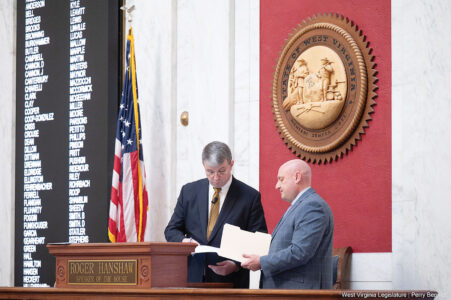
- From left, House Speaker Roger Hanshaw, R-Clay, and House Clerk Jeff Pack go over Thursday’s floor agenda prior to the start of the 9 a.m. session. (Photo courtesy/WV Legislative Photography)
-
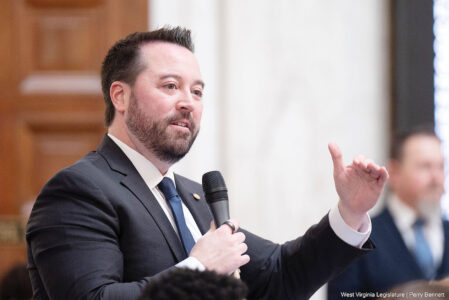
- House Minority Whip Shawn Fluharty speaks out Thursday against Senate Bill 531, prohibiting state agencies and political subdivisions from utilizing media reliability and bias monitors. (Photo courtesy/WV Legislative Photography)
-
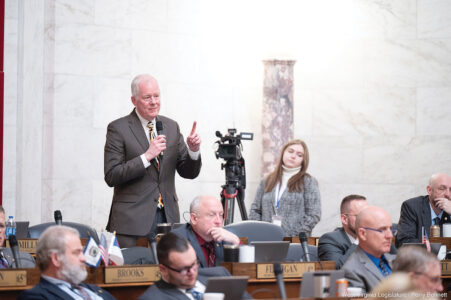
- Del. Bob Fehrenbacher said Thursday that Senate Bill 641, amending the Above-Ground Storage Tank Act, would not put drinking water supplies at risk. (Photo courtesy/WV Legislative Photography)
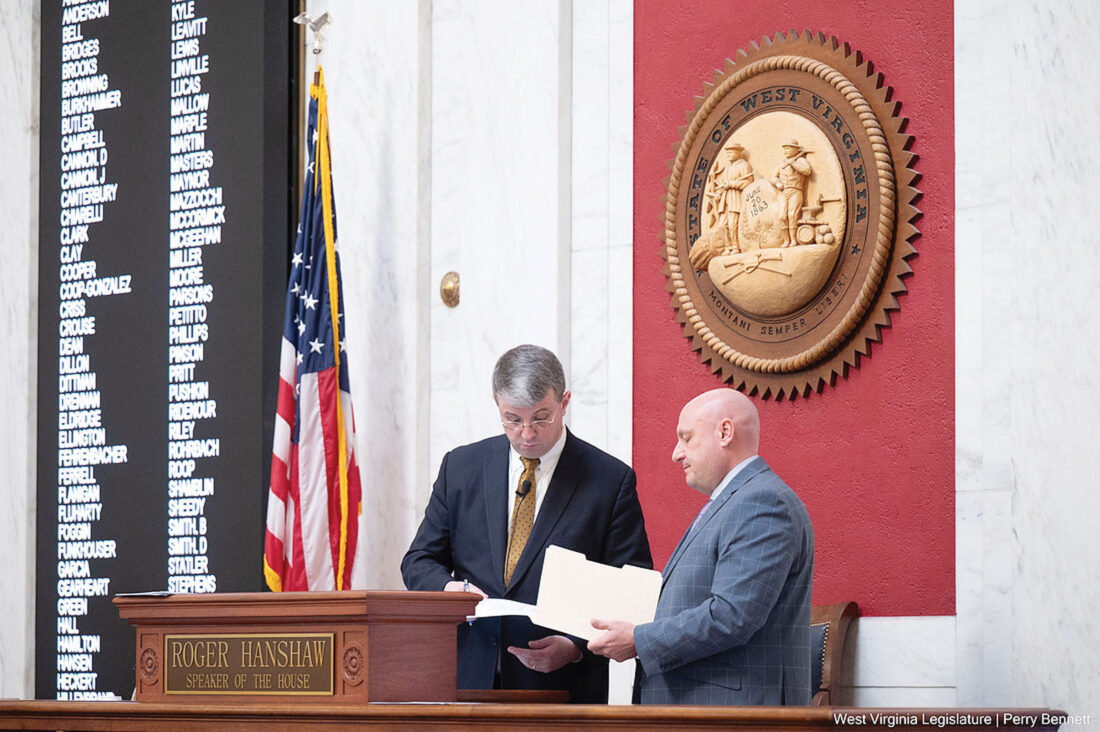
From left, House Speaker Roger Hanshaw, R-Clay, and House Clerk Jeff Pack go over Thursday’s floor agenda prior to the start of the 9 a.m. session. (Photo courtesy/WV Legislative Photography)
CHARLESTON – With the 2026 session of the West Virginia Legislature ending at midnight Saturday, the House of Delegates worked its way through a lengthy floor session to pass bills and ensure others make it to the Saturday deadline.
Thursday marked day 58 of the 60-day session. The House gaveled in after 9 a.m. to consider nearly 50 bills on third reading and move more than 80 bills on second reading.
The House amended and passed Senate Bill 59, relating to voter eligibility and residency requirements, in a 92-4 vote with three absent or not voting. The bill, which now heads back to the Senate, would establish procedures for residency challenges for voters and define the criteria used to determine a voter’s legal residence. It creates legal tests for residency based on an individual’s physical presence and their intent to remain in a district indefinitely and establishes a “bedroom test” for properties bisected by jurisdictional boundaries.
House Judiciary Committee Chairman JB Akers said the committee’s amendment to SB 59 came about after discussions with the Secretary of State’s Office regarding a similar piece of legislation, House Bill 5219.
“It clarifies that many of these provisions apply only when residency is challenged and specifies the method of review,” said Akers, R-Kanawha. “It provides greater clarity and ease of use.”
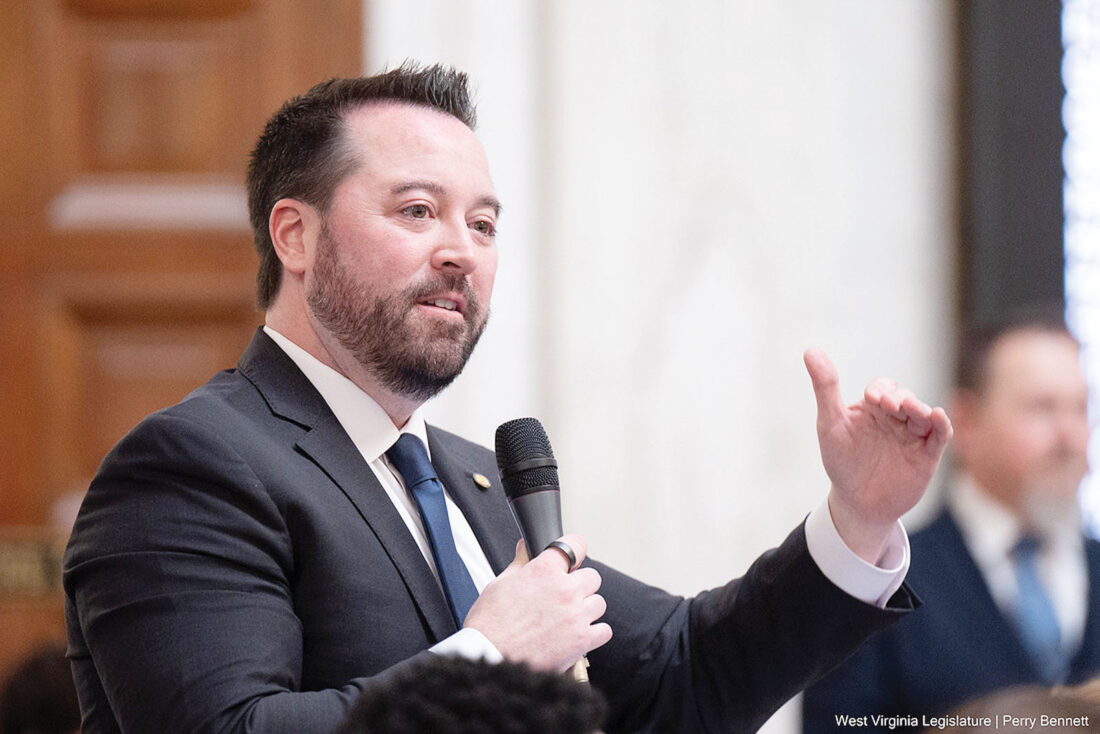
House Minority Whip Shawn Fluharty speaks out Thursday against Senate Bill 531, prohibiting state agencies and political subdivisions from utilizing media reliability and bias monitors. (Photo courtesy/WV Legislative Photography)
“The Legislature has never defined residency, and this before us codifies the case law regarding intention to remain, where you only get one residence,” said Del. Joe Funkhouser, R-Jefferson.
Del. Mike Pushkin, D-Kanawha, was one of the four members who opposed the bill. He said SB 59 was too vague and could cause some voters to be disenfranchised.
“There’s some ambiguity about how this is written. I don’t feel like this is well written,” said Pushkin, chairman of the West Virginia Democratic Party. “I don’t think this clarifies things. I think it makes things a little bit messier about whether you intend to remain in your home indefinitely.”
Del. Josh Holstein, R-Boone, offered an unsuccessful amendment to the bill that would have required individuals seeking a unique identification number from the secretary of state for voter registration purposes to provide proof of citizenship, such as a birth certificate. Under the federal Help America Vote Act, if an individual doesn’t have a Social Security number or a driver’s license in their state, the secretary of state can provide a unique identification number to those individuals when they register to vote.
“All this does is add clarifying language to that process that says if they don’t have a Social Security number or a driver’s license, and they want to receive that unique identification number, they have to provide some form of proof of citizenship,” Holstein said.
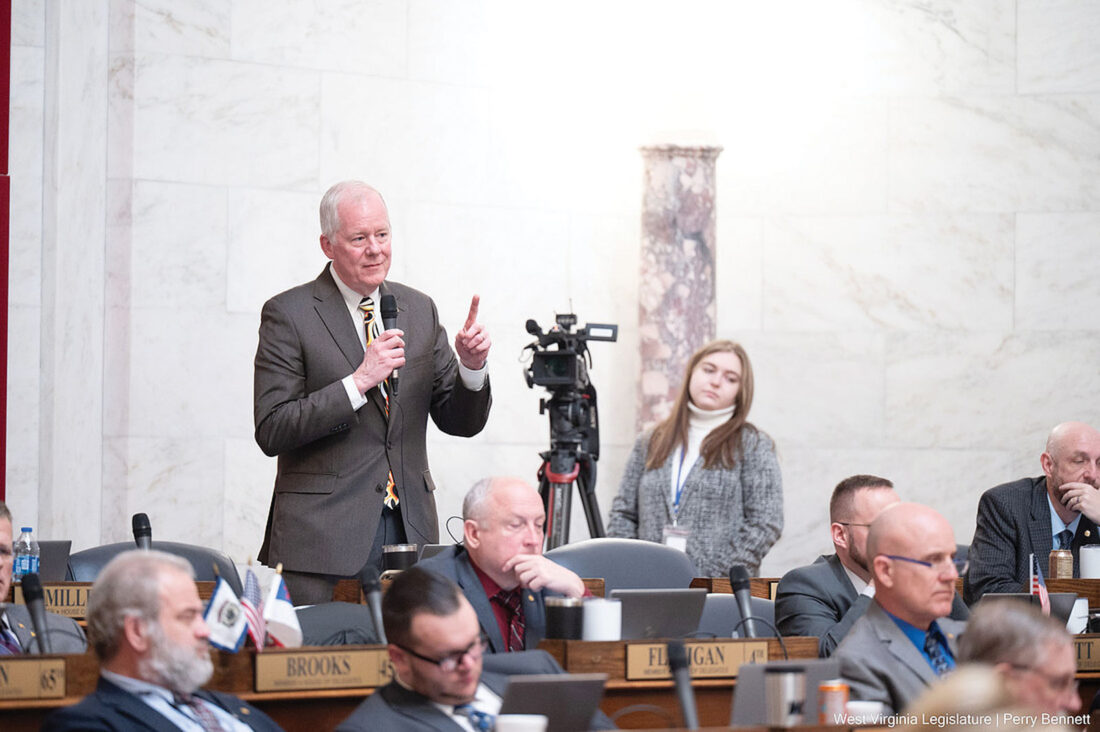
Del. Bob Fehrenbacher said Thursday that Senate Bill 641, amending the Above-Ground Storage Tank Act, would not put drinking water supplies at risk. (Photo courtesy/WV Legislative Photography)
The House passed Senate Bill 531, establishing the First Amendment Preservation Act, in an 82-12 vote with five absent or not voting. The bill heads back to the Senate.
SB 531 would prohibit state agencies and political subdivisions from utilizing media reliability and bias monitors – defined as companies that rate media outlets for factual accuracy, misinformation, bias, adherence to journalistic standards or ethics – when placing state-funded advertisements. The bill would also prohibit state agencies from contracting with foreign adversaries or terrorists as defined by federal law.
“The media organizations who we contract with, or the ad buy agencies, they can still use bias monitors,” Akers explained. “They just can’t use them with regard to the placement of our state ads if this bill were to pass. … The state’s ads are actually being placed in a more limited fashion if the media bias organizations are used because some of these ad agencies will not place ads with certain websites, even if we have a large percentage of people out there who may read them.”
The bill was opposed by members of the House Democratic caucus, who said it was designed to appease conservative media outlet Newsmax in its battle against NewsGuard, a nonpartisan organization that provides ratings of news organizations and media outlets based on a “trust score” that looks at credibility, accuracy and reliability.
“(Newsmax has) a First Amendment right to say whatever they want. They could say these fake news claims. They’re perfectly allowed to do that. But they need to be held accountable,” said Del. Evan Hansen, D-Monongalia. “They could say whatever they want. I don’t think our taxpayer dollars … should go to fund an organization like that. If they want our state dollars, let them be a real news organization and report the facts.”
“Another big gov bill. We love big government this session. This is some woke stuff here,” said House Minority Whip Shawn Fluharty, D-Ohio. “I think we should protect West Virginia and vet where the money is going, especially tourism campaigns, health campaigns, whatever it may be that it’s tied to our state.”
Del. Bill Flanigan, R-Ohio, also opposed the bill, arguing that the state needed all the information it can get when placing advertising.
“It’s going to prevent us from knowing if we’re hitting the wrong people. It’s also going to prevent us from knowing if we’re hitting the right people with our advertising,” he said. “I feel like these agencies might be doing some good for us, whether we like all of it or not.”
The House passed Senate Bill 641, relating generally to aboveground storage tanks, in a 58-37 vote with seven absent or not voting, sending the bill back to the Senate.
SB 641 amends the Above-Ground Storage Tank Act, from which storage tanks containing 210 barrels or less used for oil and natural gas production activities are exempt, provided they are outside “zones of critical concern.”
The bill creates a new exception for tanks containing 10,000 gallons or less that are within the boundaries of a mining permit, provided they are not within a zone of critical concern. Tanks containing 10,000 gallons or less used exclusively for brine produced in connection with oil and natural gas production and storage will be regulated as level two tanks rather than level one tanks, even when within a zone of critical concern.
Tank owners would be granted a nine-month proviso to upgrade tanks before their regulatory status changes following the creation of new zones of critical or peripheral concern. The Department of Environmental Protection would now be required to allow remote, non-destructive examination technologies during periodic inspections, reducing the need for human entry into dangerous confined spaces.
“These changes do not alter the registration, notice and signage requirements found in the act, nor does the bill alter other protections found in other state and federal laws,” explained Del. Bob Fehrenbacher, R-Wood. “I believe the owners of these tanks understand the requirements and comply stringently with the requirements to protect all of us and our drinking water systems.”
House Minority Leader Pro Tempore Kayla Young, D-Kanawha, opposed the bill even though she acknowledged that recent House amendments made it better.
“This bill makes drinking water less safe,” Young said. “I do think this version is a lot better than the original version that we had in the Energy Committee, so I’m glad that it’s less bad. But that doesn’t make it good.”
The House passed Senate Bill 645, prohibiting surprise billing of ground emergency medical services by nonparticipating providers, in a 94-1 vote with four absent or not voting. That followed the House reconsidering its vote for an amendment to the bill from the House Health and Human Resources Committee and adopting an entirely new amendment to appease the concerns of some delegates.
The version of SB 645 amended Thursday would mandate that private health insurance companies reimburse out-of-network EMS agencies at 200% of the Medicare rate, a compromise down from an initial 400% suggestion included in the committee amendment that was rescinded.
“I believe this is a good compromise that we can reach, and we can get something that we can get across the line and all the way to the governor for signature,” said Del. Joe Statler, R-Monongalia. “I do not believe we would have got to 400%, and I’m simply trying to do the best we can do for the EMS systems across the State of West Virginia.”
Steven Allen Adams can be reached at sadams@newsandsentinel.com
Local News

Picture This: Hanging Out

Actors Guild of Parkersburg to host annual Lip Sync Battle

West Virginia Senate Finance Committee refocuses school aid formula bill on special ed funding

Movie Review: In ‘Undertone,’ a paranormal podcast turns perilous

Coin marks nation’s 250th anniversary