Most of West Virginia House Republican caucus economic agenda crosses finish line
-
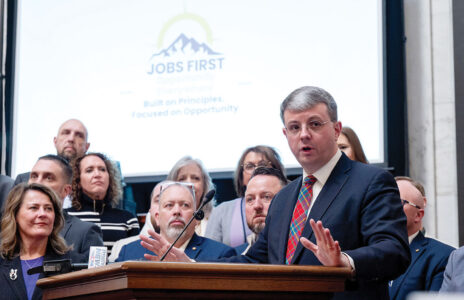
- West Virginia House of Delegates Speaker Roger Hanshaw and members of the House Republican caucus announced their Jobs First – Opportunity Everywhere agenda during a Dec. 9 press conference in the House chamber. (Photo Courtesy/WV Legislative Photography)
-
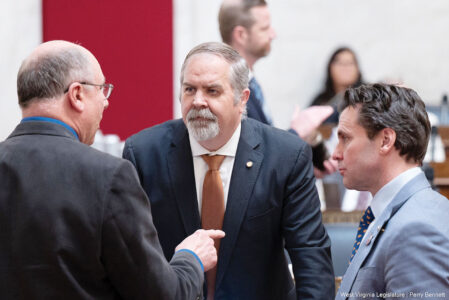
- House Finance Committee Vice Chairman Clay Riley, center, helped shepherd much of the House Republican caucus’ Jobs First agenda through the legislative session. (Photo Courtesy/WV Legislative Photography)
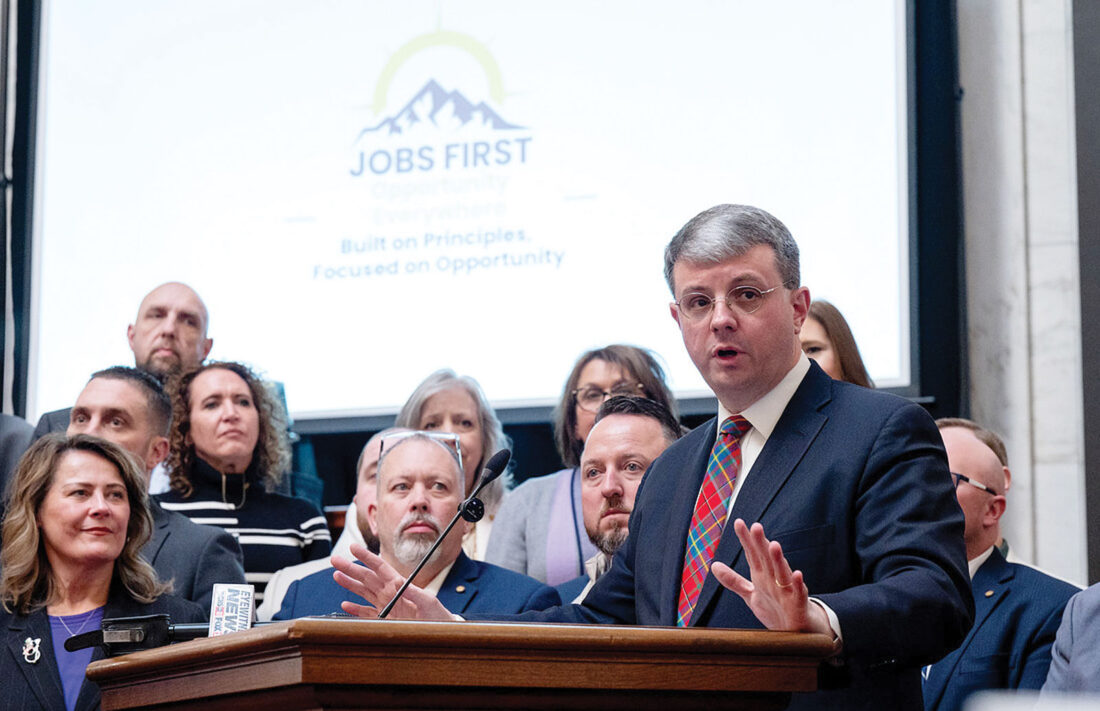
West Virginia House of Delegates Speaker Roger Hanshaw and members of the House Republican caucus announced their Jobs First – Opportunity Everywhere agenda during a Dec. 9 press conference in the House chamber. (Photo Courtesy/WV Legislative Photography)
CHARLESTON — In December, members of the Republican supermajority in the West Virginia House of Delegates unveiled their legislative agenda focused on growing the state’s economy and producing jobs. Nearly four months later, most of that agenda is awaiting Gov. Patrick Morrisey’s signature.
House Speaker Roger Hanshaw, R-Clay, first promoted the House Republican caucus’ Jobs First – Opportunity Everywhere economic development package of bills during December legislative interim meetings at the State Capitol Building.
“Putting jobs first works everywhere; whatever the issue, it’s most effectively solved in an environment that has a robust jobs economy, that has a robust jobs program that puts people to work in good-paying jobs and gives them the capacity to make decisions for themselves and their families,” Hanshaw said then. “West Virginians said they wanted to put economic growth in job creation at the center of public policy debate here in West Virginia. And that still shapes our policy landscape today.”
Flash forward to midnight on March 14, the end of the 2026 legislative session, and 10 out of 16 Jobs First bills completed the legislative process, with one already signed by Morrisey. House Finance Committee Vice Chairman Clay Riley, one of the shepherds of the Jobs First agenda this past session, said he was proud of the House’s work and appreciated the support of the state Senate.
“Our caucus really dove in with our members and said, where do you want our focus to be as we go into the session?,” said Riley, R-Harrison. “And while we always do it, I felt like we were a little bit more laser focused.”
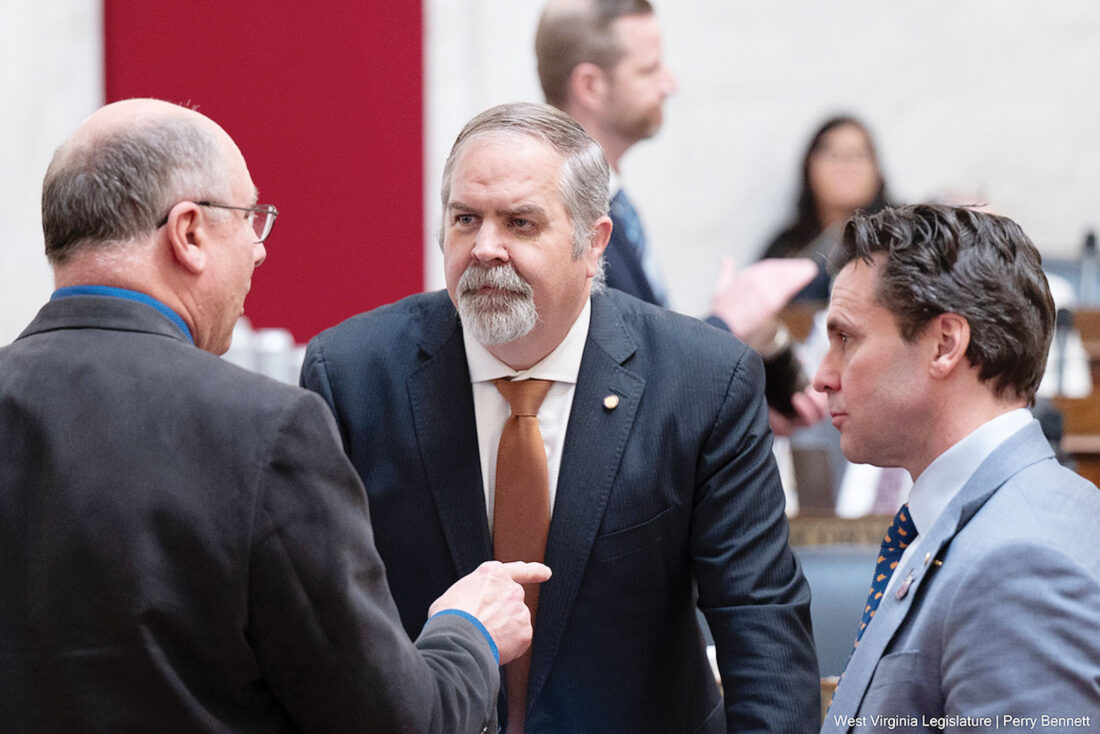
House Finance Committee Vice Chairman Clay Riley, center, helped shepherd much of the House Republican caucus’ Jobs First agenda through the legislative session. (Photo Courtesy/WV Legislative Photography)
Riley said the Jobs First agenda came about from members of the House Republican caucus returning home after the 2025 legislative session and during legislative interim meetings, asking for feedback from constituents on what they would like to see in an economic development package.
“We really worked throughout the offseason,” he said. “Our entire caucus drove these issues and began working on pieces of legislation that would really fill in the agenda.”
Brian Dayton, the vice president for policy and advocacy at the West Virginia Chamber of Commerce, said the entire 10-bill package would send positive messages to those wishing to locate a business in West Virginia or to long-time in-state businesses wishing to expand.
“I would say there’s a lot of really good work that was done,” Dayton said. “First of all, shifting the focus to jobs and the economy just sends a really good message, both internally and externally.
“Businesses looking to expand, they’re happy to see that you have a legislative body focusing on jobs and economic development,” he continued. “That gives them more confidence to move into an area. I think just from a very macro level, that was a good move to do coming out of the House.”
Getting the job done
The first bill the House passed was House Bill 4007, which would increase the annual financial limits for projects funded through the Industrial Access Road Fund, effectively doubling the available unmatched and matched funding for individual counties.
The bill mandates that the Division of Highways provide a formal response to project requests within 90 days and clarifies that these funds are only for economic development sites, such as manufacturing hubs and airports.
HB 4007 passed the House on Jan. 23, just 10 days after the start of the session, in a 90-4 vote. The Senate took up the bill on March 14, one day before the end of the session, and passed it unanimously.
“We heard from a business last fall that was able to significantly increase their output, their productivity, hire more jobs, just because they needed a road widened to their business,” Dayton said. “Once they were able to get that road widened, then they were able to really go ahead and ship more goods and have more product coming in.
“It’s a bill like that that on the surface, you’re going, OK, that seems kind of minor, but it can make all the difference in the world to a business and their ability to grow.”
The first Jobs First bill to complete the legislative process and be signed into law by Gov. Morrisey was Senate Bill 1, a collaboration between the House and the Senate.
SB 1 establishes the West Virginia First Small Business Growth Program, under which specialized growth funds collect capital from investors to provide financing to eligible small businesses that maintain the majority of their operations and workforce within the state. In exchange for these investments, growth investors receive non-refundable tax credits that can be applied against their state tax liabilities starting in 2029.
SB 1 was a combination of the provisions in House Bill 4003 and a legislative priority of Senate President Randy Smith, R-Preston.
“We applaud Governor Patrick Morrisey for putting West Virginia small businesses front and center…,” Smith and Hanshaw said in a joint statement on Feb. 24. “This bill helps give those small businesses that little boost they need by drawing in private investments to let them expand their efforts when they’re ready, not just when other traditional sources of lending are ready. Small businesses are the backbone of this great state, and we’re proud to be a part of helping to strengthen them statewide.”
Other bills awaiting the governor’s signature include House Bill 4002, which would create the West Virginia Collaboratory, a research initiative based at Marshall University that would facilitate scientific research and data sharing across topics like economic development, workforce training and natural resource management.
House Bill 4004 would create Recharge West Virginia, a program where the Division of Economic Development would reimburse private employers up to $50,000 annually for the costs of enhancing their employees’ professional skills. To qualify for these funds, businesses must demonstrate that the training resulted in an industry-recognized credential and a significant salary increase of at least 25% for the participating worker.
“I’m a really big fan of Recharge West Virginia,” Riley said. “I think that we talk so many times about upskilling our employees in our workforce within West Virginia … The commitment of training in-state West Virginia folk is really important to me.”
“That’s a really important tool because … it benefits the employee,” Dayton said. “They’re getting additional skills, and they’re also getting an additional wage increase on their paycheck. But it benefits the company because now they’ve got an employee that is better, that has more knowledge and more capability. I think that’s a really good bill.”
House Bill 4005 would create the Workforce Development Act of 2026, aimed at expanding vocational opportunities for students in West Virginia. The bill establishes a youth apprenticeship program for students age 16 and older, allowing them to earn secondary credits and professional certifications through a combination of classroom instruction and on-the-job training while outlining safety standards.
House Bill 4008 would establish the Certified Sites and Development Readiness Program. The bill would empower the Department of Economic Development to evaluate, certify and provide high-level funding for land preparation.
Through a combination of matching grants and micro grants, the bill offers financial support to government entities to eliminate site deficiencies and improve utility access. The legislation also incentivizes public utilities to expand infrastructure to these locations by allowing them to implement expedited cost-recovery mechanisms.
House Bill 4009, creating the Voluntary Portable Benefits Plan Act, would provide independent contractors with access to employee benefits like health insurance and retirement savings. The bill would allow hiring parties to contribute funds to these accounts without the risk of the workers being legally reclassified as employees.
To encourage participation, the bill introduces tax incentives that allow both individuals and corporations to subtract contributions from their taxable income. Morrisey expressed his support for such a proposal during his State of the State address at the start of the 2026 legislative session. During a press conference Monday, Morrisey thanked the Legislature for passing HB 4009.
“If you’re a freelance worker, you could have access to employment-related benefits that could help you move from job to job,” he said. “This is really big for our country. I’m thrilled. (That’s) another huge success that we helped drive out of this office, and I want to thank the Legislature for their collaboration.”
Other Jobs First bills include HB 4028, providing a tax exemption for contractors on services and building materials used to build or repair public school facilities; HB 4784, extending tax incentives for businesses operating within federally designated Qualified Opportunity Zones until 2033; and the 3% average pay raise for public employees within SB 250, the budget bill, and HB 4765, the standalone pay raise for teachers, school service personnel and employees of the West Virginia State Police.
While not part of the Jobs First agenda specifically, Dayton also praised lawmakers for focusing on boosting child care this session. Dayton said the costs and lack of access to child care across the state are preventing people from entering the workforce.
“West Virginia has the lowest workforce participation rate in the country,” Dayton said. “It’s not the only reason, but a big reason is the lack of affordable and accessible child care in the state. … We know the cost of child care is about $800 per month per child. If you have two children and you have a spouse making $50,000 a year, the other one’s a higher earner, there’s a good chance that spouse making $50,000 a year is going to come out of the workforce because they’re just not going to make enough money to make the differences up.”
SB 250, the budget bill, includes $5 million to expand the eight-county tri-share pilot program, where the employee, employer and state pay one-third of the child care costs. The Legislature also passed House Bill 4191, which proposes tax credits for businesses that either build on-site facilities or financially back third-party child care providers for their staff.
HB 4191 also mandates a shift toward enrollment-based subsidy payments instead of attendance-based payments, requires a new electronic filing system for provider reimbursements, and directs the Department of Human Services to implement strategies that prevent families from suddenly losing child care assistance due to incremental pay raises.
More work to be done
Despite these successes, not all of the Jobs First bills made it across the finish line at midnight on March 14, including House Bill 4001, creating TEAM-WV.
TEAM-WV would have established a private, non-stock, nonprofit corporation – modeled after JobsOhio and similar programs in other states – designed to modernize and accelerate economic development in West Virginia. It would have functioned as a depoliticized partner to the Department of Commerce, focusing on business recruitment, site readiness and workforce integration while utilizing private-sector expertise.
HB 4001 passed the House in an 87-8 vote on March 4. But while the bill was recommended for passage by the Senate Economic Development Committee on March 10, it was never taken up by the Senate Finance Committee, where it died. Riley said the legislation would have taken the politics out of economic development decisions but was a very complicated bill he plans to tweak for next year based on feedback from other lawmakers.
“It’s not anything negative towards the economic development division. They do great work, and they’ve had a lot of successes,” he said. “But it’s just like anything. How do we continue to find ways to be more successful to improve? It was a thought … and we had a lot of good conversations.
“I hope what happens over the next year is there’s continued discussion amongst the Senate and the governor and the House so that we can find ways that West Virginia can win,” Riley continued.
Steven Allen Adams can be reached at sadams@newsandsentinel.com
Local News
Most of West Virginia House Republican caucus economic agenda crosses finish line

Trump officials announce 10-gigawatt data center, gas plants for former Ohio uranium site

McConnelsville native in charge at largest US Navy Warfare Center

Picture This: All Abuzz for the Marietta Times Regional Spelling Bee

Gas price increases add pressure across the Mid-Ohio Valley economy