
Brunner keynotes Washington County Democrats’ Spring Dinner
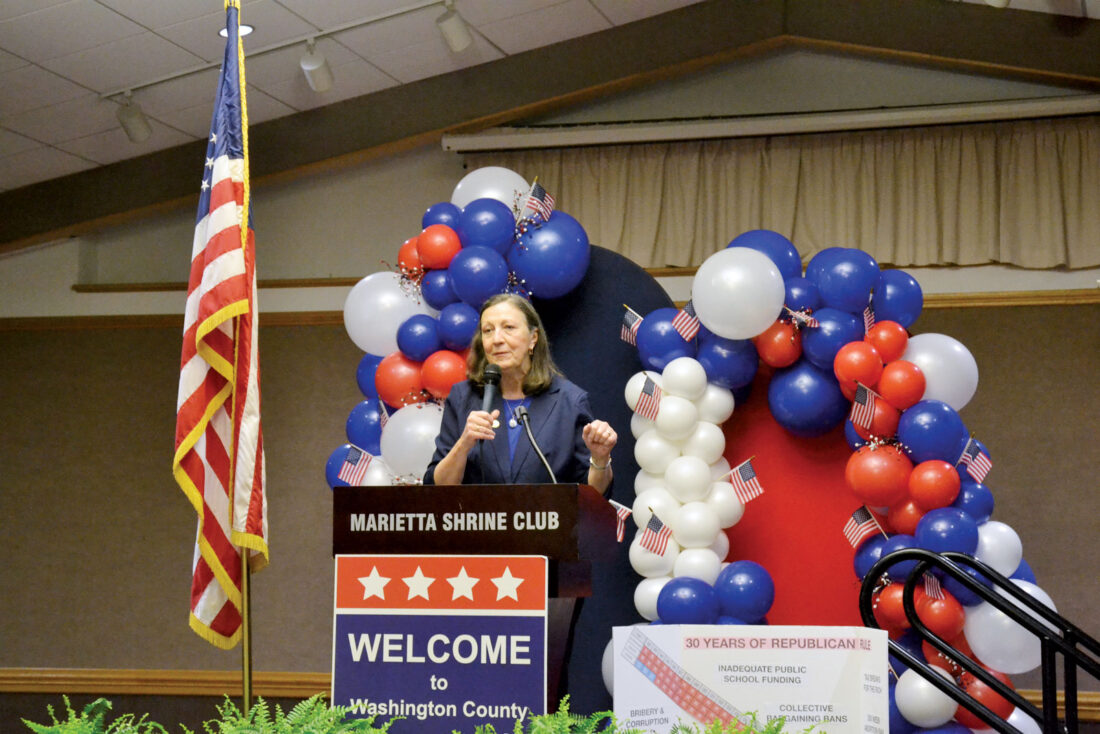
Ohio Supreme Court Justice Jennifer Brunner was the keynote speaker Friday at the 2026 Washington County Democrats Spring Dinner held at the Marietta Shrine Club. Brunner was joined by 12 other Democratic candidates running in the 2026 primary. (Photo by Douglass Huxley)
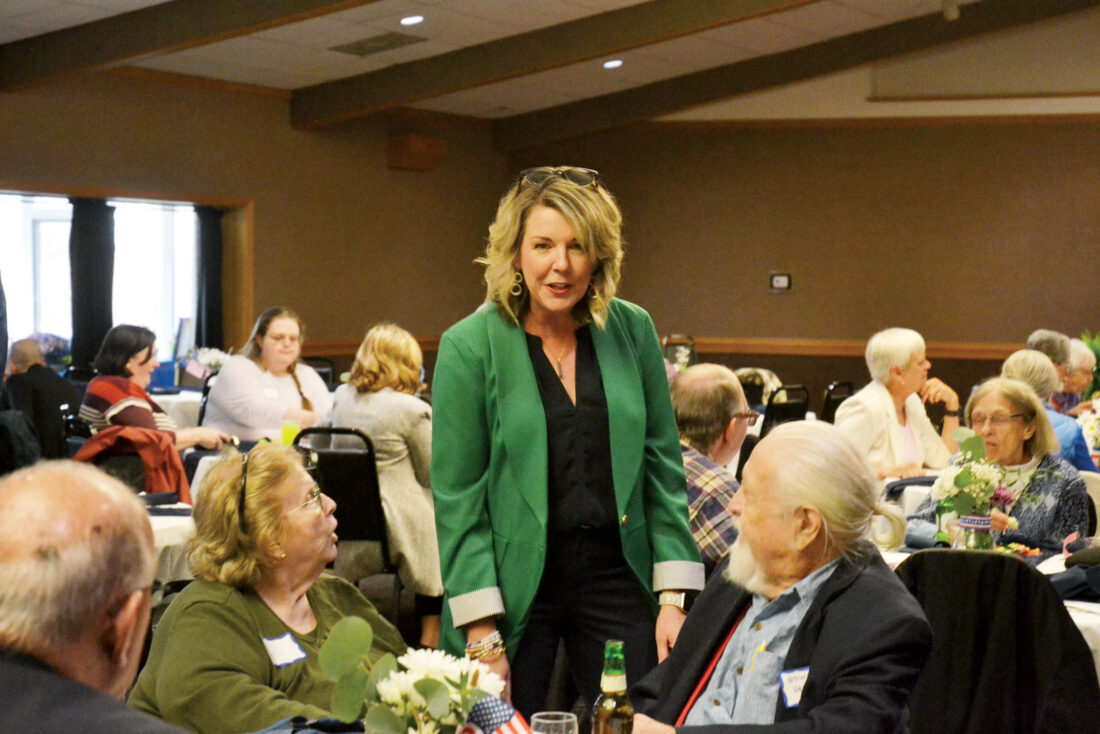
State Rep. Allison Russo, D-Upper Arlington, speaks to a table of guests Friday at the 2026 Washington County Democratic Spring Dinner held at the Marietta Shrine Club. (Photo by Douglass Huxley)
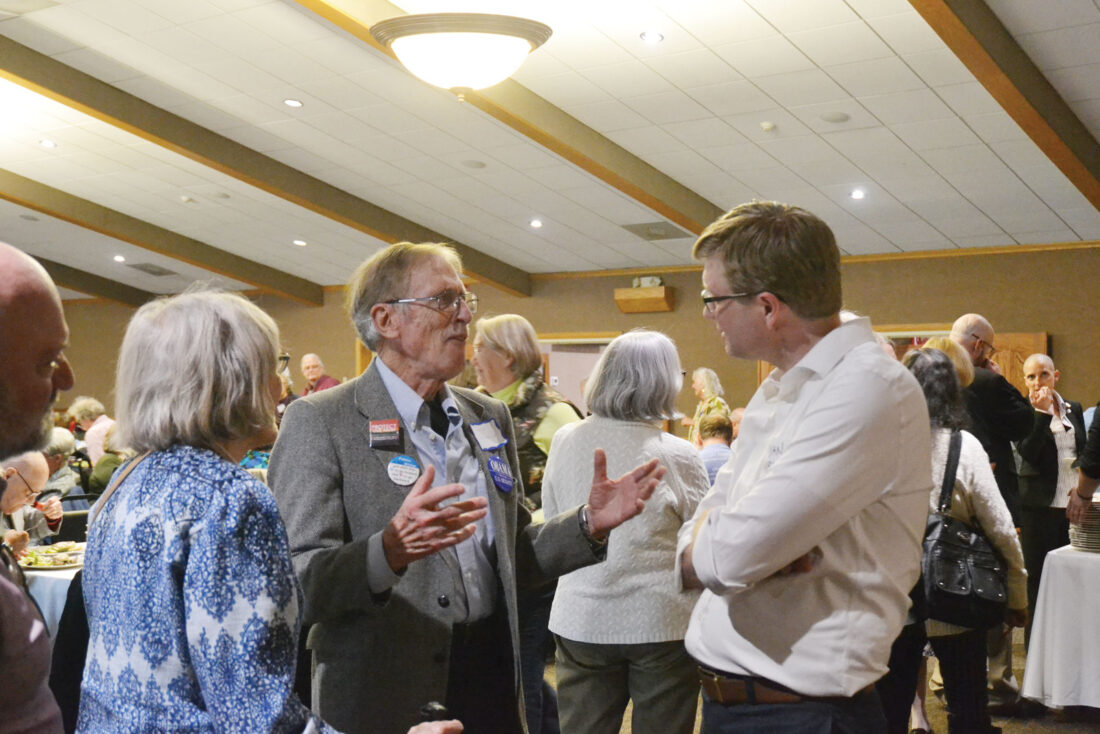
Marietta residents Gwen and George Banziger talk to Ohio Secretary of State candidate Bryan Hambley at the 2026 Washington County Democratic Spring Dinner held at the Marietta Shrine Club on Friday. (Photo by Douglass Huxley)
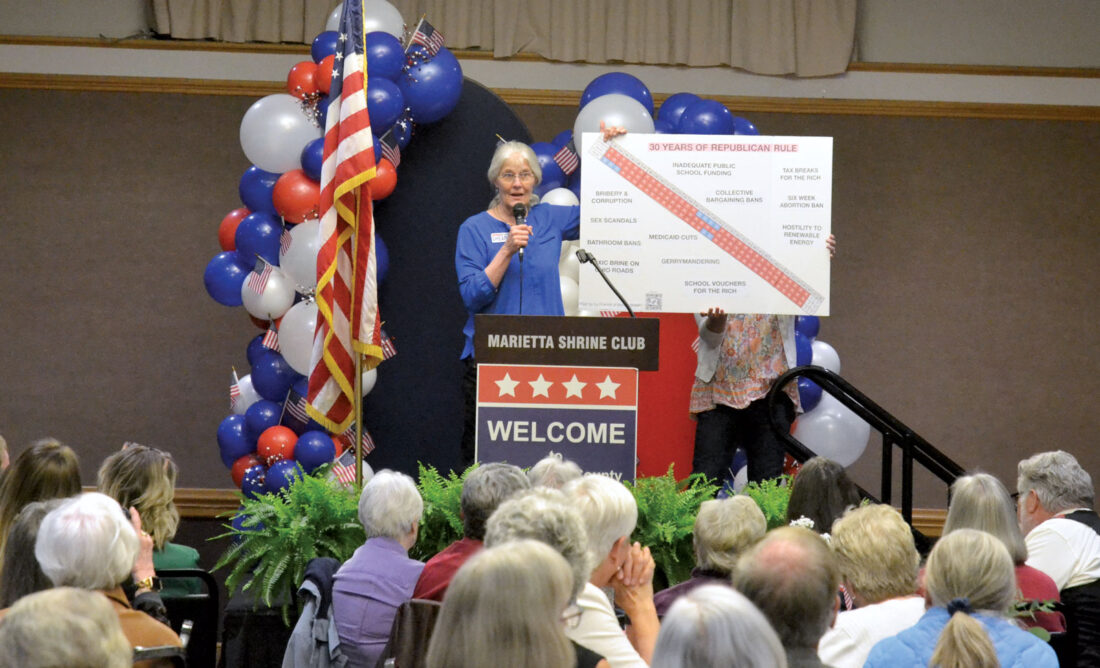
Ohio House of Representatives District 94 candidate Wenda Sheard holds up a poster showing what she said was 30 years of Republican control that included bribery, corruption and sex scandals at the 2026 Washington County Democratic Spring Dinner held at the Marietta Shrine Club on Friday. (Photo by Douglass Huxley)
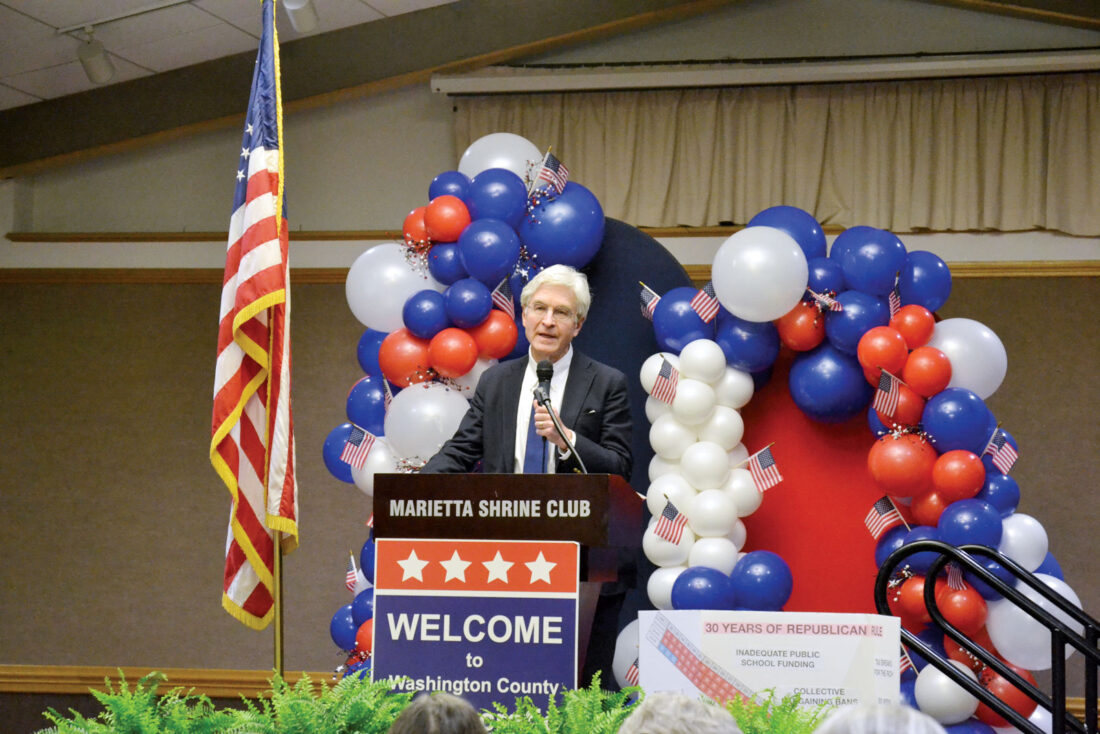
John Kulewicz, Democratic candidate for secretary of state, spoke to a crowd gathered at the Marietta Shrine Club Friday for the 2026 Washington County Democratic Spring Dinner. (Photo by Douglass Huxley)
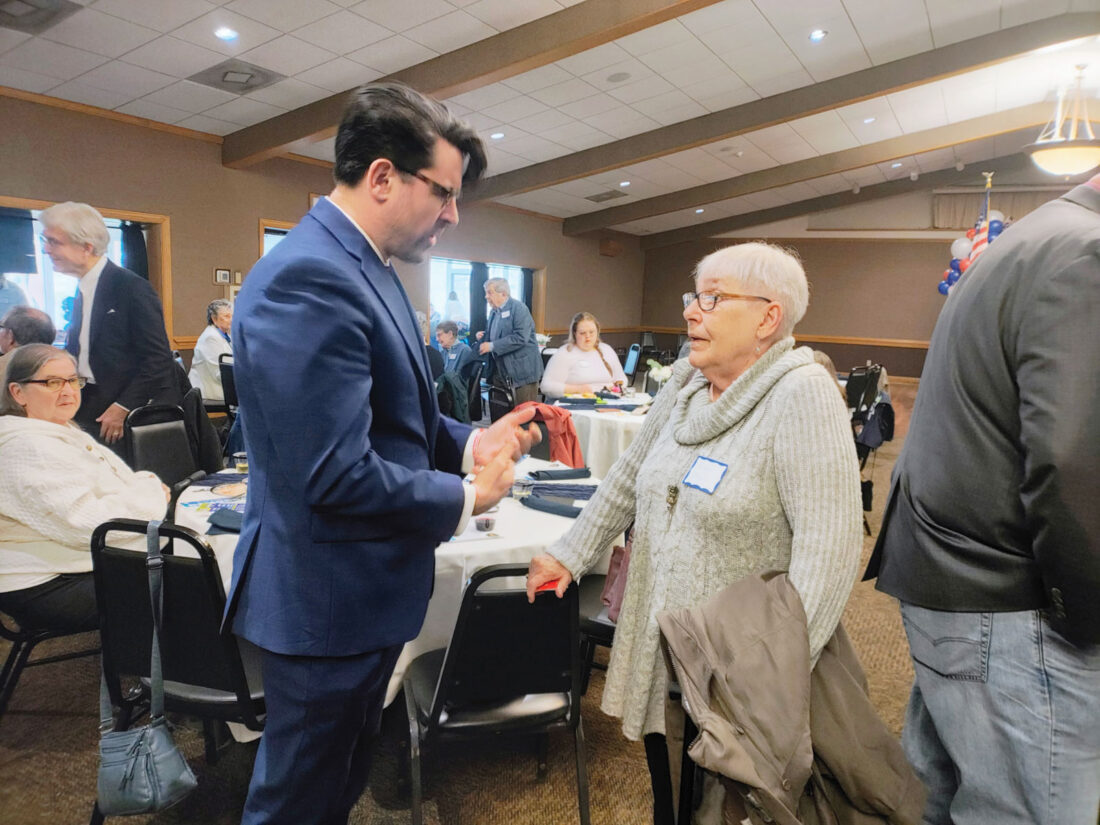
Elliot Forhan, candidate for Ohio Attorney General, speaks to Marietta resident Debbie Brown Friday before the start of the 2026 Spring Dinner fundraiser of the Washington County Democratic Party held at the Marietta Shrine Club. (Photo by Douglass Huxley)
Ohio Supreme Court Justice Jennifer Brunner was the keynote speaker Friday at the 2026 Washington County Democrats Spring Dinner held at the Marietta Shrine Club. Brunner was joined by 12 other Democratic candidates running in the 2026 primary. (Photo by Douglass Huxley)
State Rep. Allison Russo, D-Upper Arlington, speaks to a table of guests Friday at the 2026 Washington County Democratic Spring Dinner held at the Marietta Shrine Club. (Photo by Douglass Huxley)
Marietta residents Gwen and George Banziger talk to Ohio Secretary of State candidate Bryan Hambley at the 2026 Washington County Democratic Spring Dinner held at the Marietta Shrine Club on Friday. (Photo by Douglass Huxley)
Ohio House of Representatives District 94 candidate Wenda Sheard holds up a poster showing what she said was 30 years of Republican control that included bribery, corruption and sex scandals at the 2026 Washington County Democratic Spring Dinner held at the Marietta Shrine Club on Friday. (Photo by Douglass Huxley)
John Kulewicz, Democratic candidate for secretary of state, spoke to a crowd gathered at the Marietta Shrine Club Friday for the 2026 Washington County Democratic Spring Dinner. (Photo by Douglass Huxley)
Elliot Forhan, candidate for Ohio Attorney General, speaks to Marietta resident Debbie Brown Friday before the start of the 2026 Spring Dinner fundraiser of the Washington County Democratic Party held at the Marietta Shrine Club. (Photo by Douglass Huxley)
Trending
MARIETTA - The 2026 Spring Dinner fundraiser of the Washington County Democratic Party was held at the Marietta Shrine Club on Friday.
"It is so encouraging to see so many people here, and we welcome all the candidates to Washington County. Folks, this is our year," said Willa O'Neill, Washington County Democratic Executive Committee chairwoman. "People are tired of elected officials who fail to respond, or who ignore the concerns of their constituents."
The event had 13 Democratic candidates seeking office on hand to speak to voters from statewide races such as secretary of state and attorney general, to those seeking office locally on the Washington County Commission.
Both candidates for the commissioner seat said they were concerned about data centers and injection wells.
"My motivating issues are: One, protecting our drinking water sources by stopping new injection wells; and number two, stopping or pausing the data center so that we can be sure it will be a net positive for our communities," Brain Whalin said.
Candidate John Rauch said last summer the commission seemed to care about clean drinking water but said all they seem to care about now are "groundbreaking ceremonies and following party lines."
He said commissioners have not stepped up enough to advocate to legislators and state agencies who are charged with protecting natural resources.
"Injection wells and proposed data centers both pose a risk of contamination to our precious groundwater," Rauch said.
Ohio Supreme Court Justice Jennifer Brunner, unopposed in the May primary, was the keynote speaker and said that a range of complex disputes - from natural resources to high‑tech infrastructure - are increasingly finding their way into Ohio's court system.
"This part of the state has a lot of oil and gas issues," she said, adding that the Ohio Supreme Court routinely hears direct appeals from the Public Utilities Commission and cases involving taxation and land use.
Brunner cited ongoing disputes involving data centers as an example of how quickly new industries can become legal flashpoints. Ohio, she said, "is a state that has a very large proportion compared to the rest of the country of data centers," noting that a ballot effort had emerged in Adams and Brown counties "to outlaw the new data centers," an issue she said was "interesting" from a legal standpoint.
"A lot of times those ballot issue cases will come to us for disputes over whether they make the ballot, what the ballot language is, and we do our part to apply the law," Brunner said.
Brunner, who has served at every level of Ohio's court system and previously as secretary of state, said her decision to run for another term was a continuation of long‑standing public service.
"I’m just doing what I normally do, which is try to run a good race, try to talk about public service, talk about the court and why it’s important to the state," she said.
She described assignments in Serbia, where she worked with the anti‑corruption agency, misdemeanor judges and the Ministry of Justice; election observation in Egypt after the Morsi era; collaboration with the Bar Association in Colombo, Sri Lanka; remote work in Kazakhstan on civil society; and support for the Human Rights Commission in Benin, a West African country.
From these stories, she said she drew a contrast with the United States and a deeper appreciation for its institutions.
"I understood then that there's two things we have: We have the American democracy, and we have rule of law," she said. "When we work well with the two together, we get a system where there is accountability ... where there's predictability, where there's safety, and when done very well, there's the ability to pursue that dream of happiness that we talked about 250 years ago in the Declaration of Independence."
Brunner said she speaks to young people often who say they want to get into politics to make a difference.
"And I say, that's good, but that's kind of about you," Brunner said. "Public service is just about service. It's about doing what you can with the time that you've been given ... to make people's lives better."
She said the true goal of politics, and life, is to inspire others to serve as well.
"What you do will inspire other people to do things for other people, so that we have that ripple effect," she said. "We don't have to be in government. We don't have to be holding elective office. As long as we're doing something for others, and we're seeing that we're part of a greater community, we are public servants. We're all public servants in that way."
When asked what ordinary people can do to make a difference, she said they simply need to make that decision to start.
"I took the mantra for myself: Start where you are, use what you have, do what you can," she said. "You would not believe how much you can get done if you just focus on where you are."
Ohio's primary election will take place on May 5.
The deadline to register to vote is April 6.
Early voting begins April 7.
Douglass Huxley can be reached at dhuxley@newsandsentinel.com