West Virginia Senate passes bill further criminalizing abortion pills
Bill banning use of media monitoring services by state agencies also advances
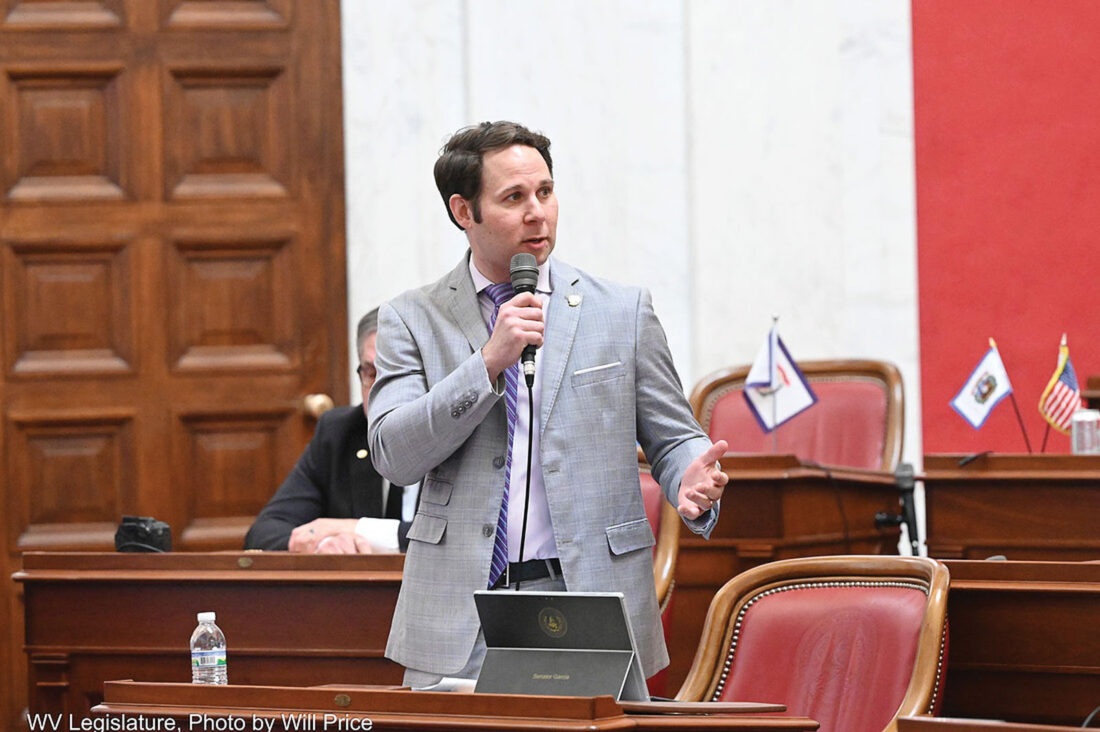
Senate Assistant Minority Leader Joey Garcia, D-Marion, raised concerns Friday with Senate Bill 531 which he believes is aimed at targeting the free speech of a specific company, NewsGuard, that provides rankings of media outlets based on accuracy and credibility. (Photo Courtesy/WV Legislative Photography)
CHARLESTON — The West Virginia Senate passed a number of bills Friday, including legislation to further punish unsanctioned distributions of abortion pills in the state and one aimed at preventing state agencies from using a media monitoring service being targeted by the Trump administration. Senate Bill 173, prohibiting abortifacients, passed the Senate Friday morning in a 31-1 vote with two absent or not voting. The bill now heads to the House of Delegates. SB 173 includes new regulations and penalties regarding the distribution of medications used to induce abortions within West Virginia. According to the bill, individuals who mail, prescribe, or distribute abortion-inducing drugs would face criminal penalties, including felony imprisonment for non-medical providers. “The majority of abortions in America today occur via the abortion pill. Not only do these pills terminate the life of the baby, but studies have shown that in up to 10% of the cases, they also have severe adverse effects on the health of the mother requiring medical attention,” said Senate Judiciary Committee Chairman Tom Willis, R-Berkeley. “This important legislation is designed to protect life in West Virginia and stop the practice of abortifacients being unlawfully sent to West Virginia residents.” Licensed professionals found in violation of these rules could have their medical licenses revoked and may face civil litigation and fines. The bill includes exemptions protecting the pregnant woman from criminal charges while granting her and the Attorney General’s Office the right to sue violators for damages. The bill also requires that all state health care providers sign an affidavit confirming their understanding of these updated reproductive health laws. The bill was amended on third reading Friday. Two amendments offered by state Sen. Ryan Weld, R-Brooke, would allow civil actions to be filed either in the county where the abortion occurred or where the abortifacient was received, and provides exemptions to manufacturers or distributors sending abortifacients for use in connection with prescriptions issued by licensed medical professionals in accordance with existing West Virginia law. Weld’s second amendment would prohibit the state from entering into contracts with manufacturers or wholesale distributors of abortifacients effective July 1. The amendment targets “shield states” by preventing companies that push abortion pills into West Virginia from benefiting economically from taxpayer dollars. “I think it truly provides for an enforcement mechanism to put something behind this bill,” Weld said. A third amendment, offered by Senate Assistant Majority Leader Patricia Rucker, R-Jefferson, would add the spouse of the woman or the father of the child to the list of parties permitted to participate in court actions or criminal penalty proceedings. “We are a pro-life state, but those laws are being violated by these bad actors … are putting these pills in your children and your daughters’ and your wives’ mailboxes without even seeing a physician, a pharmacist or any other medical provider,” said Sen. Chris Rose, R-Monongalia, the lead sponsor of the bill. “This bill adds teeth to our private laws to let them know that we will not tolerate out-of-state bad actors to disregard the sanctity of life that this body has preserved.” Senate Assistant Minority Leader Joey Garcia, D-Marion, was the lone no vote. He criticized members for once again pushing another anti-abortion bill despite the state’s near-total ban passed by the Legislature in 2022. He also said the bill would encourage OB/GYNs to leave the state. “Every year it seems that we find a way to come back to the subject of abortion,” Garcia said. “We actually have OB/GYN deserts in places like Greenbrier County, where now they have to travel several hours to find care for a pregnancy. I believe this is not by accident but by the very actions that we do over and over again in this Legislature the past several years … It is an overreach, and it’s just one other example of trying to put politicians and politics into health care.” The Senate also passed Senate Bill 531, creating the First Amendment Preservation Act, in a 30-2 vote, sending the bill to the House. SB 531 would prohibit state agencies from entering into contracts with advertising firms or media monitors that use bias-rating services or fact-checking organizations to guide their ad placements. The stated goal of the bill’s supporters is to prevent viewpoint discrimination by ensuring that public funds are not used to support entities that rank news outlets based on political ideology or perceived misinformation. “This bill reaffirms West Virginians’ First Amendment rights by ensuring that state advertising dollars do not fund viewpoint discrimination,” Willis said. “State agencies will no longer be allowed to contract with media reliability and bias monitors or advertising companies that use these media reliability and bias monitors.” The bill requires companies bidding for state advertising contracts to formally certify that they do not utilize these specific monitoring services. While the bill bans the use of reliability rankings, it still allows agencies to purchase services that track audience size, demographics or general news aggregation. SB 531 is similar to efforts in Florida and by President Donald Trump’s Federal Trade Commission related to NewsGuard, a nonpartisan organization that provides ratings of news organizations and media outlets based on a “trust score” that looks at credibility, accuracy and reliability. NewsGuard was founded in 2018 by Court TV founder and veteran journalist Steven Brill and former Wall Street Journal publisher Gordon Crovitz. NewsMax, a conservative news outlet available through satellite TV providers and streaming, has been lobbying states, including West Virginia, to pass these kinds of bills. NewsMax – which has been accused of spreading misinformation and conspiracy theories – has a lower trust rating on NewsGuard than other conservative media outlets, including Fox News. But the bill’s lead sponsor, state Sen. Mike Azinger, R-Wood, accused NewsGuard of leaning left. “There’s an overt and plain bias that is there, and this is simply saying that West Virginia going forward will not be using a biased organization like NewsGuard in terms of routing where our advertising money goes,” Azinger said. “We are an outdoor state. We are a hunting and fishing state and so on. And these folks, these hunters and fishermen, watch conservative media outlets,” Azinger continued. “We’ll starve these folks of watching the advertising that the State of West Virginia could benefit from in terms of these folks seeing that.” NewsGuard recently filed a lawsuit against the Federal Trade Commission, accusing the agency of trampling on its First Amendment rights and trying to silence its rankings. “While Newsmax has a constitutional right to criticize NewsGuard and lobby government officials, the First Amendment bars those officials from acting on Newsmax’s behalf in an attempt to snuff out NewsGuard’s speech,” an attorney for NewsGuard wrote in its Feb. 6 court filing. Garcia and Senate Minority Leader Mike Woelfel, the two lone Democratic members of the 34-member Senate, both voted against the bill. “We can’t regulate the First Amendment here,” said Woelfel, D-Cabell. “The bill won’t hold up when somebody litigates this. We took an oath to abide by the United States Constitution. The First Amendment is first for a reason. The drafters made the First Amendment first because they considered it the most important amendment to the Constitution.” “I think it’s not a bad thing for the State of West Virginia to be credible in what we do,” Garcia said. “And we have one organization that’s not happy and so therefore they’re trying to use us in their fight instead of maybe increasing their journalistic integrity. Wouldn’t that be a thing?”Local News
Morrisey, state education officials clash over budget needs

Picture This: In Their Hay Day
West Virginia Senate passes bill further criminalizing abortion pills

Ice breaking up along Mid-Ohio Valley rivers

Wood County man pleads guilty to federal drug crime