
West Virginia Senate Judiciary Committee recommends bills on campaign finance disclosures, human smuggling
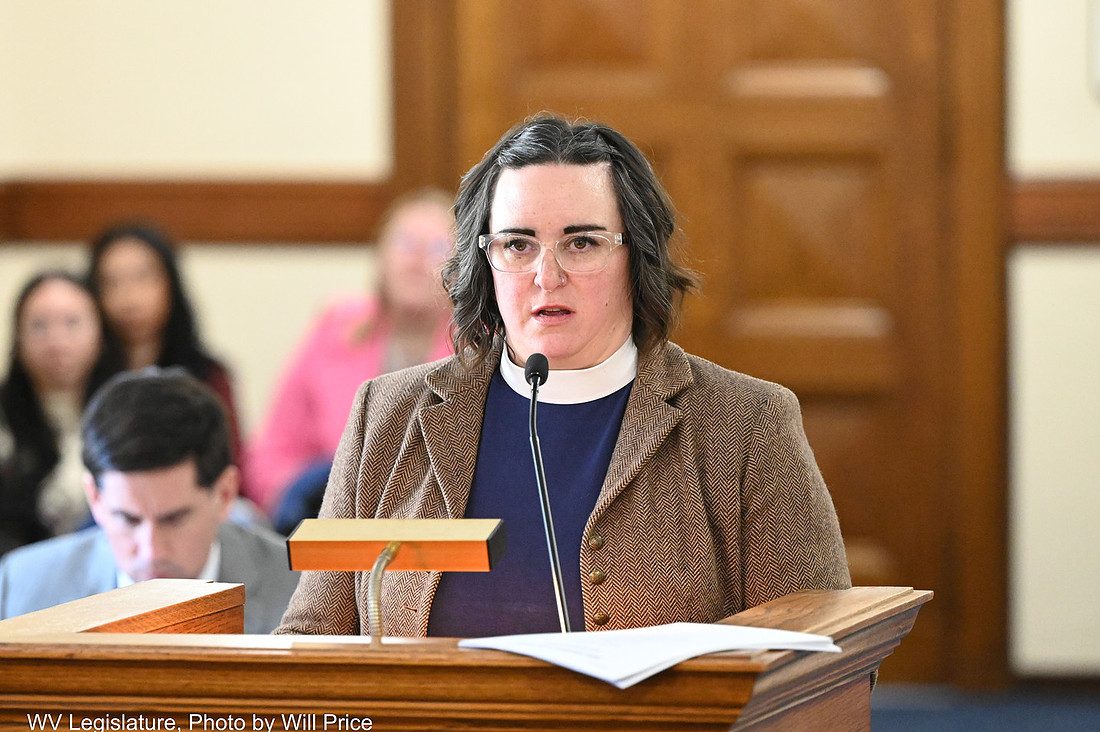
The Rev. Cindy Briggs-Biondi, a United Methodist pastor who lives in Charleston, said Tuesday that the provisions in HB 4433 aimed at criminalizing human smuggling could also criminalize common acts of assistance to undocumented immigrants. (Photo courtesy/WV Legislative Photography)
CHARLESTON – After working on it in a subcommittee, the Senate Judiciary Committee on Tuesday recommended legislation limiting certain campaign finance information from public view, as well as a House of Delegates bill aimed at curbing assistance to help undocumented immigrants abscond from the law.
The committee accepted a subcommittee report for Senate Bill 640, prohibiting release of certain personal information of contributors to political elections, and recommended a committee substitute for the bill to the full Senate for consideration.
The committee substitute for SB 640 clarifies that the street number and employer of a campaign donor would be redacted from publicly posted campaign finance reports and not subject to the Freedom of Information Act beginning Jan. 1, 2027. The bill does not apply to past campaign finance reports still publicly available.
Publicly available campaign finance data would include a donor’s name, city, state, occupation, and how much they donated. The bill requires financial statements in local elections to be filed with the secretary of state. It permits the secretary of state to disclose restricted information in limited instances.
If a government agency publishes protected information, the bill gives the agency 10 business days to cure the offending notice before imposing a $1,000 penalty.
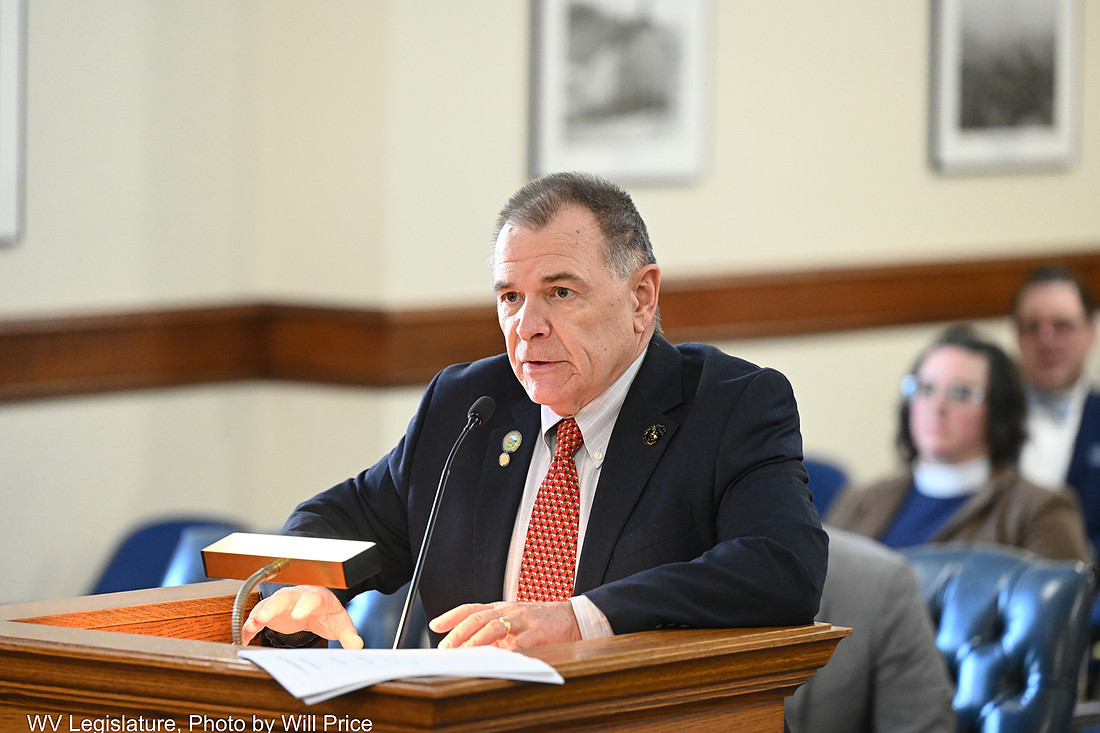
West Virginia Del. Bill Ridenour explained his bill, House Bill 4433, to members of the Senate Judiciary Committee Tuesday afternoon. (Photo courtesy/WV Legislative Photography)
Senate Judiciary Committee Chairman Tom Willis, R-Berkeley, assigned the bill to a subcommittee last week after the Secretary of State’s Office raised a number of issues.
“I think everything seemed to be cleared up well there, so I appreciate you assigning the subcommittee,” said state Sen. Mike Azinger, R-Wood, the lead sponsor of the bill.
“I just wanted to thank (Azinger) in the subcommittee for working with our office to address the practical concerns I raised at the last committee meeting,” said David Cook, the general counsel for the Secretary of State’s Office.
Senate Assistant Minority Leader Joey Garcia, D-Marion, said he appreciated some of the goals behind SB 640, but said the bill would take away needed transparency for campaign finance reports.
“I don’t think less information is better when it comes to transparency and when it comes to financial disclosures,” Garcia said. “I look at these all the time, and I think it’s important to know where people are getting funded from. Whether that’s me, whether that’s the other people around this table, whether that’s people that are running for city, county elections, all of those things, less information is not better.”
The committee also recommended a strike-and-insert House Bill 4433, prohibiting human smuggling and trafficking, to the full Senate for passage Tuesday afternoon.
HB 4433 — whose lead sponsor is Del. Bill Ridenour, R-Jefferson — creates new state-level crimes for human smuggling, defined as “knowingly transporting, transferring, receiving, isolating, enticing, or harboring an illegal alien to avoid enforcement of the laws of this state, another state or the United States.”
The bill creates separate felonies for the human smuggling of adults and minors. It also imposes much stricter sentences for existing criminal offenses – such as human trafficking, forced labor, debt bondage and sexual servitude.
“This bill was designed to … facilitate an increase in penalties relative to human trafficking, because that is obviously an incredibly odious activity that we should be trying to deter,” Ridenour told committee members Tuesday.
“The other aspect of this is human smuggling, and that is designed to try to prevent the types of human smuggling that we see, not only in West Virginia, but throughout the rest of the country, by individuals who are trying to evade law enforcement, who are trying to facilitate that type of smuggling of people, and often, at the same time, drugs, other types of criminal activity that are associated with human smuggling,” he said.
HB 4433 includes exemptions, such as when the alleged undocumented immigrant is being voluntarily transported by family members, or individuals contracted by the state or federal government transporting them through the state. The legislation carves out legal and medical exemptions for professionals providing essential services to individuals regardless of their immigration status.
The strike-and-insert amendment made largely stylistic and technical changes, including changes to the definitions of smuggling at the request of the Domestic Violence Coalition.
The Rev. Cindy Briggs-Biondi, a United Methodist pastor who lives in Charleston, said she was worried HB 4433 could wind up criminalizing those merely trying to assist undocumented immigrants, with things like travel for food and basic needs.
“I do want to be clear at the outset that I absolutely support strong laws against human trafficking,” Briggs-Biondi said. “But I think this bill, as it’s written, it ends up obscuring that goal by risking criminalizing ordinary West Virginians who are simply helping their neighbors. … One of the problems that I see with that is, it’s defined so broadly that simply driving someone to work, or school, or church, or the grocery store could potentially qualify as a crime.”
Garcia offered an unsuccessful amendment to the bill to insert language into the definition of human smuggling that included a motive, such as for financial or material benefit. He said the bill without that language would unfairly ensnare law abiding citizens.
“You can think a bill does important work, but you can find an error in the bill or something that causes you not to want to vote for it,” Garcia said. “For me, I really wish I could vote for this bill, but I believe that it has the possibility of causing the harm … with those people who are faith-based, those people who are wanting to help their neighbors, getting caught up into this.”
Senate Assistant Majority Leader Patricia Rucker, R-Jefferson, said the bill is not meant to penalize those providing charity but is meant to protect undocumented immigrants who are possibly being exploited or enslaved.
“They are in danger every single day, because it does not matter if their intent is to be good law-abiding Americans,” Rucker said. “When they do not have the protection of being here legally, their employers abuse them. Neighbors abuse them. The community abuses them. … The more we encourage folks to be here without legal status, it is slavery. It is modern-day slavery, and they don’t have protections.”
-
- The Rev. Cindy Briggs-Biondi, a United Methodist pastor who lives in Charleston, said Tuesday that the provisions in HB 4433 aimed at criminalizing human smuggling could also criminalize common acts of assistance to undocumented immigrants. (Photo courtesy/WV Legislative Photography)
-
- West Virginia Del. Bill Ridenour explained his bill, House Bill 4433, to members of the Senate Judiciary Committee Tuesday afternoon. (Photo courtesy/WV Legislative Photography)
Local News
West Virginia Senate Judiciary Committee recommends bills on campaign finance disclosures, human smuggling

Trump administration says El Paso airspace closure was tied to Mexican cartel drones
W.Va. House of Delegates passes bill narrowing window for clerks to receive absentee ballots
CHARLESTON — A bill to move up the deadline for West Virginia’s county clerks to receive absentee ballots in ...
Marietta College announces Learning in Retirement slate
MARIETTA – Six new classes are in the Spring 2026 schedule at the Institute for Learning in Retirement at ...
Senate Education Committee discusses school aid formula reform
No action taken on Washington County for Safe Drinking Water complaint
MARIETTA — No action has been taken yet regarding the reported complaint filed by Washington County for Safe ...