
Del. McCormick bill regulating vape shops moves in House Health Committee
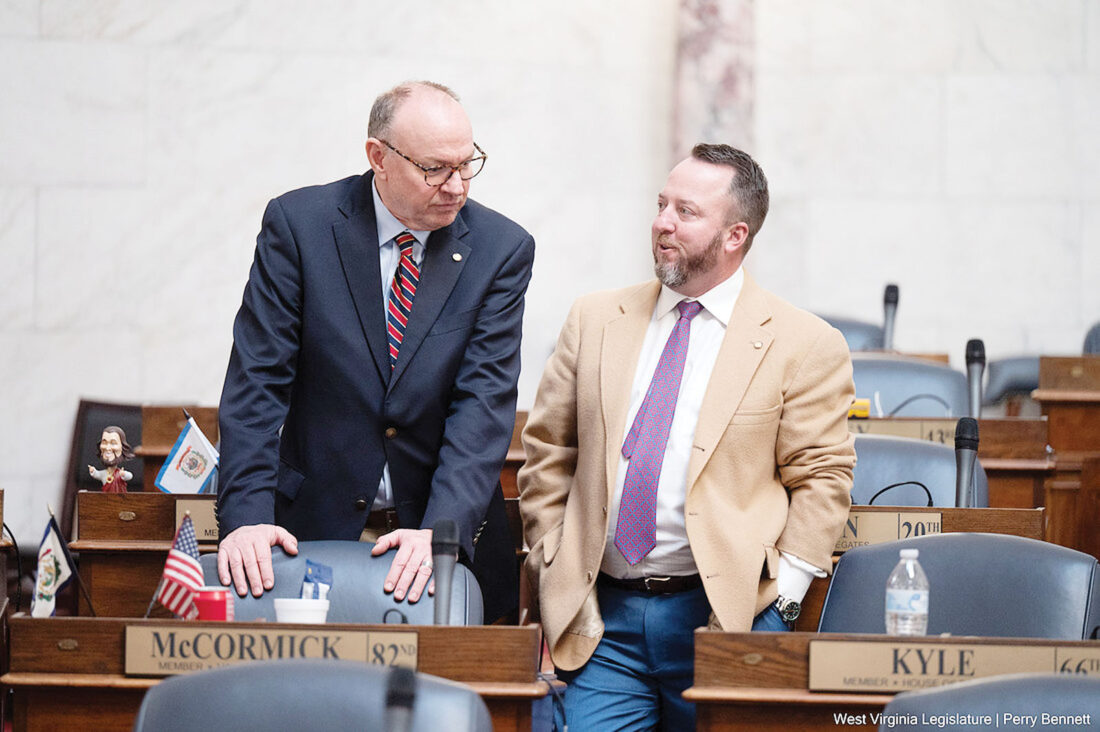
Del. David McCormick, left, said his bill establishing the Vape Safety Act would crack down on bad actors operating vape and smoke shops across West Virginia. (Photo Courtesy/WV Legislative Photography)
CHARLESTON — A bill sponsored by Del. David McCormick to curb the expansion of businesses pushing vape and e-cigarette products made it through the House Health and Human Resources Committee Monday afternoon. The House Health Committee recommended a committee substitute Monday afternoon for House Bill 5437, the Vape Safety Act, to the full House. The bill’s next stop is the House Judiciary Committee. HB 5437 would require all specialty shops selling tobacco, tobacco-derived products, alternative nicotine, or vapor products and accessories to obtain a state license from the Alcohol Beverage Control Administration (ABCA), which requires passing thorough criminal background checks and paying annual fees. The bill specifically targets vape and smoke shops, defined as any retailer that devotes at least 33% of its floor space to these products. No part of a vape or smoke shop could be used as a “residence, dwelling place, or location for human habitation.” “The purpose of House Bill 5437 is to regulate an industry or a business segment that is virtually unregulated and virtually untaxed,” said McCormick, R-Monongalia, in an interview. “These vape shops are all over the state. There’s many bad actors. Many are not here legally. They live in the shops. They’re selling to underage kids. They’re marketing to underage kids.” “There are also many legitimate and above-board shops as well, so we’re not targeting these folks,” McCormick continued. “We’re targeting the bad actors that are selling to underage kids and marketing to underage kids. We’re just trying to put some guardrails on a business that is largely unregulated.” The bill would require vape and smoke shop owners to be U.S. citizens. Background screenings would disqualify an owner from being licensed if they have been convicted of perjury, false swearing, or crimes punishable by more than one year of imprisonment. Licensees would be required to identify every person who has “control of the applicant,” including corporate parent companies and key personnel, with licenses non-transferable. Annual fees would be $1,200 for vape and smoke shops — up from $100 — with fees for partial years and reactivation. Unlicensed operators could face a misdemeanor charge carrying a fine of up to $10,000 and up to one year in jail. “That money will be split 50-50 between the Attorney General’s Office and the ABCA to help fund the increased cost of enforcement and testing,” McCormick said. “Basically, we took the LVL (Limited Video Lottery) hotspot licensing regulations and use them for vape shops.” The bill includes several civil and criminal penalties and establishes a process for routine inspections. HB 5437 includes the establishment of the Vapor Product Directory, managed jointly by the State Tax Commissioner and the Alcohol Beverage Control Commissioner. Beginning July 1, manufacturers must certify that their products have received marketing authorization through the U.S. Food and Drug Administration (FDA), or if the product was marketed as of Aug. 8, 2016, and a premarket tobacco product application (PMTA) was submitted by Sept. 9, 2020, and remains under review. “The registry is a list, essentially, of vape products that have been approved or are pending approval from the FDA,” McCormick said. “The FDA has been very slow to approve these things. They haven’t approved any of the products in the past several years. So, there’s a lot of PMTAs … that are pending at the FDA. As long as these companies can produce a pending PMTA, that would be acceptable and get you in the door.” The directory must be public and updated monthly starting Sept. 1. If a product is removed from the directory, retailers and wholesalers have 21 days to clear inventory. After this period, the products are considered contraband and are subject to seizure and destruction. Retailers, wholesalers, or manufacturers selling unlisted products face a civil penalty of $100 per day, per product. The bill also includes stricter labeling requirements. Products must feature warnings regarding harmful effects, state the legal purchase age, and include a full disclosure of ingredients in descending order, from highest to lowest weight, with the heaviest ingredient first. “The marketing to the kids with things that resemble cereal and candy … the flavors, bubble gum, these things. It’s all in the bill, but those won’t be legal,’ McCormick said. “What we think … is going to happen is by eliminating the bad actors and the licensing regulations as such, that a lot of these places will cease to exist,” McCormick continued. “I think that a lot of the problem will be eliminated, because the people who are doing it right and have legitimate businesses, they’re not selling to underage kids.”Local News

Wood County Commission declares March Developmental Disabilities Awareness Month
Empty Bowls scheduled for Saturday
Sen. Helton, PSC Chairwoman Lane debate energy policy during committee meeting

Entertainment and more in the Mid-Ohio Valley

Democratic Party in West Virginia applauds ruling on Trump tariffs
