West Virginia Senate takes slow approach to Hancock County Schools emergency funding bills
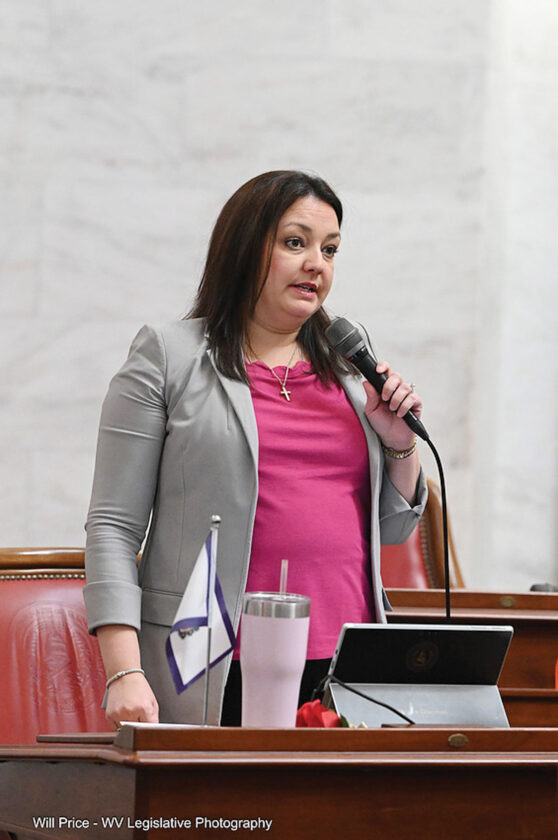
State Sen. Laura Wakim Chapman accused Senate Republican leadership Wednesday of being slow to act on two bills aimed at addressing the financial emergency in Hancock County Schools. (Photo Courtesy/WV Legislative Photography)
CHARLESTON – While the West Virginia House of Delegates moved with lightning speed to pass two bills aimed specifically at the financial issues in Hancock County Schools, the state Senate is moving those bills through its normal committee process, angering one lawmaker.
On Tuesday, the Senate received House Bill 4574, creating a path for condition-based emergency funding for financially distressed county school systems, and House Bill 4575, making an $8 million supplemental appropriation to the state Board of Education for the proposed fund, moving HB 4574 to the Senate Education and Finance Committees and moving HB 4575 to the Senate Finance Committee.
This came one day after the House Finance Committee originated the two bills, suspended its committee rules to recommend both bills for passage without going through the House’s two-step committee process, and suspended state constitutional rules to pass the two bills over to the Senate in one day.
HB 4574 establishes the “Temporary Shortfall Supplement Fund for County Boards of Education,” a new fund to provide loans for temporary shortfalls for county school systems categorized as either financially distressed or in a state of maladministration.
HB 4575 designates $8 million from the available unappropriated surplus tax revenue to seed this relief fund. The first county school system that will have to avail itself of those funds is Hancock County Schools, which faces a nearly $8 million deficit which could affect county school system payroll in the second half of the 2025-26 school year.
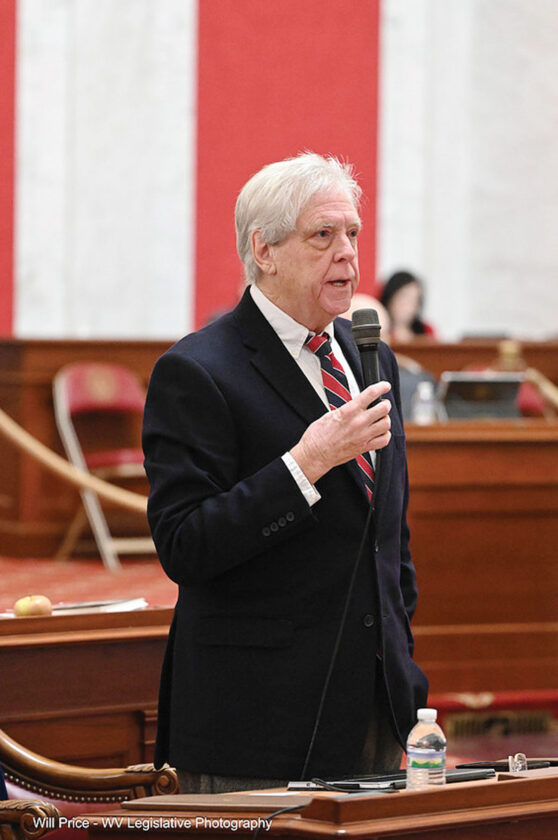
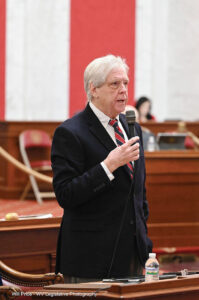
State Senate Minority Leader Mike Woelfel thanked Senate GOP leadership Wednesday for taking a deliberate approach to two House bills quickly passed Monday aimed at helping Hancock County Schools and other county school systems under financial distress. (Photo Courtesy/WV Legislative Photography)
HB 4574 passed 91-2 and HB 4575 passed 92-2 during Monday’s House floor session. Speaking after the vote, House Majority Leader Pat McGeehan, R-Hancock, said an agreement had been worked out with the Senate to quickly take up the bills. But speaking Wednesday during remarks from members on the Senate floor, state Sen. Laura Wakim Chapman accused Senate GOP leadership of reneging on that agreement.
“You could have knocked me over with a feather,” said Chapman, R-Ohio. “No one informed me that there was no intention of honoring the agreement to suspend constitutional rules and immediately pass House Bills 4574 and 4575 … To add insult to injury, those bills were referred to not one committee, but two. This is outrageous because of the emergency situation.”
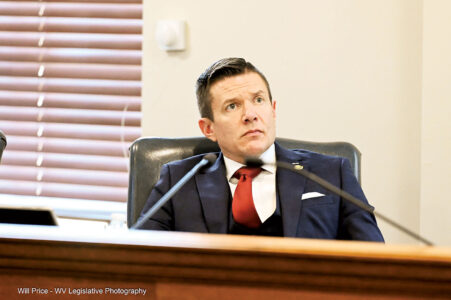
However, speaking Wednesday afternoon, state Sen. Ryan Weld said that the state Department of Education is fronting the school system its school June school aid formula funds to cover February payroll and would re-evaluate the county’s property tax collections later in February to determine whether those funds are sufficient enough to make payroll through the remainder of the fiscal year.
“No one is not going to be paid in Hancock County. That is not going to be the case,” said Weld, R-Brooke. “The emergency that supposedly existed a couple of days ago and weeks ago no longer exists, so that bill did not need to be fast tracked.”
According to HB 4574, financially distressed counties are county school systems either in deficit or on the most recently established watch list by the Department of Education for counties at risk of becoming in deficit.
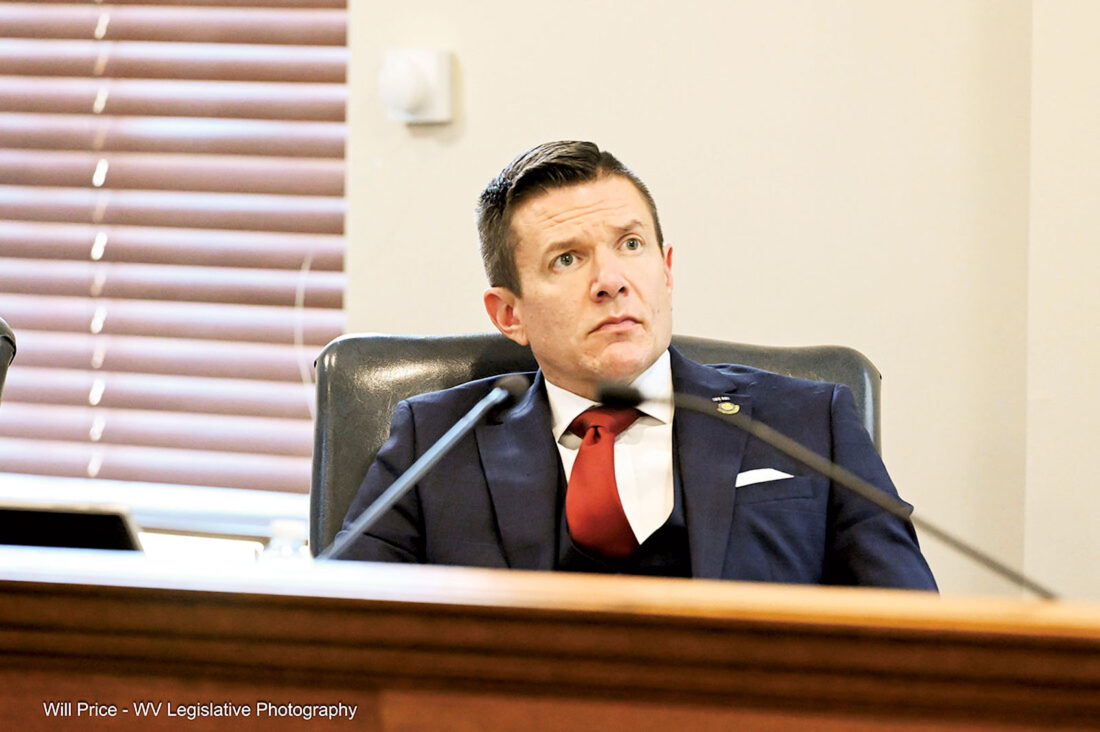
State Sen. Ryan Weld said that with the Department of Education helping Hancock County Schools in the short-term, senators now have time to review two bills aimed at Hancock County and other financially distressed school systems to develop proactive fixes to the system. (Photo Courtesy/WV Legislative Photography)
County school systems in a state of maladministration include counties that fail to maintain required reserve balances for two consecutive reporting periods without a corrective action plan; counties that fail to submit required financial reports, audits, or West Virginia Education Information System (WVEIS) data by statutory deadlines; or submit reports with material inaccuracies, such as approving expenditures that exceed gross revenue for more than one fiscal year.
“I have worked with (McGeehan) on these bills for well over a month,” Chapman said. “These bills have guardrails, transparency, and accountability provisions.”
Weld said the Senate wants to take a closer look at the bills and use them as vehicles to institute proactive measures to prevent county school systems from ending up in similar financial straits, such as greater auditing reforms. Weld pointed to Hancock County Schools’ previous clean audits over the past three years which appeared to hide its recent financial issues.
“What the Senate wants to do is use that bill … or another bill as a vehicle for accountability,” Weld said. “For the past three years, Hancock County schools have received a clean audit … How did that happen? Are we not looking at the right numbers? Are we not auditing the necessary or the right financial accounting information, or was incorrect information being inputted into those audits by Hancock County?”
The state board voted Jan. 16 for the Department of Education to take over Hancock County Schools, remove its superintendent and assistant superintendent, appoint a new superintendent, and limit the authority of the Hancock County Board of Education.
State education officials said the dire financial crisis in Hancock County schools was caused by over-dependence on one-time COVID-era federal dollars, cost overruns for new HVAC systems, spending $1 million on athletic fields, and maintaining more positions over what the state school aid formula could pay for.
“The Hancock County teachers and staff did nothing wrong,” Chapman said. “They were not a part of the administration’s decisions. They are innocent and deserve to know that they will receive their paycheck.”
In her floor speech, Chapman reminded her Senate colleagues that it frequently has suspended state constitutional rules to pass bills in one day instead of the required three-day period to address emergency situations. She cited Senate Bill 127, a bill passed in the Senate on the first day of the 2023 legislative session addressing hospital reimbursement rates.
“The only difference between that emergency fix and House Bills 4574 and 4575 is that one was for the medical community, and the one at hand helps a public school system,” Chapman said. “These actions show the public exactly where our priorities lie. While we have no problem passing school choice measures, some families choose to send their kids to public school. Do we expect our teachers and staff to show up to work when they won’t receive a paycheck? What about the children when schools are closed for lack of staff?”
While acknowledging the emergency financial situation, senators on both sides of the political aisle said the bills need further scrutiny before being fast-tracked through the legislative process.
Speaking shortly after Chapman’s remarks, Senate Minority Leader Mike Woelfel praised Senate GOP leadership for taking a thoughtful and deliberate approach to House bills 4574 and 4575 and called for Hancock County Board of Education members to face further scrutiny and removal from office.
“With local control comes local accountability,” said Woelfel, D-Cabell. “I would call on the local prosecuting attorney to conduct an investigation into whether or not there was any criminal wrongdoing here. I’m not saying there was. I just wanted to take a minute to say that the Senate is a deliberative body, and I commend you for being deliberative on this particular bill. I’m not necessarily at all opposed to what the Senator is advocating, but in this case, we’re going to take our time … and we’re going to do it right.”
“The situation in Hancock County is going to be a marathon, not a sprint,” Weld said. “We’re not going to solve this problem in the next 20 days, 15 days, 30 days. This is a problem that’s going to require a long-term solution and fixes that are going to go much broader than just Hancock County, because there are a lot of counties in the state that are under financial strain.”
Steven Allen Adams can be reached at sadams@newsandsentinel.com
-
- State Sen. Laura Wakim Chapman accused Senate Republican leadership Wednesday of being slow to act on two bills aimed at addressing the financial emergency in Hancock County Schools. (Photo Courtesy/WV Legislative Photography)
-
- State Senate Minority Leader Mike Woelfel thanked Senate GOP leadership Wednesday for taking a deliberate approach to two House bills quickly passed Monday aimed at helping Hancock County Schools and other county school systems under financial distress. (Photo Courtesy/WV Legislative Photography)
-
- State Sen. Ryan Weld said that with the Department of Education helping Hancock County Schools in the short-term, senators now have time to review two bills aimed at Hancock County and other financially distressed school systems to develop proactive fixes to the system. (Photo Courtesy/WV Legislative Photography)
Local News
West Virginia Senate takes slow approach to Hancock County Schools emergency funding bills
Board of Governors hears update on West Virginia University at Parkersburg efforts

Outnumbered Senate Democratic caucus lays out agenda and priorities for session

Wood Magistrate

Woman to face charges after two-vehicle accident on Interstate 77