Senate Education Committee begins discussion of Hancock County Schools emergency funding bill
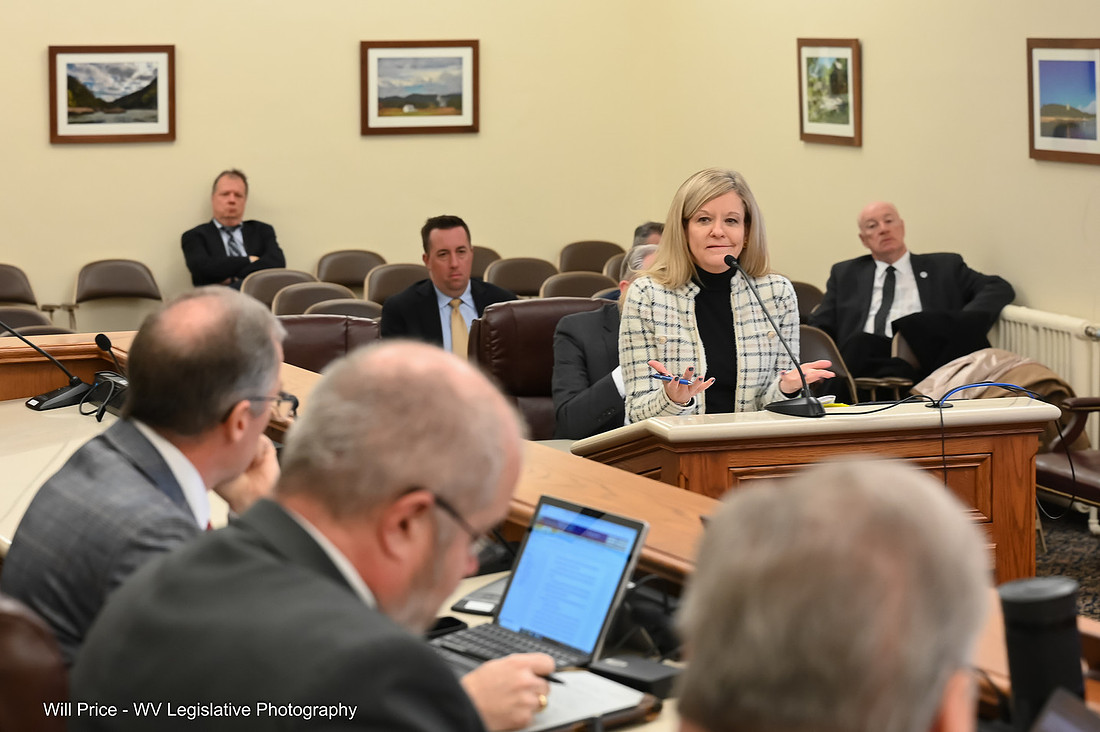
State Superintendent of Schools Michele Blatt answers questions from members of the state Senate Education Committee on Tuesday about a bill meant to help financially distress school systems, such as Hancock County. (Photo Courtesy/WV Legislative Photography)
CHARLESTON – While the West Virginia House of Delegates took quick action last week on two bills addressing the financial crisis in Hancock County schools and potentially other counties, a state Senate committee asked questions and heard testimony about one of the bills, taking no action. The Senate Education Committee met Tuesday morning to hear about House Bill 4574, providing for condition-based emergency funding for financially distressed county school systems. HB 4574 establishes the “Temporary Shortfall Supplement Fund for County Boards of Education,” a new fund to provide loans for temporary shortfalls for county school systems categorized as either financially distressed or in a state of maladministration. The loans are limited to honoring personnel obligations and other essential operating expenses. A “financially distressed county” is defined as a county either in deficit or on the Department of Education’s most recently established watch list. The trigger for applying for funds is when the county’s reserve funding falls below 5% of available funding. County school systems considered to be in “maladministration” are counties that fail to maintain reserve balances or fail to submit required financial reports and date, or counties that approve expenditures that exceed gross county revenue for more than one fiscal year. The county board must repay the loan amount with interest capped at 3% by December 31 of the calendar year following the appropriation. Repaid funds would be returned to the state general revenue fund. Counties receiving the funds are required to follow all West Virginia Education Information System (WVEIS) reporting requirements, implement the West Virginia Checkbook transparency portal maintained by the State Auditor’s Office, and present their financials to the Department of Education upon request. The bill also requires that any county board of education employee responsible for financial decisions be prohibited from employment in all county school systems for two years, with those employees being immediately removed from their positions. It also states that county board members could be removed from office for official misconduct, neglect of duty, or incompetence, citing already existing State Code for the removal of elected officials. While HB 4574 could apply to any county school system, the bill was brought about due to financial issues in Hancock County Schools discovered by the Department of Education over the last few months. The county faces a nearly $3.1 million funding shortfall and is unable to meet payroll obligations without state assistance for the remainder of the current fiscal year. According to the Department of Education, the county failed to implement a reduction in force (RIF) after federal COVID-19 relief funds expired. The county had maintained 143 staff positions over the state school aid formula, paying for them with temporary federal dollars, and then moved the employees to the general fund without a sustainable funding source. “They did not do any reduction in forces over the last … 10 years,” said State Superintendent of Schools Michele Blatt. “We had been talking for the past three years to counties that you’re going to hit a fiscal cliff. You can’t maintain all of these additional staffing positions that you’ve put in place with all this federal influx of money, to the point that even we were providing lists to every county at the trainings of the employees that are paid on these COVID funds.” The county’s financial hole continued to grow thanks to decisions to fund an athletic facility upgrade, including a turf field. In past briefings with lawmakers, state education officials discovered the county bypassed the mandatory WVEIS accounting system, opting instead to manage finances via manual spreadsheets that obscured their actual deficit. The state Board of Education voted Jan. 16 for the Department of Education to take over Hancock County Schools, remove its superintendent and assistant superintendent, appoint a new superintendent, and limit the authority of the Hancock County Board of Education. The state has fronted the county its June school aid formula allowance to fund February payroll, but additional funding could be needed as soon as the end of March. An investigation is ongoing. “All teachers, staff, everyone will be paid as normal for their February payroll, which was a concern, of course, of everyone. So, that has been taken care of,” Blatt said. “We project that if the local tax collections come in on time in March, we should be good, but there may be a small percentage of the May (payroll) that we would need to front, but that’s still to be determined.” Several committee members posed questions to legal counsel for the committee and Blatt, but no action was taken on HB 4574 Tuesday. A companion bill awaiting action in the Senate Finance Committee, House Bill 4575, is a supplemental appropriation of $8 million that could be used as a bridge loan for Hancock County Schools. But Senate President Pro Tempore Jay Taylor, R-Taylor, questioned the look of loaning Hancock County Schools funds for bad behavior. “The problem we’re seeing across the state is the hard decisions that are being asked of these local board members to vote in their small communities for things that are not popular,” Taylor said. “Well, and I’m having trouble explaining to people why I should vote for this bill for Hancock County when they just upgraded their athletics facility. I love sports, probably more than most. But daggone it, you can’t do that.” Hancock County became the eighth county taken over in some form by the state Board of Education, along with Boone, Logan, Mingo, Upshur, Randolph, and Roane counties. Randolph and Roane counties are designated as “state of emergency,” where the local board retains some authority. Steven Allen Adams can be reached at sadams@newsandsentinel.comLocal News
Senate Education Committee begins discussion of Hancock County Schools emergency funding bill

Road crews staying ‘busy, busy, busy’ clearing snow
Warming centers report steady use in wake of storm

Picture This: Cold Shoulder

Government offices, events across Mid-Ohio Valley disrupted by snow