Lawmakers receive recommendations for fixes to West Virginia school aid formula funding
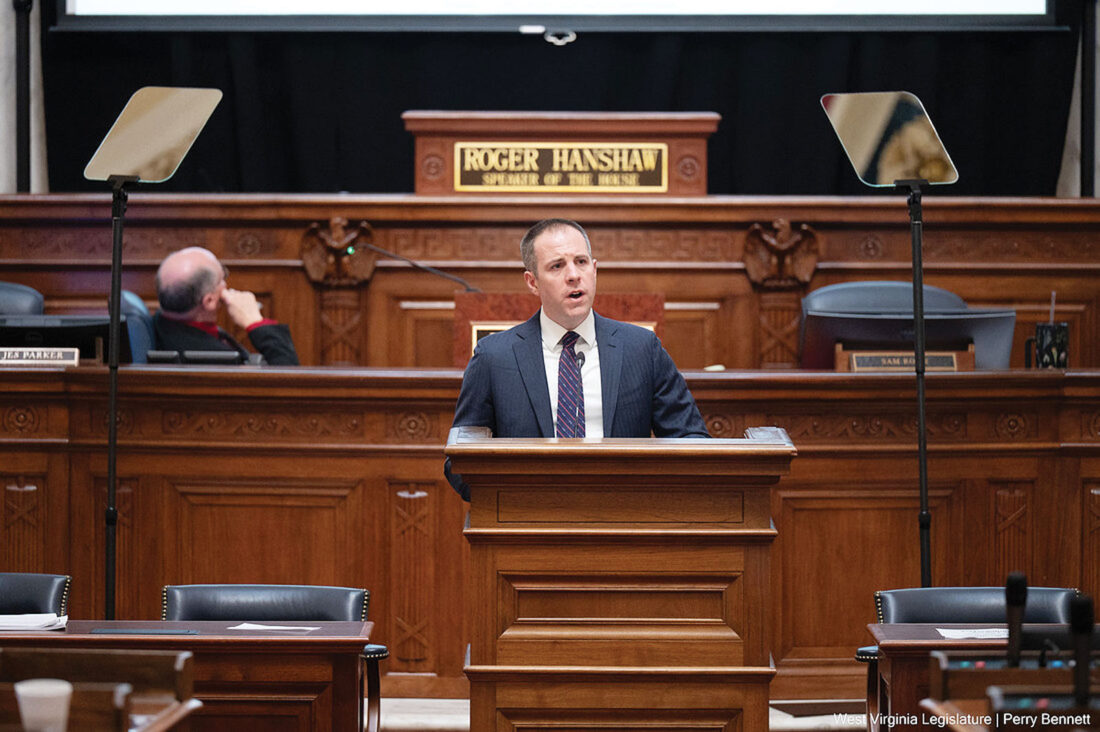
RAND Corporation researcher Brian Phillips briefs lawmakers Wednesday on possible improvements to the state school aid formula. (Photo Courtesy/WV Legislative Photography)
CHARLESTON – As public school enrollment continues to shrink in West Virginia’s 55 county school systems due to multiple factors, including families taking part in the state’s educational voucher program for private and homeschooling, lawmakers were given ideas for fixing the state school aid formula. The House of Delegates Education Committee received a briefing on the formula from the RAND Corporation Wednesday afternoon. The Public School Support Plan, also known as the school aid formula, is a seven-step formula that determines how much state funding goes to county school systems based on factors including the number of students enrolled in the county public school system. According to RAND Corporation researchers Benjamin Master and Brian Phillips, while overall state education spending is near the national average, the system fails to adequately account for the higher costs associated with low-income students and those with disabilities. “The state ranks eighth in percent of students in poverty, fifth in the percent of students with a disability and 47th in the nation in terms of the percent of students’ parents that have a bachelor’s degree,” Master said. “Research tells us that these factors strongly influence how students perform in school. And on the National Assessment of Education Progress, West Virginia ranks near the bottom in math and reading.” “Districts need more resources to adequately serve students from low-income families, students with disabilities and English learners,” Phillips said. “These students require additional supports, specialized staff and services if they’re going to have an equal opportunity to succeed.” The RAND analysis recommended implementing a student-weighted funding system, similar to those used in most other states, to direct more resources to counties with higher-need student populations. RAND also proposed increasing total state aid to ensure no county loses resources during the transition. Master said the state school aid formula creates “unhelpful incentives” by linking state funding allocations directly to certain data inputs by counties. Specifically, Master said allocations for staffing based on educator salary bands and transportation funding based on prior-year spending reduce the natural incentives for counties to review spending. “We identified a few cases in the formula where there’s a direct link between funding allocations and inputs that creates some unhelpful incentives for districts to ignore cost-cutting opportunities,” Master said. “In both of these cases, the current incentive structure reduces some of the incentive for districts to do cost cutting where it’s possible.” Making changes to the school aid formula has been on the lips of lawmakers and state education officials over the last year. While county school systems receive local funding through property tax revenue, bonds and levies, the school aid formula plays a large role in their budgets. The state Department of Education finalizes student enrollment numbers every October, which then determines how much money county school systems get from the formula the next school year. According to this year’s headcount report, there were 234,957 students enrolled in the state’s 55 county school systems, a 2.52% decrease from fall enrollment this time last school year of 241,024 and a 15.32% decrease from the 277,452 fall enrollment number in 2015. The decrease in student enrollment has forced county school systems to make tough choices about closing and consolidating schools. Last December, the state Board of Education approved requests from six counties to approve amendments to their comprehensive educational facilities plans involving the closure of 15 public elementary, middle and high schools, consolidating those students with existing schools in the counties. The number of public schools in the state decreased from 637 last year to 618 as of October for a 2.98% decrease. The closures of the 15 schools approved by the state board last month represent a 2.4% decrease in schools. The RAND report cautioned against the universal expansion of the Hope Scholarship educational voucher program, which opens up to all eligible children beginning in fiscal year 2027 in July. The Hope Scholarship, which is currently only available for public school students leaving for private or home schooling, provides students the equivalent of the per-pupil expenditure made available to counties through the state school aid formula. Master said the RAND report recommends that future Hope Scholarship eligibility be income-based to maximize the program’s impact on student achievement. “We estimate that if approximately half of newly eligible students were to take up scholarships, this would cost the state around $105 million annually,” Master said. “In the other direction, income-based eligibility is an approach that could increase the cost efficiency of the program. There is a trade-off since it would reduce access, but it would target funds towards students who are more likely to use the scholarships to make a change to private schools and would otherwise be less likely to do so.” Steven Allen Adams can be reached at sadams@newsandsentinel.comLocal News

Lawmakers receive recommendations for fixes to West Virginia school aid formula funding

Bolstered by GOP losses, West Virginia Democrats plan candidate push
State Sen. Chapman resigns as health committee chair

Parkersburg City Council passes final reading of sanitation contract
Wood County BOE moves forward with Madison renovation project