Injection wells discussed at Washington commission
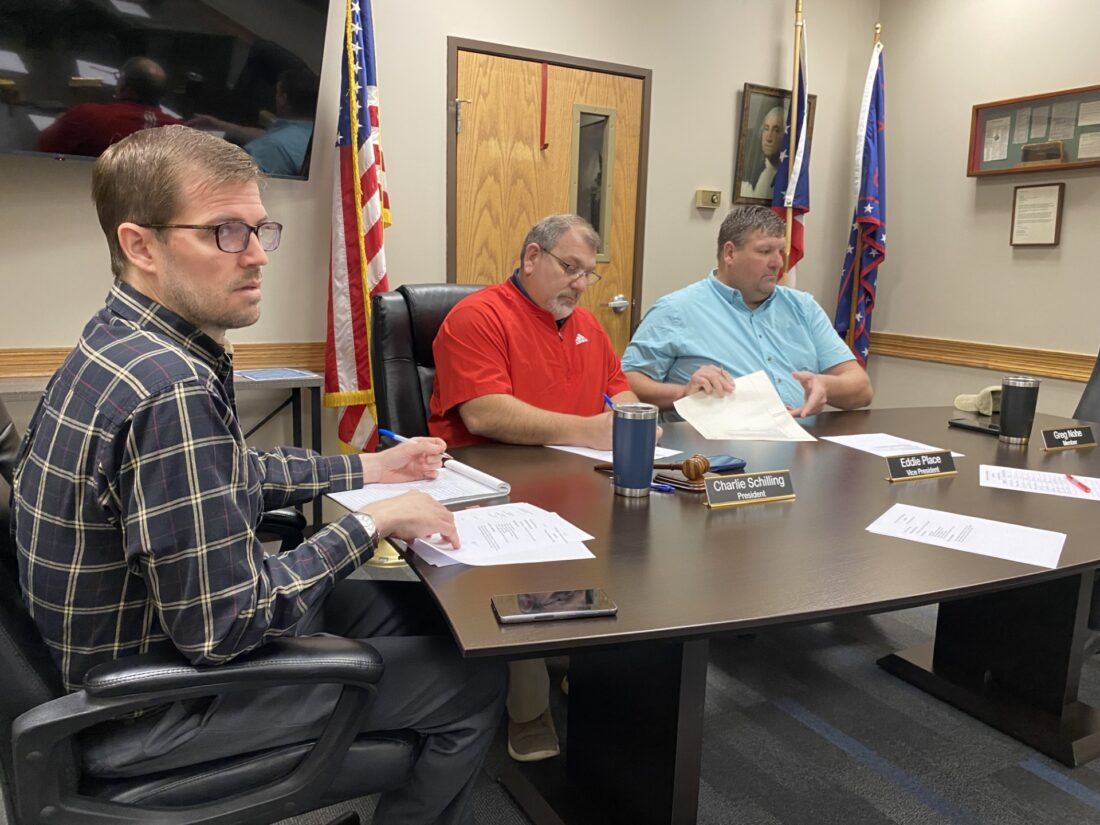
Photo by Brett Dunlap The Washington Commission held its last meeting of 2025 on Wednesday where officials had a discussion on injection wells and other matters. Pictured are Clerk Ben Cowdery, Commission President Charlie Schilling and Commissioner Eddie Place.
MARIETTA – The continuing issue of injection wells was discussed Wednesday during the final meeting of the year by the Washington County Commission.
Commission President Charlie Schilling and Commissioner Eddie Place listened to people representing both sides of the issue as concern for the safety of local drinking water was a priority for some of the people in attendance.
Commissioner Greg Nohe was absent from Wednesday’s meeting.
A woman named “Hillary” spoke on the issue of injection wells and brine. She did not give her last name and she did not sign the sign-in sheet for the meeting. She said she recently joined Washington County For Safe Drinking Water.
“I truly believe that no matter how you vote or who you pray to, you deserve clean drinking water,” she said, adding the concept of clean drinking water has become a political issue with a variety of different viewpoints on how it is handled and dealt with.
There are 17 injection wells in Washington County with two more being permitted. Hillary talked about the steel and concrete used to reinforce the wells, but the geology of the area still allows leaks.
She said she has lived in the area for three years with her husband and expects to spend many more years in this area. She talked about being around people who regularly praise the oil and gas industry and assumed brine from fracking procedures was just salty water and nothing to worry about.
However, after researching injection wells she has become concerned with the levels of radioactivity brought up in the brine being used to crack the Marcellus Shale, she said, adding this region, due to its geological makeup, has amounts of radium that have appeared in brine water that was used in fracking at dangerous levels which was brought up from deep underground (around 5,000 feet or so).
The truck drivers who end up having to haul it are not told it could be dangerous and are not given protective clothing, Hillary said.
“I hope everyone in this room will start caring about this issue and saying more,” she said.
The types of radium being dealt with can have a half life of 1,600 years, she said, and many generations will have to deal with it. She is concerned about the people working around these materials and any possible effects they might have on the population, animal life and plant life.
“Commissioners, you have real power to protect the people,” Hillary said. “People care about this issue and ask you to care.”
Matt Dole, an adviser to the Accountability Project Institute, said they have looked into the injection well issue. Dole said he is not a scientist.
He presented the commission with a report titled “Why Class II Injection Wells Are Safe in Ohio.” He talked about efforts to dispose of radioactive brine water through deep well injections.
“We take these things seriously,” Cole said. “The good news is we are not trying to put radiation into school lunches, we are trying to put it 4,000 feet underground in a very safe way.
“It is the way the EPA handles environmental waste. It is the regulators’ preferred way to dispose of this material.”
The bottom line, he said, was that brine water in Ohio, across 250 wells, has never polluted a municipal or public water source.
Hillary pointed out there is a pending court case nearby, but was open to taking a tour of facilities that could be arranged sometime in the near future. The Washington County For Safe Drinking Water held an event on Dec. 15 that was attended by 250 people so people are concerned about this issue, she said.
She is not asking for a ban on fracking in the area, but wants it regulated as it is supposed to be to protect the public and environment.
Schilling thanked both people for coming in and expressing their views.
“There has been a lot of research done in this office from both sides of the spectrum,” he said. “We are happy with how things are regulated and how things are permitted.
“We hold clean safe water at a high priority. We certainly do. We feel things are regulated and permitted properly. It takes research and everyone doing that type of research and understanding the industry so people can make an informed decision.”
In other business, Darren Shearlock, the executive director of the Washington County Veterans Service Commission, talked about the work his office has done with others in the county about helping local veterans. He talked about how a number of groups and governing bodies, like the commission, have come together to make sure local veterans get the services they need.
“People in the community stepped up to make sure every veteran in this county is getting respected and taken care of,” he said.
Officials talked about starting on Jan. 1, everyone will be starting to celebrate 250 years of history since the founding of this country, including events at Campus Martius Museum and other places in the area, said County Recorder Teresa Judson.
“We have a lot of great things happening,” she said. “People are really excited.”
Commissioners said they wanted to be made aware of events happening and they would let people know about them on their social media accounts.
“In this area, we really embrace our history,” Schilling said. “(Marietta) was the first settlement in the Northwest Territory and the Gateway to the West.
“This is a big year for Washington County in celebrating this anniversary.”
Contact Brett Dunlap at bdunlap@newsandsentinel.com
Local News

Israel bulldozes Palestinian homes
Noon Year’s Eve celebrated at Belpre Library
BELPRE - The Belpre Public Library, a branch of the Washington County Public Library System, rang in the New Year a ...
Russian drone attack kills three children

These bipartisan bills were noncontroversial — until Trump vetoed them

Barmore facing domestic assault charge