First Two Weeks: West Virginia House of Delegates, Senate pass additional bills
-

- Much of the state Senate’s time was spent Thursday on whether to include a replica of the Aitken Bible, the first English Bible printed in colonial America, in certain social studies classrooms in West Virginia. (Photo Courtesy/WV Legislative Photography)
-
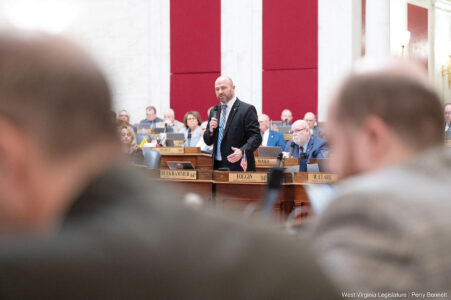
- Del. Adam Burkhammer talked Thursday about the need for a statewide comprehensive plan by state human resources officials for at-risk children and young adults. (Photo Courtesy/WV Legislative Photography)
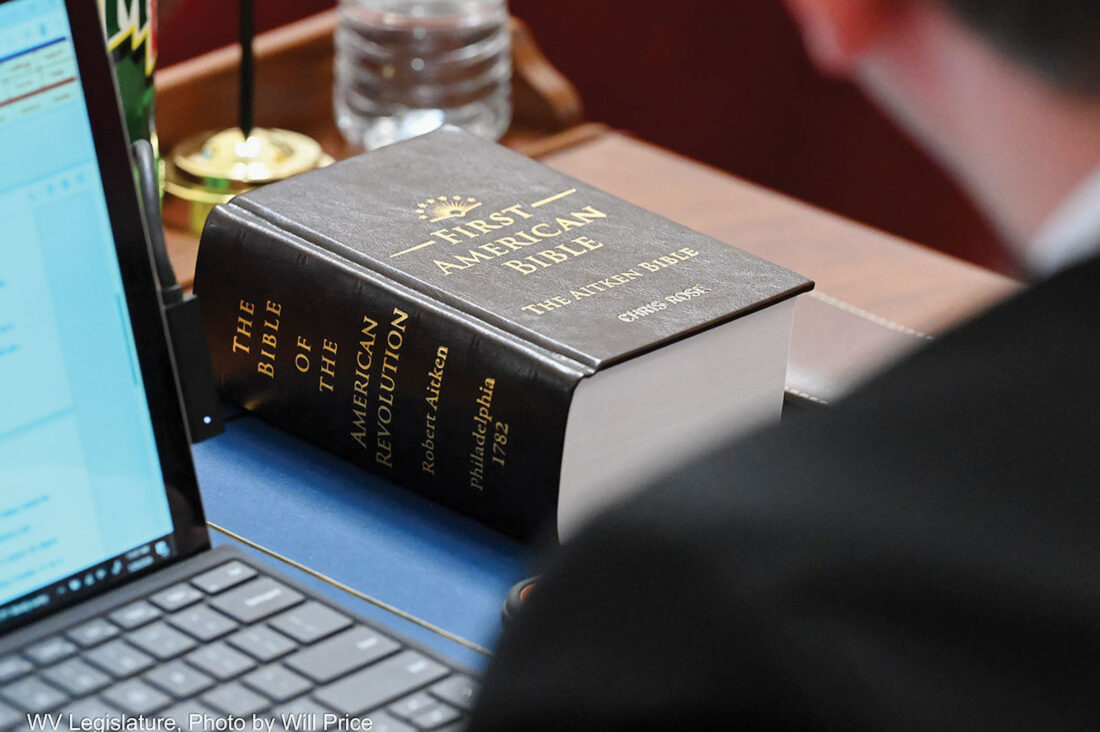
Much of the state Senate’s time was spent Thursday on whether to include a replica of the Aitken Bible, the first English Bible printed in colonial America, in certain social studies classrooms in West Virginia. (Photo Courtesy/WV Legislative Photography)
CHARLESTON — The West Virginia Senate and House of Delegates passed additional bills Thursday more than two weeks since lawmakers gaveled in to start the 2026 legislative session and with just under 45 days left in the 60-day session.
As of Thursday, the House has passed 23 bills out of the 980 House bills introduced to date, while the Senate has passed 14 bills out of 670 bills to date. The House is still 20 days away from its deadline to introduce new bills, while the Senate is 26 days away from its bill introduction deadline.
The House passed five bills Thursday morning, including House Bill 4393, requiring the development and implementation of a statewide prevention plan. The bill passed the House in a 96-0 vote with four absent.
HB 4393 requires the Department of Human Services to establish a comprehensive statewide prevention plan by early 2027, focused on delivering evidence-based, trauma-informed care to minors, foster families, and young adults transitioning out of the state’s welfare system.
“Currently West Virginia is the highest in removing kids per capita in the nation … And that’s a problem,” said Del. Adam Burkhammer, R-Lewis. “What we’re trying to address here is getting upstream. How do we turn off the faucet? How do we stabilize things prior to the need for CPS (Child Protective Services)?”
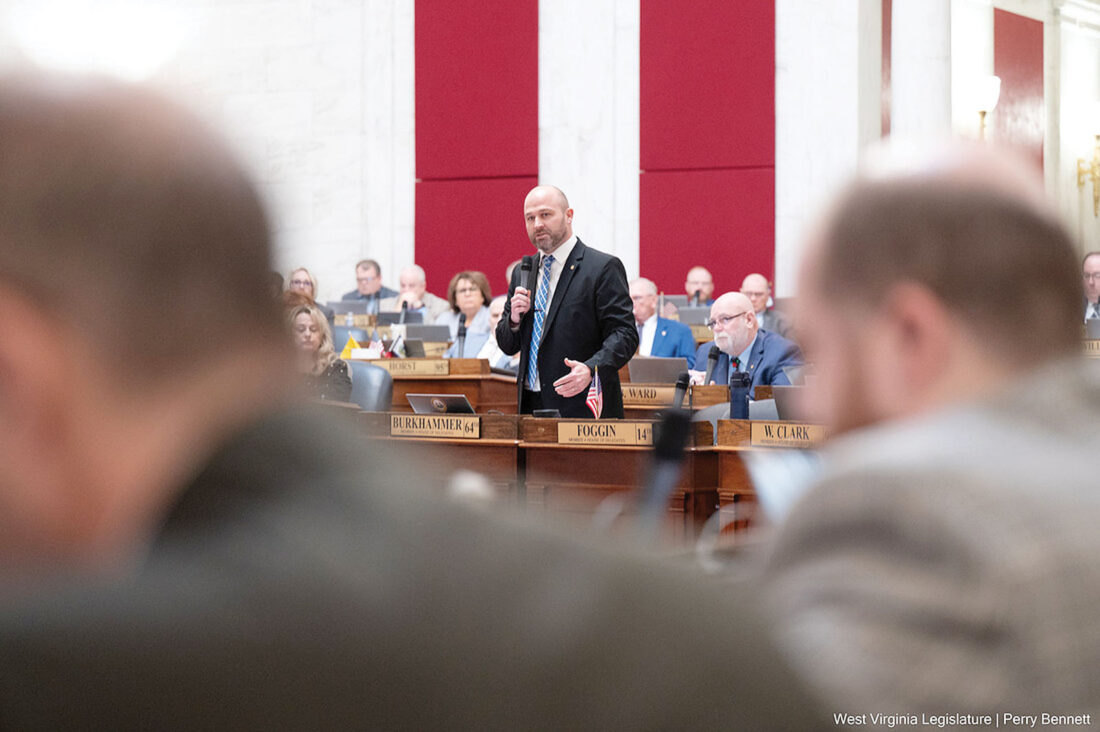
Del. Adam Burkhammer talked Thursday about the need for a statewide comprehensive plan by state human resources officials for at-risk children and young adults. (Photo Courtesy/WV Legislative Photography)
HB 4393 requires a geographic balance of physical service locations and telehealth options rather than relying on remote care. The bill requires the state to maximize federal funding and provide annual reports to the Legislature regarding program costs and specific regional outcomes.
“Some people … would argue this isn’t government’s role to be within families’ homes. They should take that responsibility on their own,” Burkhammer said. “I agree with you, but that’s not reality. Reality is if we do not get upstream, if we do not stabilize families, if we do not support families in their need and in their vulnerability and the desperate state that they’re in, government is going to get involved through the CPS system.”
The House also passed House Bill 4410, relating to special stops required for on-track equipment, in a 96-0 vote. The bill amends State Code to provide a definition of on-track railway equipment, which includes railroad maintenance right-of-way equipment. It adds “on-track equipment” to a list of items that will traverse railroad tracks, such as trains, which cars should stop for and provides for the actuation of signals at crossings.
House Bill 4437, allowing Gold Star parents to receive one free Gold Star vehicle registration for personal use, passed 96-0. The bill grants free vehicle registrations to parents who have lost children in military service.
“Gold Star parents are special to me and should be to everyone,’ said Del. Charles Sheedy, R-Marshall, the lead sponsor of the bill. “Gold Star parents have lost a son or daughter in service to the nation, serving to protect and defend your freedom and safety at home and abroad. The ability to display a Gold Star license plate on their vehicle denotes them having lost a son or daughter and should call up our respect to recognize their sacrifice.”
House Bill 4610, creating the Safeguard the Right to Try Cutting-edge Medicine Act, passed 96-0. The bill is aimed at expanding access to experimental medical treatments, expanding the definition of eligible patients to include those suffering from life-threatening or severely debilitating illnesses rather than only those with terminal conditions.
House Bill 4626, relating to the establishment of a grant program to fund the U.S. Food and Drug Administration’s drug development trials with Ibogaine, passed 96-0. The bill creates a grant program to study Ibogaine, a psychoactive drug, that has promising applications for treating opioid addiction.
“It’s very experimental,” said Del. Mike Pushkin, D-Kanawha. “It can be dangerous, but I think … people get pretty desperate and are willing to try anything. I’ve heard that it works. I think people should have a right to have access to it, and I’d like to see further studies of it. I just want the body to be aware of what we’re voting on.”
The Senate passed seven bills Thursday, including Senate Bill 388, requiring public elementary or secondary schools to make the Aitken Bible available to certain classrooms. The bill passed in a 30-4 vote.
SB 388 mandates that all public and charter schools provide the Aitken Bible to specific fourth, eighth, and tenth grade social studies classrooms, though the bill does not require teaching from the specific Bible. The legislation prohibits the use of public funding to purchase these Bibles, but schools can accept private donations to acquire the necessary materials.
Senate Education Committee Chairwoman Amy Grady, R-Mason, is the lead sponsor of SB 388. She defended the Aitken Bible’s inclusion in classrooms due to its historic significance as the first Bible printed on the American continent prior to the end of the Revolutionary War. She criticized the media and others for not understanding what her three-paragraph bill does.
“I am always amazed at how the media, the public, and members of this body can misinterpret, misconstrue, and misunderstand a bill that is three sentences, seven lines,” Grady said. “Students are allowed to study the Bible as part of history, literature, or culture. Learning about religion in an objective, educational way is allowed under the Constitution. The Robert Aitken Bible can be used this way because it helps to teach important American history topics, such as Congress, culture, trade, and immigration.
“During the Revolutionary War, the Continental Congress officially recommended it and approved it for printing to the American people,” Grady continued. “This shows how important that Bible is and was in early American life, in early American education and culture. Because it was approved by Congress at the time, that alone gives it a special historical importance.”
Opponents of the bill criticized it for only focusing on Protestant history in early America and not the contributions of Catholics in the founding of the nation and called the bill a backdoor attempt to insert a preferred religious and Christian denomination into public schools.
“I think the Senate missed an opportunity … to be able to tell a much broader and larger part of the history of the American Revolution and the first couple of years of the founding of the United States, the ratification of the Constitution, and the early years of Washington’s presidency,” said state Sen. Ryan Weld, R-Brooke, who supported a failed amendment to the bill Wednesday to also include a copy of the Catholic American Bible in schools. “I think we’re missing out on telling a broader tale of that time period by not adopting the amendment yesterday.”
“I have a firm belief that when we deal with matters of faith that instruction be carried out by the family, faith leaders, or in our private schools, our parochial schools, by our educators in those schools,” said Senate Minority Leader Mike Woelfel, D-Cabell. “I think we’re opening up Pandora’s box. I don’t think we have any guardrails in this bill.”
The Senate passed Senate Bill 4, relating to crimes against public justice, in a 32-2 party line vote. The bill establishes a 30-foot safety zone that bystanders must respect after receiving a verbal warning from personnel such as police officers or firefighters, as well as criminal penalties for violating the safety zone.
“If someone approaches or remains within that barrier after a verbal warning and acts to interfere with the first responder’s duties, threaten or menace the first responder, or harass the first responder, that person can be charged and arrested on a misdemeanor charge,” said senate Judiciary Committee Chairman Tom Willis, R-Berkeley. “This bill both protects our first responders and extinguishes the lawlessness that has become rampant around our country.”
Senate Minority Leader Joey Garcia, D-Marion, raised concerns that the bill could run afoul of First Amendment free speech protections. Garcia cited the recent shooting last Saturday in Minneapolis by U.S. Border Patrol officers of 37-year-old ICU nurse Alex Pretti, who was recording the law enforcement agents. The shooting occurred after the agents took Pretti into custody and disarmed him.
“There is a potential chilling effect on the way that this bill is written,” Garcia said. “If we harken back to Saturday, we’ve seen that if there weren’t video cameras showing what some of these Customs and Border Patrol agents were doing, we would have had a narrative coming from the federal government that told explicit lies. This is so important to a healthy democracy that we have this transparency.”
Senate Bill 84, prohibiting law enforcement from placing surveillance cameras on private property, passed 34-0; Senate Bill 390, altering conditions for flood resiliency disbursements, passed 34-0; Senate Bill 400, updating personal income tax definitions and provisions of law relating to gaming and gambling losses, passed 33-1; Senate Bill 443, granting municipal fire marshals authority to assist in lawful execution of law-enforcement officer’s official duties, passed 34-0; and Senate Bill 445, adding Potomac State College as eligible institution for participation in Learn and Earn Program, passed 34-0.
Steven Allen Adams can be reached at sadams@newsandsentinel.com
Local News

Affordable Heart Health Screening event in Racine this February

Venezuela’s acting president signs oil industry overhaul, easing state control to lure investors

Washington County residents discuss ODNR lawsuit

Movie Review: Jason Statham sticks close to the formula as a lethal former spy in ‘Shelter’
Morrisey making new push for income tax cut