
Morrisey to create fund to help to bring home foster children, improve facilities
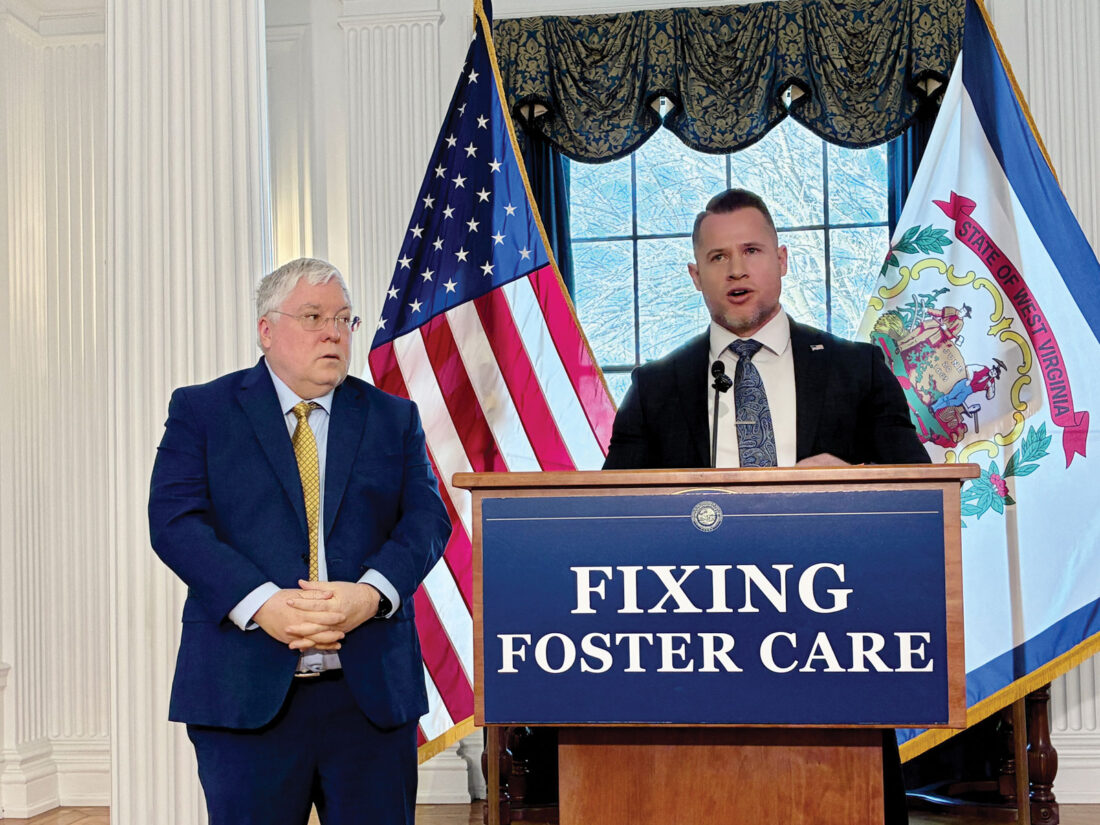
Gov. Patrick Morrisey, left, and Department of Human Services Secretary Alex Mayer, right, take questions from the press Tuesday about a proposed revolving investment fund to improve and expand in-state foster care facilities to begin bringing foster care children placed in out-of-state facilities back to West Virginia. (Photo by Steven Allen Adams)
CHARLESTON – Gov. Patrick Morrisey announced a plan to bring home the hundreds of West Virginia foster children in out-of-state placement by creating a fund to improve existing foster facilities and construct new facilities.
Morrisey and state Department of Human Services (DoHS) Cabinet Secretary Alex Mayer held a press conference Tuesday morning at the State Capitol Building to propose a new revolving investment fund to renovate state-owned foster care facilities and enhance in-state treatment capacity.
“What we want to do is we want to create a new revolving investment fund in order to make sure we’re building out some of the existing state-owned facilities, and that those dollars are going to be used to renovate and repair existing state properties, by providing high acuity psychiatric, neural developmental, and trauma services for kids in West Virginia,” Morrisey said. “We’re also going to be furthering treatment programs that match the clinical profiles of our kids.”
According to the DoHS Child Welfare Dashboard, there are 5,960 children in the state’s foster care system, with 543 foster children – or 9.11% – in out-of-state placement. According to Morrisey, the cost to taxpayers for one out-of-state placement is $156,000 per child on average.
Morrisey said he is working with lawmakers on legislation to create the revolving investment fund, which will need $6 million to get started. But Morrisey said the savings by bringing West Virginia’s foster children home from out-of-state placement would be deposited into the new revolving investment fund.
“As you put money in to refurbish the facilities, and you bring people home, we think we can actually save money as a result, and then we can reinvest it back into the program with the goal of eventually eliminating out of state placements,” Morrisey said. “That needs to be our goal, and we need to be very aggressive about that. If you have reductions in those out-of-state placements, that’s more money for investment here in West Virginia.”
According to statistics provided by DoHS, there have been modest improvements in foster care and child welfare numbers. These include 1,100 adoptions completed over the last year, described as “one of the highest totals on record” by Morrisey; a monthly decrease in child removals from an average of 365 in 2024 to 324 in 2025, and a 37% decrease in substance use-related child removals.
“Progress does not mean the work is finished. It does not mean that the system is perfect, and it certainly does not mean the challenges facing children, families and frontline staff have disappeared,” Mayer said. “What this progress does mean is that we have begun to lay a foundation strong enough to support sustained change. Change that can now accelerate at an exponential rate.”
In May, Morrisey and DoHS announced a reform agenda for Child Protective Services (CPS) and the Bureau for Social Services, the two agencies within DoHS that handle child welfare and foster care issues. These include full compliance with the federal Child Abuse Prevention and Treatment Act, enhanced transparency, improved supervision of child welfare cases, critical incident review teams, a comprehensive practice model, and allowing caseworkers to gather more comprehensive information beyond the initial referral.
“For many years, the child welfare system experienced long periods of limited movement. Leadership shifted, initiatives were introduced, and new ideas were discussed. But the underlying infrastructure, practice, data, and workforce supports were made essentially unchanged,” Mayer said. “We took deliberate steps to stabilize key aspects of the system before attempting to transform it.”
DoHS recently implemented the Communications, Operations, Mobile Engagement Tool (COMET) to increase communication and collaboration among foster parents, caseworkers, attorneys, and service providers, enabling them to share information and track updates. DoHS is also actively exploring data-driven tools to improve outcomes; and using analytics to identify where foster families are needed, what supports they require, and how to reduce placement disruptions.
“These foundational improvements are now opening the door to a new phase of progress,” Mayer continued. “As a governor highlighted, West Virginia’s child welfare system is still on a journey. And more work is ahead. But today we are no longer building on sand. We are affirming a foundation capable of supporting innovation, accountability, and continuous improvement.”
Steven Allen Adams can be reached at sadams@newsandsentinel.com
Local News

Morrisey to create fund to help to bring home foster children, improve facilities
Picture This: Good Sams Donate Stockings
Snow, ice create difficulties across Mid-Ohio Valley
Crews use sandbags to shore up levee breach near Seattle after failure prompts flood warning
Search for the Brown University shooter continues as questions swirl about campus security
