Mission Accomplished: Getting the mast of the USS West Virginia to WVU’s Oglebay Plaza was a tall order
-
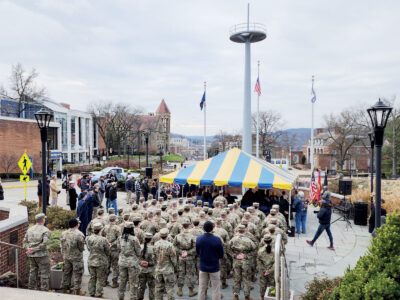
- The mast of the USS West Virginia is shown during a Pearl Harbor Day ceremony on Dec. 7, 2023. (Photo by David Beard/The Dominion Post)
-
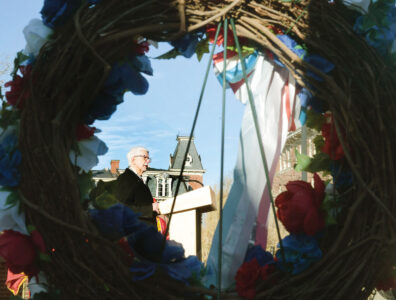
- Jack Bowman was the keynote speaker at the 80th Pearl Harbor anniversary ceremony Dec. 7, 2021, at West Virginia University. (Photo by Ron Rittenhouse/The Dominion Post)
-
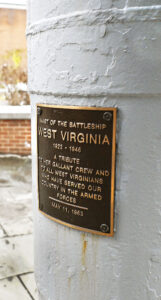
- A plaque affixed to the mast of the USS West Virginia. (Photo by Ron Rittenhouse/The Dominion Post)
-
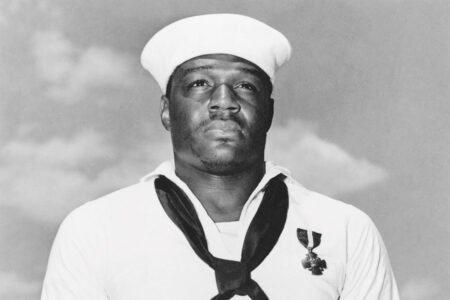
- Dorie Miller (Photo Provided)
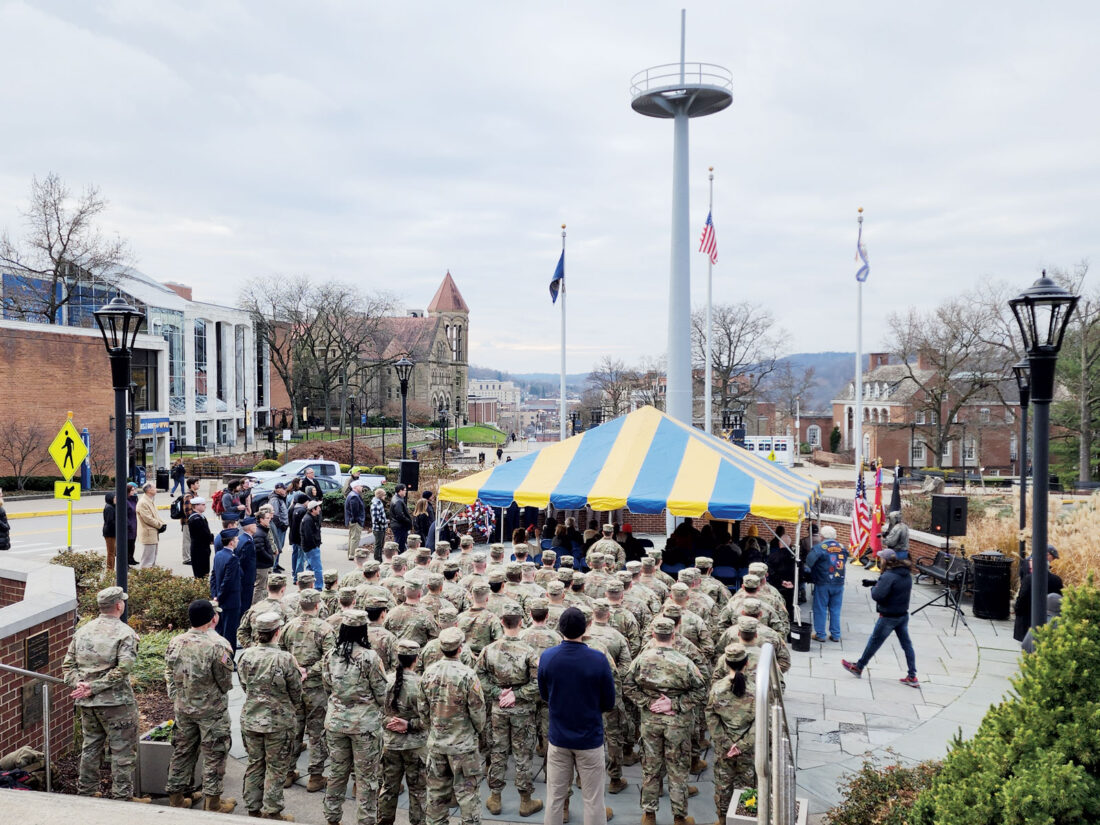
The mast of the USS West Virginia is shown during a Pearl Harbor Day ceremony on Dec. 7, 2023. (Photo by David Beard/The Dominion Post)
MORGANTOWN — Good thing Jack “The Mast” Bowman doesn’t bear grudges.
“Well, I was pretty annoyed about it back then, to be honest,” the dean emeritus of the West Virginia University College of Law allowed amiably, with a little chuckle last week. “But what are you gonna do? The important thing was that it did get here.”
In 1959, Bowman, a quick-witted kid from Petersburg who was the first in his family to go to college, had just gotten elected student body president of WVU – a WVU that was very much transformed by World War II.
“It had only been 14 years,” Bowman said, referring to the 1945 denouement of the epic, world-defining clash that spanned two oceans with two distinctly different theaters of war. “Around here, it was still pretty fresh.”
The post-war boom in Morgantown that was America in microcosm was just as fresh.
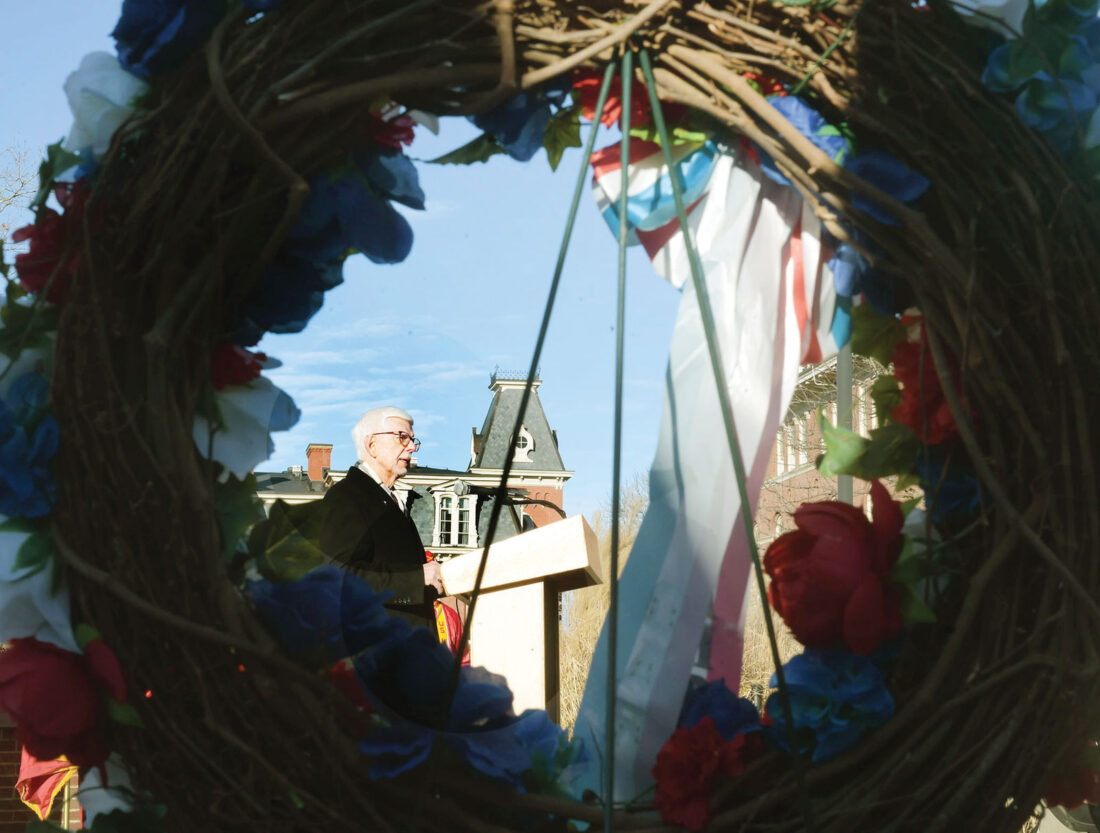
Jack Bowman was the keynote speaker at the 80th Pearl Harbor anniversary ceremony Dec. 7, 2021, at West Virginia University. (Photo by Ron Rittenhouse/The Dominion Post)
Just look at Suncrest.
Before the war, the area was basically a bucolic two-lane road and a passel of family farms. After Germany and Japan, the rural enclave exploded into the Evansdale campus – with the chief accelerant being all those soldiers turned students, who were most definitely in a hurry to make a new society, as they poured in to register for class.
One day, the phone in the student government office rang. The president of the school’s bustling student veterans chapter was on the other end:
“Jack, they’re scrapping the West Virginia. She’s at the shipyard in Bremerton. Just letting you know.”
Bowman didn’t need any background or explanations.
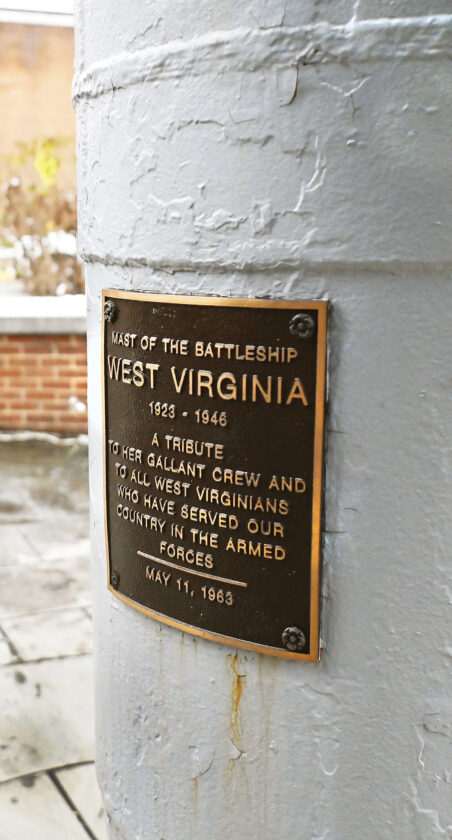
A plaque affixed to the mast of the USS West Virginia. (Photo by Ron Rittenhouse/The Dominion Post)
Now what?
It was the USS West Virginia, the big ship its sailors called the “Wee-Vee,” the one that had been rendered dead in the water at Pearl Harbor on Dec. 7 – and then patched up and put back into the fighting, in the Pacific.
The Wee-Vee was being decommissioned.
Bremerton, the big shipyard in Washington state where she was all but rebuilt after the attack, was also where she would end her tour of duty.
“I started thinking that we should try to get an artifact, something we could display here,” Bowman said. “It was the USS West Virginia, and this is West Virginia University.”
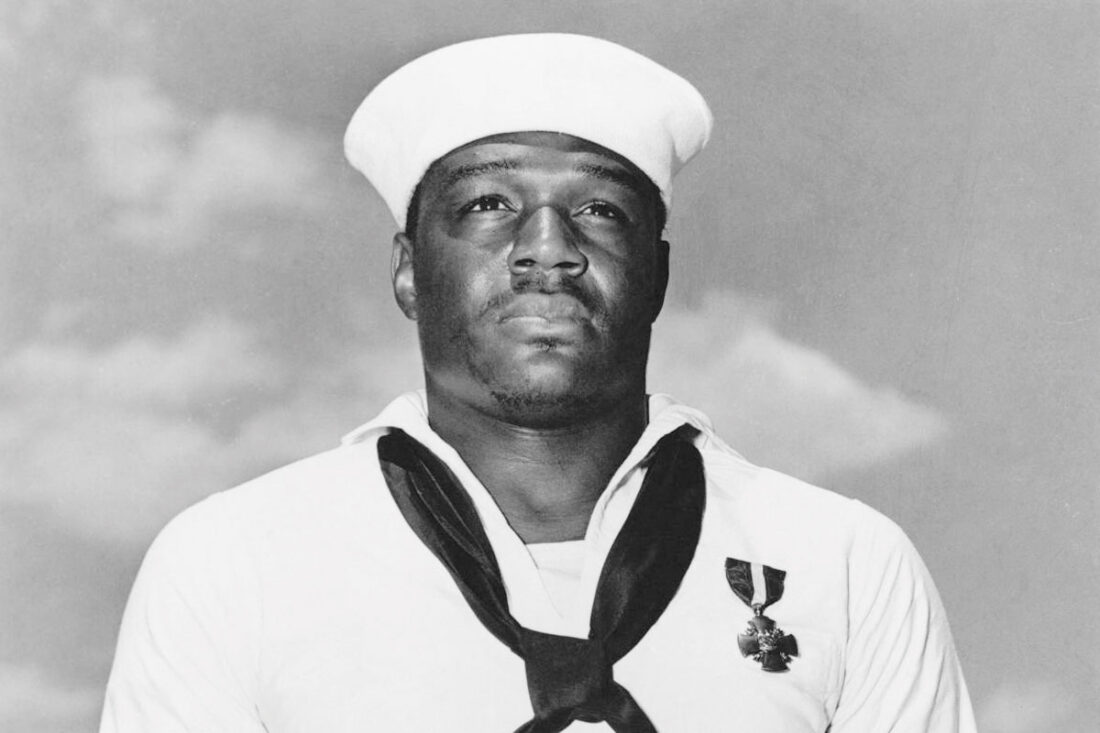
Dorie Miller (Photo Provided)
So he called the other Washington, in hopes of talking to Jennings Randolph and Harley Staggers, who served the Mountain State on Capitol Hill in the U.S. Senate and Congress.
He didn’t directly hear back from them, but when his phone rang again, it was the Navy – because the lawmakers had called the service branch on his behalf.
You can have the mast, if you want it, that voice on the other end said. But you have to get it to Morgantown.
For the record, it wasn’t the original mast from Pearl Harbor. It was its replacement, with the Wee-Vee being as damaged as she was.
But it was still the mast of the proud craft.
It was also a literal tall order, logistics-wise.
“You couldn’t just send two guys to Washington state in a pickup truck and say, ‘Bring it back,'” Bowman said.
Fellow soldiers
For guidance, the student body president enlisted Joe Gluck, the WVU dean of students who had ridden the Pacific’s rough seas as a Navy chaplain during the war. Together, they lobbied and networked.
Darrell McGraw, Bowman’s classmate who would go on to become West Virginia’s attorney general, jumped in, also. So did Fred “Freddie” Wyant, who starred as quarterback for the Mountaineers in the early 1950s and was a successful businessman in the University City. Jack Fleming, the WAJR radio star and play-by-play announcer for WVU sports, enthusiastically lent his voice to the cause.
Fleming, in fact, had been a navigator in the U.S. Army Air Corps in World War II and was wounded when his plane was shot down over France. A group of people in a remote village rescued him by cutting his parachute out of a tree.
Countless others, too, but the linchpin of it all was a new buddy Bowman found in Morgantown.
Pete Hartley was a local agent with the B&O Railroad who started making his own calls. It was Hartley who pulled the switches so the mast could make its transport by train from there to here.
It was Bowman who made the ’59 announcement with unabashed fanfare.
Then … nothing.
Birth of a nickname
It took time to line up the trains and the paperwork. The mast wasn’t going anywhere until the ship was sufficiently dismantled – and that kind of work, the student soon learned, wasn’t done in a day.
Those days unspooled into weeks and then months.
“What happened with the West Virginia?” an inquiring student body wanted to know.
Bowman was lampooned as Jack “The Mast” in The Daily Athenaeum, the school newspaper. He wasn’t immune to yearbook jibes, either. The 1960 Monticola piled on with a caricature on its inside cover of a somewhat unhinged-looking Bowman, climbing a cartoon mast.
Though he kept his sense of humor, he still wasn’t exactly fond of his new notoriety.
‘I never got shot at’
When the real mast finally arrived a year later, Bowman was scaling the rungs of his career.
He got his lieutenant’s bars through his ROTC commissioning and mustered into the U.S. Army after his graduation from the College of Law in 1963.
By then, John Kennedy and Lyndon Johnson were committing more “advisers” to a place called Vietnam, but Jack The Mast rode out his four years in the quite Americanized climes of then- West Germany, with the Judge Advocate General Corps.
Some of that work included drawing up wills for the married soldiers bound for the jungle. Other guys, readying for their turn in Southeast Asia, wanted to leave all their worldly possessions to girlfriends in San Francisco, Bowman recalled.
“If somebody says to me, ‘Thank you for your service,’ I’m embarrassed. I never got shot at.”
Bowman’s alma mater on Friday observed the 84th anniversary of Pearl Harbor, two days early so the school community could attend, at the base of that mast at Oglebay Plaza on the downtown campus.
For duty, honor and Dorie
Dec. 7 is a day for the brave, Bowman said.
And in Morgantown, it’s especially so, for the crew of the USS West Virginia.
That definitely includes Dorie Miller – the Wee-Vee’s improbable hero on that morning of infamy in Hawaii.
Miller was a genial, beefy kid from Texas who was sorting laundry below deck while also working in the mess hall on Dec. 7, 1941. Those were the only assignments deemed worthy for Black sailors at that time, the Navy said.
When the first wave of Japanese Zeros found their mark, Miller uncoiled. He ran up top and started manning guns he had never been checked out to use.
According to accounts, the ship’s mess attendant may have shot down, or at least damaged, a couple of planes at the height of the assault.
In the fog of war, he scooped up every wounded shipmate he saw, somehow managing to keep his feet – even as the battered boat began listing, perilously, in the water.
The only crew member Dorie couldn’t scurry to safety was Capt. Mervyn Binion, who was still rasping out orders – even as he was bleeding to death on the bridge. The mortally wounded skipper refused to abandon his post.
Miller would be awarded the Navy Cross for his heroism that day.
Given its Pearl Harbor history, there was talk that the West Virginia would be the vessel the Japanese delegation would board to sign the surrender papers. However, Harry Truman, who assumed the presidency after Franklin Roosevelt’s death in the waning days of the war, pushed instead for the USS Missouri, named for his home state.
Bowman thinks of all that whenever he regards the mast of the Wee-Vee.
Every time. Not just a certain day in December.
“That’s why I’m so proud it’s here,” he said. “Where it belongs.”
Local News
The Supreme Court will decide whether Trump’s birthright citizenship order violates the Constitution
Parkersburg Area Community Foundation accepting scholarship applications
Mission Accomplished: Getting the mast of the USS West Virginia to WVU’s Oglebay Plaza was a tall order
Judge: Grand jury transcripts from abandoned Epstein investigation in Florida can be released
Women’s Cancer Fund at the Marietta Community Foundation receives $20K donation from WVU Medicine