Mayer: West Virginia taking federal child welfare audit seriously
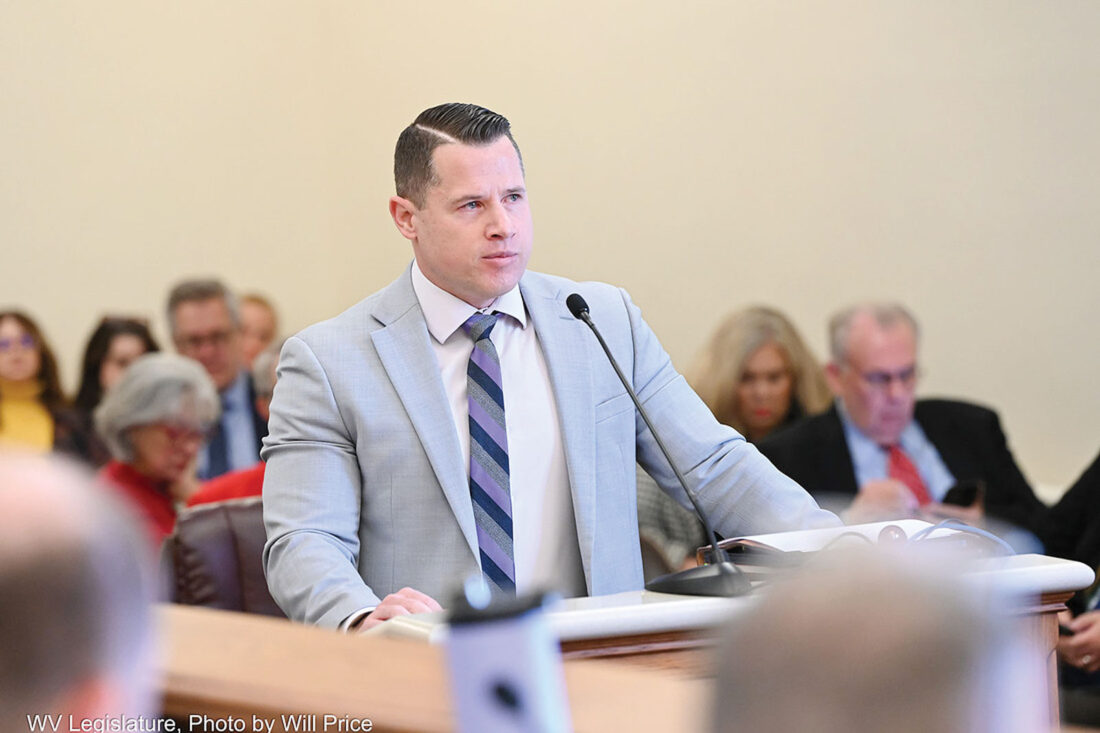
Department of Human Services Secretary Alex Mayer laid out reform efforts for Child Protective Services and child welfare to lawmakers Tuesday following a federal audit released in November. (Photo Courtesy/WV Legislative Photography)
CHARLESTON – The cabinet secretary for West Virginia’s Department of Human Services outlined eight pillars of reform responding to a recent federal audit of Child Protective Services, including plans to improve technology, practice, placements, and fiscal responsibility. Department of Human Services Secretary Alex Mayer testified Tuesday morning before the Legislative Oversight Commission on Health and Human Resources Accountability on the final day of December interim meetings at the State Capitol Building. The U.S. Department of Health and Human Services Office of Inspector General released a report in November focused on the state’s compliance with child abuse and neglect requirements under the Child Abuse Prevention and Treatment Act. “I want to begin with this: We take the OIG’s findings seriously,” Mayer said. “The report did not tell us anything we didn’t know already. These are children’s lives, families’ futures, and the credibility of state government. What the audit did do was validate the steps we were already taking, the issues we identified, and the approaches to address what was outlined in the report. Simply, this was a deep, sustained, system-level reform that was needed, and we’ve already begun that work.” The audit – focused on a period between Oct. 1, 2023, and Sept. 30, 2024, before Gov. Patrick Morrisey took office – found that the state’s Bureau for Social Services and Child Protective Services failed to comply with intake, screening, assessment and investigation procedures in an estimated 91% of 100 screened-in family reports. Specific deficiencies included failing to send notification letters, to complete initial assessments and interviews in a timely manner, and to ensure safety plans and risk assessments were performed correctly. Of the 100 audited cases: 74 reports did not include a required written notification letter; initial assessments were not completed within 30 days of receiving a referral in 61 reports; 41 reports included no required interviews with children or adults during the initial assessment; mandated reporters did not receive notification of whether a child abuse and neglect referral had been accepted for assessment or screened out in 41 reports; nine reports included no required safety plan; and eight reports did not include required impending safety threat risk assessments. “On the basis of our sample results, we estimated that 21,621 of the 23,759 (91%) screened-in family reports for our audit period were not in compliance with one or more requirements related to the intake, screening, assessment, and investigation of child abuse and neglect,” the report stated. Mayer, who succeeded previous DoHS secretary Cynthia Persily when Morrisey took office in January, outlined an eight-pillar reform agenda for CPS and the Bureau for Social Services. “Over the past year, we have been building that reform agenda and moving it forward,” Mayer said. “At the end of the day, the OIG audit was a serious document, and it described serious problems; serious problems that existed long before I came into the seat and the administration came into the role. But it’s not the final word on West Virginia’s child welfare system. It’s a snapshot of a system in transition; a system that had deep, longstanding issues, but is now in the midst of aggressive, coordinated reform.” Pillar one focuses on foster care and kinship care supports, by redesigning the electronic referral/placement process, investing in kinship caregivers, and providing them with specialized training to manage high-needs children and reduce reliance on residential care. Pillar two would reshape the approach to residential care by expanding in-state treatment options, reducing out-of-state placements of foster children, and developing alternatives to using hotels for youth in crisis. The department is actively canvassing state-owned properties to repurpose as facilities to lower the barrier to entry for out-of-state providers willing to open programs in West Virginia. “The OIG highlighted our dependence on out-of-state placements and the use of hotels for youth in crisis,” Mayer said. “Those practices are not acceptable as long-term models, and we are acting to change them.” Pillar three involves implementing a new statewide practice model to ensure CPS decisions are trauma-informed, structured, and consistent. The goal is to create a streamlined system that allows staff to spend more time with families. Pillar four would create and expand partnerships with churches and community organizations to recruit foster families and provide wraparound support for families in crisis. “This pillar matters because the OIG rightly pointed out that government cannot solve these problems alone,” Mayer said. “We must build a broader ecosystem of support around children and families and faith communities as well as community organizations that are crucial to that part of supporting West Virginia’s children.” Pillar five focuses on prevention and early intervention, working with schools, behavioral health providers, and community organizations to identify and support at-risk families sooner. Pillar six focuses on technology, improving the troubled and expensive PATH (West Virginia People’s Access To Help) system, making use of AI and predictive modeling to identify risk patterns, and enhancing public-facing data dashboards for greater transparency. Pillar seven involves strengthening collaboration with the judicial system and legal partners to improve consistency, accountability, and problem-solving approaches, with a specific focus on truancy diversion. Pillar eight focuses on fiscal responsibility, strengthening internal controls, enhancing monitoring of provider payments, and ensuring programmatic and fiscal teams are aligned. “Sound fiscal management is not separate from good practice. It is what ensures that the support – the supports children and families rely upon – are stable, predictable, and sustainable,” Mayer said. “Building a more accountable financial system, the department has been undergoing a comprehensive effort to strengthen financial oversight, ensuring taxpayer dollars are used effectively, transparently, and in alignment with both state and federal requirements.” Steven Allen Adams can be reached at sadams@newsandsentinel.comLocal News

Police chief calls for calm after a man is shot and killed during Minneapolis immigration crackdown

United Bankshares announces record earnings for 2025

Mid-Ohio Valley residents prepare for massive winter storm

Picture This: Spirituals at Zion Baptist Church

Thousands rally against immigration enforcement in subzero Minnesota temperatures