
Morrisey announces substance abuse grant during Parkersburg visit

From left, Gov. Patrick Morrisey is joined by Lance Yardley, acting commissioner of the West Virginia Department of Corrections and Rehabilitation, and Rob Cunningham, secretary of the West Virginia Department of Homeland Security, at the Parkersburg Correctional Center where the governor said the Corrections Department will receive $231,894 for the Residential Substance Abuse Treatment Program. (Photo by Jess Mancini)
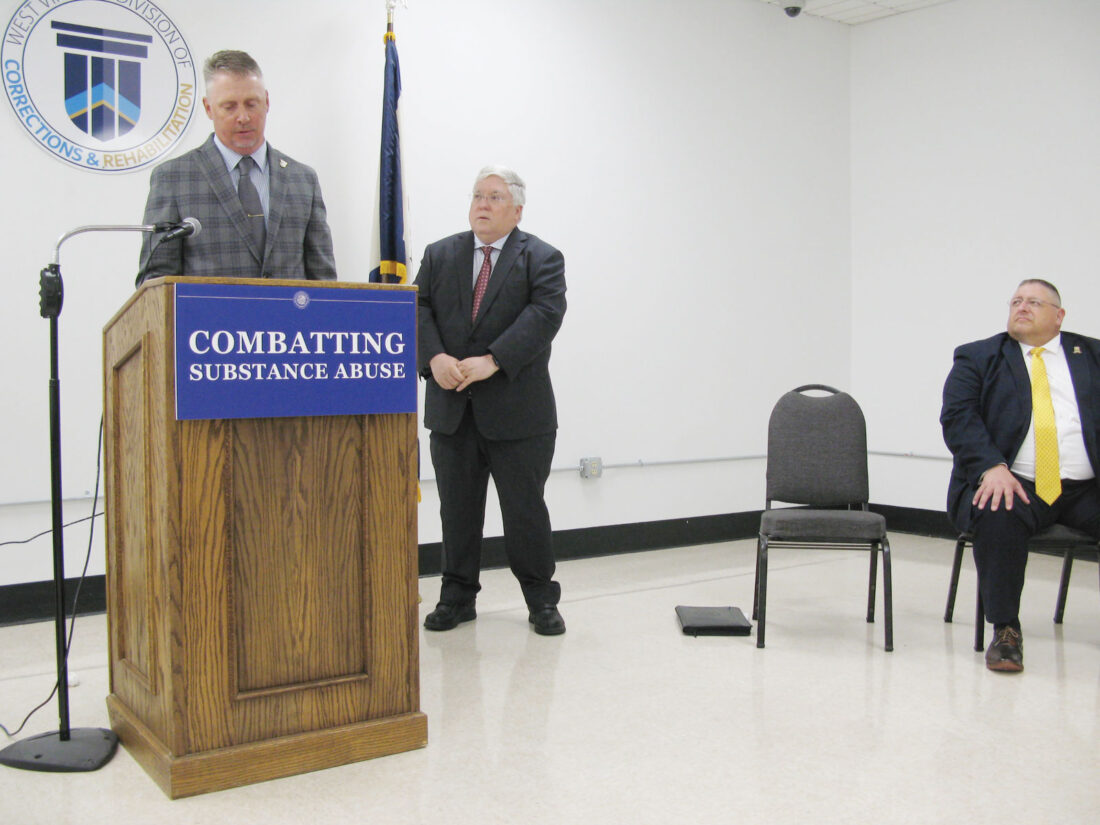
From left, Lance Yardley, acting commissioner of the West Virginia Department of Corrections and Rehabilitation, speaks while Gov. Patrick Morrisey and Homeland Security Secretary Rob Cunningham listen during an announcement Tuesday at the Parkersburg Correctional Center where the governor announced a grant of $231,894 for the Residential Substance Abuse Treatment Program in regional jails and correctional centers. (Photo by Jess Mancini)
From left, Gov. Patrick Morrisey is joined by Lance Yardley, acting commissioner of the West Virginia Department of Corrections and Rehabilitation, and Rob Cunningham, secretary of the West Virginia Department of Homeland Security, at the Parkersburg Correctional Center where the governor said the Corrections Department will receive $231,894 for the Residential Substance Abuse Treatment Program. (Photo by Jess Mancini)
From left, Lance Yardley, acting commissioner of the West Virginia Department of Corrections and Rehabilitation, speaks while Gov. Patrick Morrisey and Homeland Security Secretary Rob Cunningham listen during an announcement Tuesday at the Parkersburg Correctional Center where the governor announced a grant of $231,894 for the Residential Substance Abuse Treatment Program in regional jails and correctional centers. (Photo by Jess Mancini)
Trending
PARKERSBURG -- A statewide grant to the West Virginia Department of Corrections and Rehabilitation to continue a program to help inmates return to society unfettered by addiction was announced on Tuesday by the governor in Parkersburg.
The Residential Substance Abuse Treatment Program will receive $231,894, one of the ways to address the addiction problem in West Virginia, Gov. Patrick Morrisey said.
"We want to make sure we get able-bodied people working," Morrisey said at an announcement at the Parkersburg Correctional Center where he said 60% of its population has addiction issues.
The substance abuse problem requires what Morrisey called an holistic approach with prevention, intervention and enforcement. Morrisey last week signed Lauren's Law, named after a Morgantown woman who ingested a drug without knowing it was laced with fentanyl, that increased the penalties on those convicted of crimes involving fentanyl and other dangerous substances.
"We're not going to let these drug dealers come into our state and poison our citizens with impunity," he said.
The goal of the substance abuse treatment program is to prevent another generation from suffering with addiction problems, Morrisey said.
"Today's award will help our inmate population receive the services they need to end the cycle of drug abuse and crime."
The funds will be used to continue treatment services at correctional centers in Parkersburg, St. Marys, Beckley, Charleston, Denmar, Huttonsville, Lakin, Pruntytown and Salem and treatment units at regional jails, the governor said. The money is from the U.S. Department of Justice, Office of Justice Programs, Bureau of Justice Assistance. The Justice and Community Services Section of the West Virginia Division of Administrative Services administers the funds.
"We are extremely appreciative of this funding," Lance Yardley, acting commissioner of the Corrections Department, said. Yardley was appointed on April 21.
Morrisey also was accompanied by Secretary Rob Cunningham, of the West Virginia Department of Homeland Security. Rehabilitation programs such as substance abuse treatment are an important Corrections Department program, he said.
"This is a key part of this," Cunningham said.
Morrisey on Tuesday morning also was in Shinnston where he signed into law bills banning cell phones and personal electronic devices in primary and secondary schools and requiring schools and colleges to display the U.S. motto, "In God We Trust."