
W.Va. Supreme Court of Appeals holds session at Williamstown High School
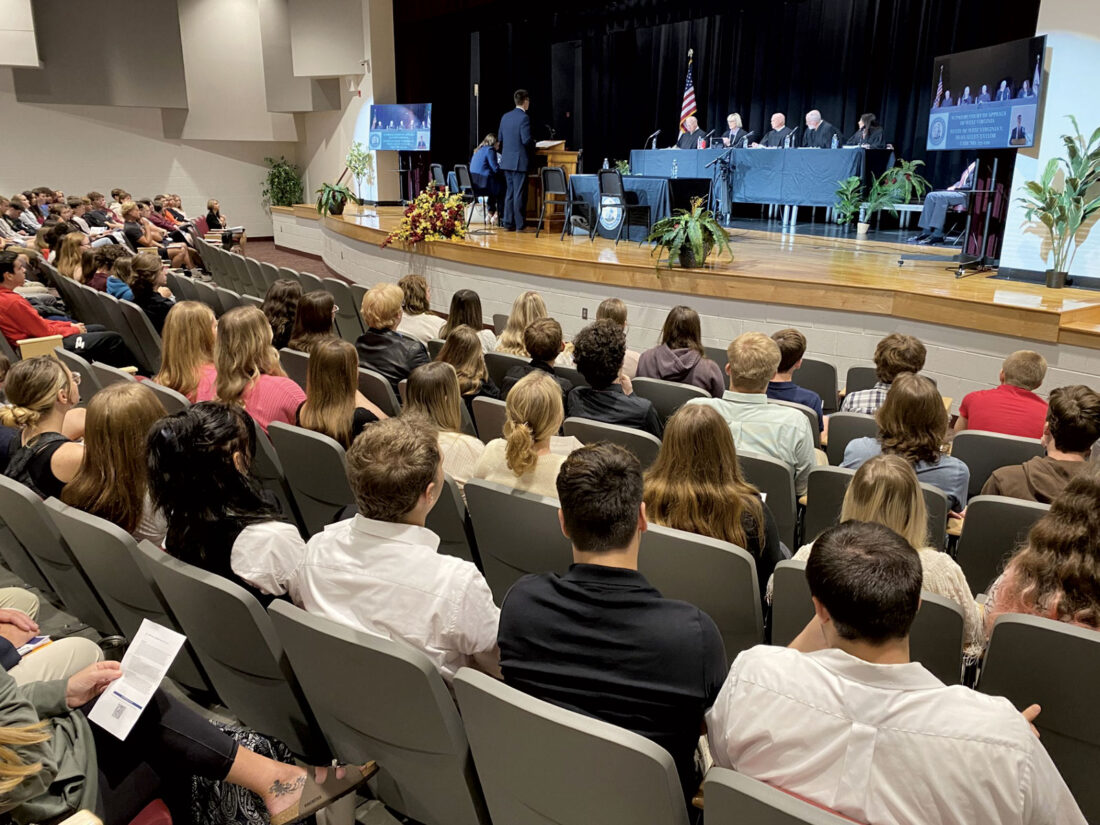
The Supreme Court of Appeals of West Virginia heard cases Tuesday at the Williamstown High School auditorium as students from area high schools watched as part of the court’s Legal Advancement for West Virginia Students (LAWS) civic education program. Students got to see how the court operates in hearing actual cases. They were able to ask questions of the attorneys and the justices in how they do their jobs. (Photo by Brett Dunlap)
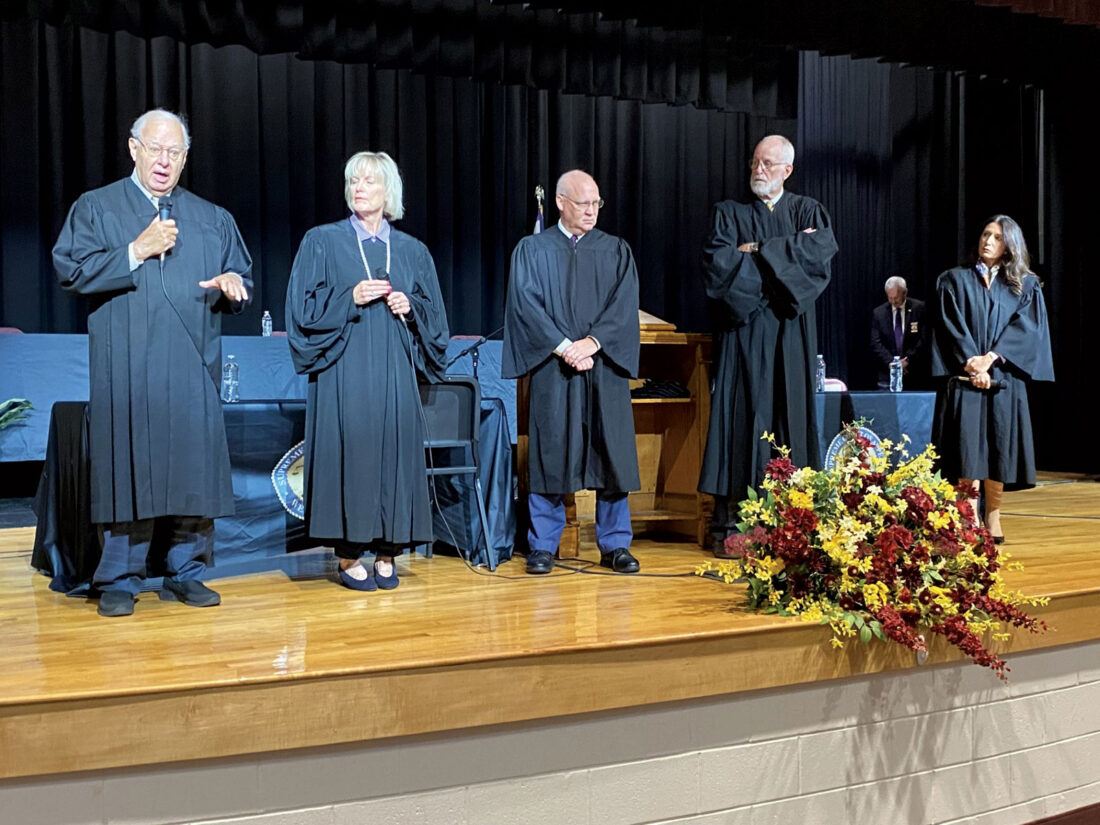
Justice William R. Wooton of the Supreme Court of Appeals of West Virginia answers a question Tuesday after the court heard actual cases at Williamstown High School as part of the court’s Legal Advancement for West Virginia Students (LAWS) civics education program where they hear cases in schools around the state and then engage with students who ask them about how the court operates and how members of the court decided to pursue a legal career. Also pictured are Justice Beth Walker, Chief Justice Tim Armstead, Justice John Hutchison and Justice C. Haley Bunn. (Photo by Brett Dunlap)
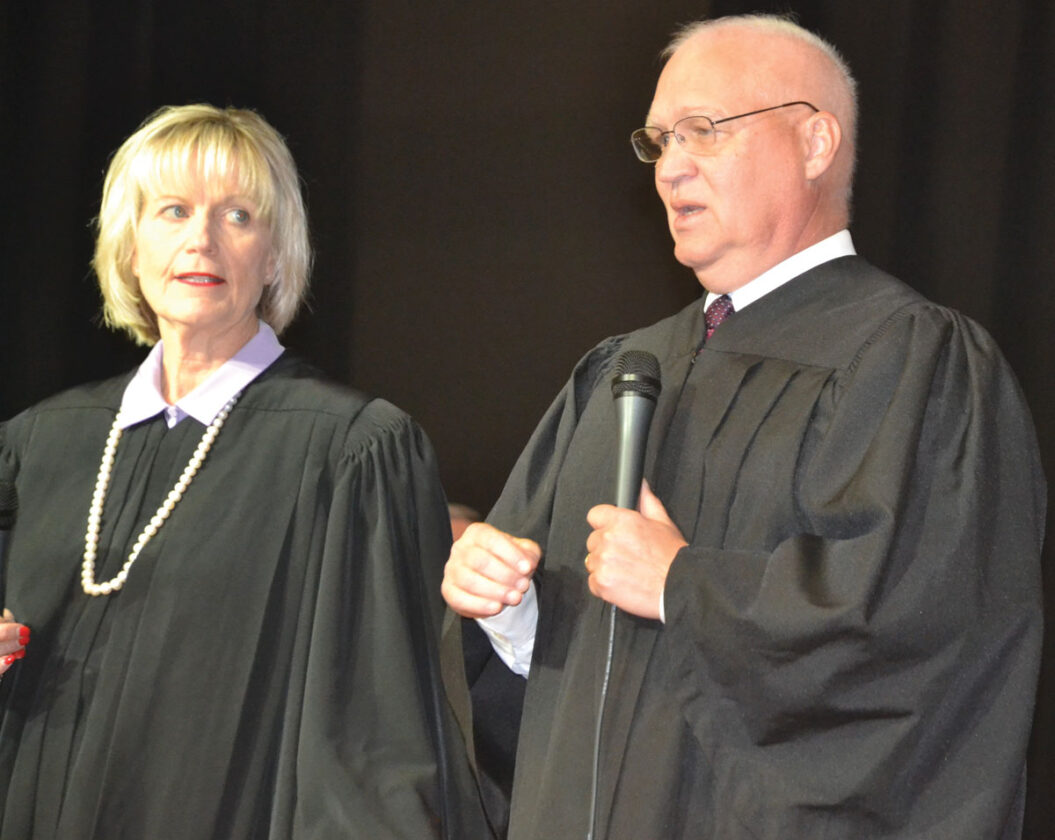
Justice Beth Walker listens to an answer Chief Justice Tim Armstead gives as the justices with the Supreme Court of Appeals of West Virginia talk with area high school students Tuesday at Williamstown High School. Students from Parkersburg High School, Parkersburg South High School and Williamstown in Wood County as well as Ripley High School and Ravenswood High School in Jackson County participated in the Legal Advancement for West Virginia Students (LAWS) civics education program. (Photo by Brett Dunlap)
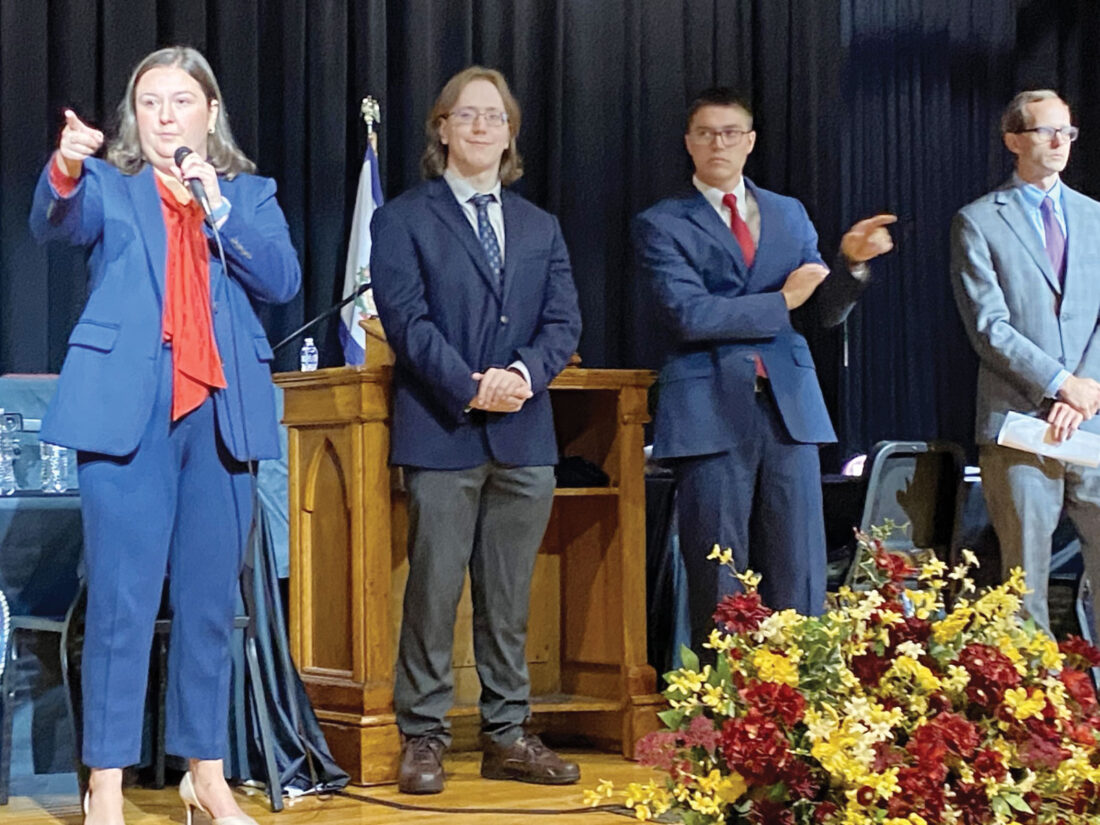
Attorney Olivia Lee takes a question Tuesday from area high school students who observed her presenting a case before the Supreme Court of Appeals of West Virginia at Williamstown High School as part of the Legal Advancement for West Virginia Students (LAWS) civics education program. Also on stage were Staff Attorney for the Clerk of Court for the Supreme Court of Appeals of West Virginia Thomas McQuain; attorney Frankie Dame who presented the state’s position in the case; and the Clerk of Court for the Supreme Court of Appeals of West Virginia Casey Forbes. (Photo by Brett Dunlap)
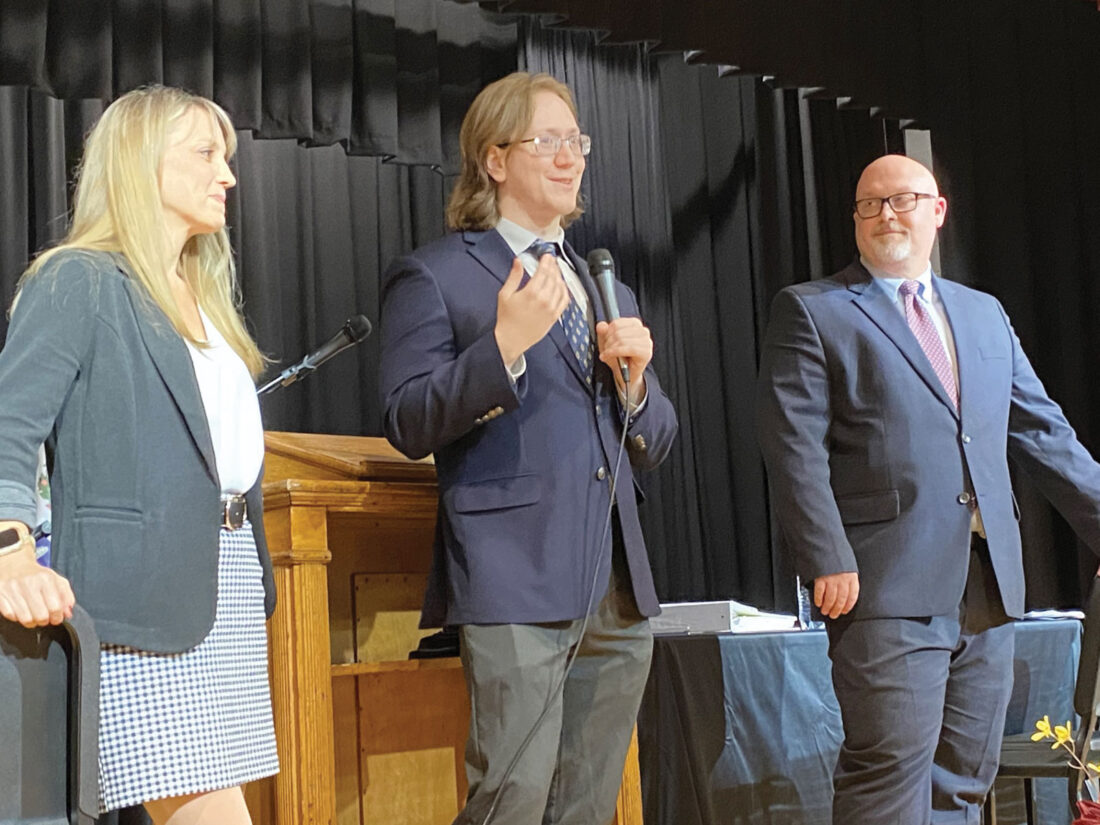
Williamstown High School Senior Jacob Gessel was one of many area high school students who got to observe the Supreme Court of Appeals of West Virginia hearing cases Tuesday at Williamstown High School as part of the Legal Advancement for West Virginia Students (LAWS) civics education program. Gessel and other students were able to ask questions of the justices and attorneys about how they do their jobs. (Photo by Brett Dunlap)
The Supreme Court of Appeals of West Virginia heard cases Tuesday at the Williamstown High School auditorium as students from area high schools watched as part of the court’s Legal Advancement for West Virginia Students (LAWS) civic education program. Students got to see how the court operates in hearing actual cases. They were able to ask questions of the attorneys and the justices in how they do their jobs. (Photo by Brett Dunlap)
Justice William R. Wooton of the Supreme Court of Appeals of West Virginia answers a question Tuesday after the court heard actual cases at Williamstown High School as part of the court’s Legal Advancement for West Virginia Students (LAWS) civics education program where they hear cases in schools around the state and then engage with students who ask them about how the court operates and how members of the court decided to pursue a legal career. Also pictured are Justice Beth Walker, Chief Justice Tim Armstead, Justice John Hutchison and Justice C. Haley Bunn. (Photo by Brett Dunlap)
Justice Beth Walker listens to an answer Chief Justice Tim Armstead gives as the justices with the Supreme Court of Appeals of West Virginia talk with area high school students Tuesday at Williamstown High School. Students from Parkersburg High School, Parkersburg South High School and Williamstown in Wood County as well as Ripley High School and Ravenswood High School in Jackson County participated in the Legal Advancement for West Virginia Students (LAWS) civics education program. (Photo by Brett Dunlap)
Attorney Olivia Lee takes a question Tuesday from area high school students who observed her presenting a case before the Supreme Court of Appeals of West Virginia at Williamstown High School as part of the Legal Advancement for West Virginia Students (LAWS) civics education program. Also on stage were Staff Attorney for the Clerk of Court for the Supreme Court of Appeals of West Virginia Thomas McQuain; attorney Frankie Dame who presented the state’s position in the case; and the Clerk of Court for the Supreme Court of Appeals of West Virginia Casey Forbes. (Photo by Brett Dunlap)
Williamstown High School Senior Jacob Gessel was one of many area high school students who got to observe the Supreme Court of Appeals of West Virginia hearing cases Tuesday at Williamstown High School as part of the Legal Advancement for West Virginia Students (LAWS) civics education program. Gessel and other students were able to ask questions of the justices and attorneys about how they do their jobs. (Photo by Brett Dunlap)
Trending
WILLIAMSTOWN -- Area high school students got a lesson in how courts work as the Supreme Court of Appeals of West Virginia heard cases Tuesday at the Williamstown High School auditorium as students from area high schools watched.
Students from Parkersburg High School, Parkersburg South High School and Williamstown in Wood County as well as Ripley High School and Ravenswood High School in Jackson County participated in the Legal Advancement for West Virginia Students (LAWS) civics education program.
The students got to see the court hear arguments in two actual cases with attorneys presenting each side's position. After the presentations, the lawyers took questions from the students about what attorneys do in presenting their cases. At the end of the second case, the justices came out and took questions from the audience about what they do, how they became judges, what they consider in hearing cases and more.
Chief Justice Tim Armstead said this program is about showing students how the courts work, especially the Supreme Court of Appeals of West Virginia.
"We really love this program," Armstead said. "Our court is very dedicated to making our courts more open and making sure the students in our state understand how our court system works."
Tuesday's program featured actual cases the court was hearing and considering with the lawyers on both sides participating in addressing the students' questions.
"These cases would be done the exact way if we were hearing them down at the Capitol," Armstead said. "It allows the students to hear them first-hand and know how a case that goes through our court works.
"It is important for the students to understand that the court system works for the people of our state and that the people look to our courts to have justice and to be fair to them."
The experience shows the students aspects that they can't get from reading about it in a book.
"We hope there will be some students who might be inspired to go into public service, maybe having a legal career or maybe eventually becoming a judge," Armstead said. "We love to hear what questions the students have, even though we can't discuss the individual cases.
"We can discuss how the court system works and how we chose to be a part of this court system. We really enjoy being able to sit down and talk with the students and see what questions they have, what their thoughts were, being here today.
"We hope that when they leave, they will understand our court system a little better and that it is there to provide justice for the people of our state."
Armstead said to many people the court system can seem intimidating which he reiterated they don't want it to be that way.
"It is something that is there to serve them and to make sure when they have a dispute that they are treated fairly and it is resolved fairly,"Armstead said.
Before Tuesday, local attorneys went into the schools to talk with students about the court and its proceedings.
They go to a school during each term of court in the spring and in the fall. The first one this year was at Herbert Hoover High School in Kanawha County.
One case dealt with a criminal appeal dealing with an officer who made a traffic stop based on an expired motor vehicle inspection sticker at a time when the governor had suspended the deadlines for annual vehicle inspections during the COVID-19 pandemic. The petitioner is arguing the traffic stop was illegal and any evidence collected during the stop should be suppressed. The respondent for the state argued the officer had previous dealings with the suspect and believed the suspect was driving on a suspended license.
The other case dealt with a workers' compensation appeal where a lower court ruled someone was entitled to permanent disability benefits. Both sides argued the extent of the original injuries, including different medical reports generated, when the injuries occurred and how treatment progressed.
A third case was on the schedule to be presented, but court officials said a settlement had been reached and the arguments in the case did not need to be presented.
Jacob Gessel, a senior at Williamstown High School, asked questions following both cases and of the justices themselves dealing with procedures, how the facts of the cases were presented and how the justices keep their own biases out of the cases being decided.
"I thought it was interesting," he said. "The questions I asked were about things I was wondering about how they do things and how they make decisions.
"It is a curiosity thing about why certain things were brought up and why certain things were said. I was wondering what it was that made them decide to do what they did."
Ravenswood High School teacher Chase Jarrell called the presentation "an incredible opportunity" for students as many people do not have the opportunity to see the court hearing cases. He teaches U.S. History from 1900 to the present day to many juniors.
"I think this is good for them to see, because it falls within the standards we do teach to explain to them, the civic process," he said.
Every year, students are put through a mock trial proceeding so seeing an actual court proceeding and all that is involved.
"They can see when it goes to the next level and how serious it can get," Jarrell said. "It is a great experience. I think it is good for them to see the process and see it is not a mundane process."
As the students read about the more high profile cases, they can have an understanding of how the courts work and how that can impact them as citizens.
"People are fighting for themselves or for their businesses and the students get to see how the process is run," Jarrell said. "When they see this, they can have a better understanding of how the courts operate and influences how they operate as citizens.''