
ONDCP Director Gupta wraps up third annual visit to West Virginia
Trending
CHARLESTON -- Dr. Rahul Gupta, a former West Virginia heath official and current federal drug czar, wrapped up a three-day visit to the state to talk with those on the front lines of the substance use disorder crisis.
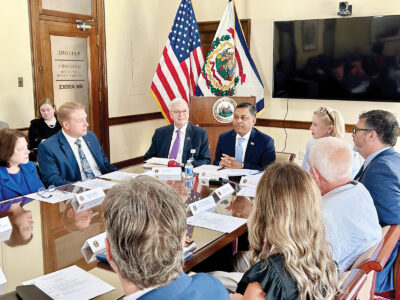
For the third year in a row, Gupta -- the director of the federal Office of National Drug Control Policy (ONDCP) -- held a roundtable discussion with state and local officials Friday afternoon at the State Capitol Building in the Governor's Cabinet and Conference Room.
He then traveled to West Virginia State University in Institute to meet with students, faculty, and peer recovery group coaches.
Earlier this week, Gupta held roundtables with local drug-free coalitions and community college students in Martinsburg. He then traveled to Charleston for a demonstration of the Bureau of Alcohol, Tobacco, and Firearms' National Integrated Ballistic Information Network (NIBIN) mobile unit. He also toured West Virginia Health Right and WVU Medicine Thomas Memorial Hospital's new intensive care unit.
Speaking after Friday's roundtable discussion, Gupta said the conversations with local and state elected officials, non-profit leaders, community organizers, law enforcement, and others were key in helping develop public policy on the drug crisis at the national level.
"As I travel across the country listening to people, it is super-important to understanding how things are going on the ground," Gupta said. "I am a practicing physician and I've done that all of my life. That's why it was so important for me to hear from a county commissioner from Mercer County, to someone from Putnam County, from someone in Martinsburg the day before yesterday, to the Mayor of the City of Charleston, to members of the House and state Senate. These are important conversations."
Friday's roundtable discussion focused on providing support for those in recovery re-entering society and continuing their work on sobriety, overdose prevention and harm reduction, and ensuring those in active recovery are able to work.
Those around the conference room table agreed that while there was plenty of state and federal funding for substance use disorder treatment and recovery, more attention and funding was needed on the re-entry aspect.
"There's been this huge focus on recovery for years, but they kind of left a cliff for people to fall off of when it comes to re-entry," said Beverly Sharp, the founder and executive director of the Reach Initiative, which works on southern West Virginia.
West Virginia has a pending 1115 waiver for its continuum of care program for state Medicaid enrollees with substance use disorder. Gupta said with the waiver, the Centers for Medicare and Medicaid Services is ready to roll out a program that would turn on Medicaid services for those in the correctional system 90 days out from release. This would allow someone in prison in recovery to be able to transfer their care once they are released, while also using the 90 days to work on job training or educational opportunities to ease the transition back into society.
"Medicaid would be paying the bills, which will be a tremendous cost savings for local jails," Gupta said. "We estimate we can save tens of thousands of lives and get them back into the world."
Emily Birkhead with the West Virginia Alliance of Recovery Residences said sober living homes need to be considered part of the continuum of care and not stigmatized. She said the longer a sober living home can keep someone engaged in their treatment, the better those individuals do with their sobriety. Stephanee Thornton, a member of the Governor's Council on Substance Abuse Prevention and Treatment, said the state needs to do better at long-term treatment beyond initial recovery.
"We're not quite there across the state as we should be," Thornton said. "Transportation is a barrier. Making sure that someone is following through on the individual is also a barrier, because relationships get people into treatment. A referral alone does not make someone choose treatment."
Gupta was confirmed by the U.S. Senate as ONDCP director, sometimes called drug czar, in October 2021. He was nominated by President Joe Biden for the position in July 2021. He previously served as senior vice president and chief medical and health officer for the March of Dimes.
Gupta was first appointed as state health officer and commissioner of the Bureau of Public Health within the Department of Health and Human Resources by former Gov. Earl Ray Tomblin in 2015. He left DHHR in 2018, finishing out his service under Gov. Jim Justice. Gupta led the Kanawha-Charleston Health Department starting in 2009.
According to the ODCP Data Dashboard, the number of emergency room visits related to drug overdoses peaked over a three-year period at 726 visits in May 2023, dropping to a low of 471 visits in January. Numbers began to trend back upward to 554 visits as of June, but that is still below 620 visits in June 2023 and 592 visits in June 2023.Emergency Medical Services (EMS) responses for suspected overdoses for 2023 are better than 2021, though available numbers for 2023 are higher than 2022. EMS responses peaked at 961 responses in March 2021. Numbers for August 2023, the most recent available data, were 837 visits, up from 833 visits in August 2022 but below 860 visits in August 2021.
Fentanyl has been the drug of choice for West Virginians who have died from drug overdoses, with 1,134 of the 1,507 drug overdose deaths in 2021 tied to the powerful synthetic opioid often mixed in with other drugs. That's down from 992 overdose deaths tied to fentanyl in 2020 out of a total of 1,336 overdose deaths that year. Only 515 overdose deaths were tied to fentanyl out of a total of 883 drug overdose deaths in 2019.
According to the U.S. Centers for Disease Control and Prevention, West Virginia had the highest drug overdose mortality rate in the nation based on 2022 numbers. However, according to the CDC's National Center for Health Statistics, West Virginia saw a .14% decrease in the predicted 12-month count of drug overdose deaths between February 2023 and February 2024, showing slight improvement. Nationally, the overdose death rate dropped 5% in 2023.
"When I came into the office in 2021, we were looking at a 30% rise in overdose deaths per year," Gupta said. "We flattened it out in 2022, and we had a 5% decline in 2023. That's not enough, having said that. We've got to do more. That is why we are doubling and tripling down on our ability to save lives."
Gupta said his office is focused on overdose prevention, including encouraging public access to Naloxone to administer to people having drug overdoses, bringing the price down for Naloxone, and providing Naloxone doses to businesses and public places. ONDCP also launched an ad campaign called The Real Deal on Fentanyl, warning young people to avoid counterfeit medication and to carry Naloxone.
"The goal here is to have Naloxone and make it available, train people on Naloxone, and make sure when somebody is overdosing from drugs, we have it available so we can save life," Gupta said. "Saving life is the first step to getting people the help they need. That's one of the reasons why we are able to see a 5% decline in overdose deaths in 2023."
One area of harm reduction that West Virginia limited was syringe exchange programs, having done so by legislation in 2021. Senate Bill 334 requires syringe exchange harm reduction programs to receive multiple permissions from city and county governments, limits exchanges to 1:1 model, limits use of the program to adults with identification, and requires referrals to different kinds of health services. Since the passage of the bill, many syringe exchanges in the state have shut down.
Gupta said that ONDCP is working on draft legislation states can implement to create syringe exchange programs that meet peer-reviewed recommendations for such programs, which are aimed at limiting the spread of blood-borne diseases, such as HIV. But it can only provide recommendations to states and cannot force states that are hesitant about such syringe exchange programs.
"The way I've learned you get success in any community with a program is to be able to build trust with the community that you're working with," Gupta said. "The way you do that is to make sure that trust is being built, the needs are being addressed, and it goes from there...It's important to institute evidence-based data-drive policies. At the end of the day, they save lives.
Steven Allen Adams can be reached at sadams@newsandsentinel.com