
Health care freedom advocates urge Justice to sign bill weakening childhood immunizations
Trending
CHARLESTON - As Gov. Jim Justice weighs whether to sign or veto a bill that could weaken West Virginia's mandatory vaccine schedule for public and private school children, a group of healthcare freedom advocates including a doctor and a former lawmaker said signing the bill would be the politically correct move.
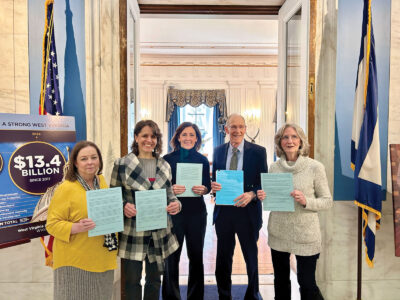
Representatives of West Virginians for Health Freedom and West Virginians for Religious Freedom presented a petition to the Governor's Office Tuesday afternoon seeking Justice's support for signing House Bill 5105, eliminating the vaccine requirements for public virtual schools, private schools, and parochial schools.
The bill would eliminate vaccine requirements for school students for those participating in one of the two statewide virtual public schools or future county-level virtual public charter schools except when those students are participating in activities supervised by the West Virginia Secondary Schools Activities Commission.
HB 5105 would continue to require immunizations for virtual school students if they also are participating in in-person school programs. It also expands vaccine exemptions to students attending private or parochial schools in the state, while allowing those schools to set their own vaccination requirements.
State Code requires children attending school in West Virginia to show proof of immunization for diphtheria, pertussis, tetanus, polio, measles, mumps, rubella, varicella and hepatitis B unless proof of a medical exemption can be shown.
West Virginia only provides for a medical exemption to immunizations. The bill that passed the House on Feb. 26 in a 57-41 vote included a broad religious exemption, allowing a parent or guardian to write a note expressing their religious exemption to school authorities.
That was amended out of the bill in the Senate.
Despite the vocal concerns of Senate Health and Human Resources Committee Chairman Mike Maroney, R-Marshall, a radiologist, the amended bill passed the Senate on March 9, the last day of the 60-day legislative session, in a 20-12 vote. The House concurred with the Senate's changes to the bill and passed it that same night in a 70-29 vote.
Alvin Moss, a professor at West Virginia University who specializes in kidney diseases, supports HB 5105 and loosening child immunization standards in the state. He said the petition being presented had approximately 1,052 signatures, with more signatures being added to their online petition. Moss said supporters of HB 5105 hope to show the Governor that there is broad support among the public for the bill.
"We're planning to tell the Governor or his chief of staff or assistant to the chief of staff or whoever will take the petitions and talk to us is the fact we were able to get this many signatures this quickly from almost all the counties in the state shows this is an issue that resonates," said Moss, who was not speaking or acting on behalf of WVU. "Not only do we have a majority of the House and a majority of the Senate, but West Virginians believe in freedom."
Chanda Adkins, who holds a doctorate in pharmacy and was appointed to the House of Delegates by Justice in 2018 representing Raleigh County, believes that concerns about vaccines has grown among West Virginians following the COVID-19 pandemic. If Justice vetoes HB 5105, she believes that it could become an election issue as he seeks the Republican nomination for U.S. Senate in May.
"Based across the State of West Virginia, we have a lot of support," said Adkins, one of the leaders of West Virginians for Health Freedom. "This bill is just good policy. In medicine, we know not everybody is the same ... it's not good policy to treat everybody the same as a whole."
The COVID-19 pandemic and push for coronavirus vaccinations has led to a backlash against childhood immunizations. According to the U.S. Centers for Disease Control and Prevention, the rate of childhood vaccinations has dropped by 1% since 2020, with a drop in vaccinations among kindergarteners from 95% for the 2019-2020 school year to 94% during the 2020-2021 school year.
Both Moss and Adkins cite information showing increases in vaccine injuries and adverse reactions, stating that more than $5 billion has been paid out to 9,800 patients through the federal Vaccine Injury Compensation Program.
"The reason why it has become such a strong issue is because so many people have vaccine-injured children or they themselves are vaccine-injured," Moss said. "We have no quibble against people who want to get the vaccines. That's great, and that's their choice. We just want to be allowed the choice also to say no. We've had previous vaccine injury in our family and we think that is too big a risk."
A 2019 review of the Vaccine Injury Compensation Program by the U.S. Department of Health and Human Services found that the program compensated more than 6,600 claims between 1990 and 2018, but in about 70% of awards, there was no evidence that the vaccines themselves were the causes of the injuries. According to HHS, for every 1 million doses of vaccines administered, about one individual was compensated for an alleged injury.
Many other healthcare professionals disagree with Moss and Adkins. Last week, the American Academy of Pediatrics and the West Virginia chapter of the AAP delivered a letter to the governor's office urging a veto of HB 5105. Dr. Steven Eshenaur, health officer for the Kanawha-Charleston Health Department, released a fiery statement last week, pleading for Justice to not turn back the clock on immunizations.
According to the West Virginia Immunization Network through the Center for Rural Health Development, West Virginia has one of the highest immunization rates in the nation for kindergarteners, ranging from between 92% and 98% depending on the vaccine. They credit the state's high MMR vaccine rate to the state not seeing a measles outbreak since 1994. The last case of measles in West Virginia was 2009.
"Nonmedical exemptions, under any name: personal belief, conscientious objection, religious, philosophical, etc., are vaccine refusal," according to a statement on the West Virginia Immunization Network's website.
"They make requirements optional, result in a decrease in vaccination rates, particularly when the nonmedical exemptions are easier to obtain than a vaccination and drive up health care and public health costs to contain an outbreak," the statement continued. "To allow nonmedical exemptions to vaccination requirements would expose our students, workers and residents to dangerous, yet preventable, diseases."
Adkins said it is a mistake for supporters of mandatory childhood immunizations to label her and supporters of HB 5105 as anti-vaccine.
"These bills are not anti-vaccine. These bills are very pro-freedom, actually. We're not weakening any mandates or law. We're just giving people a choice on what they would like to do," Adkins said. "I think a lot of times too because of the media and the attention, everybody wants to call you anti-this or we're weakening this or we are pro-disease, and that is not the truth."