
Senate passes ‘Baby Olivia Act’ bill requiring anti-abortion group’s video in schools
Trending
CHARLESTON -- Questions arose over the appropriateness of requiring public school students to watch a video from an anti-abortion political advocacy organization, but the majority of the West Virginia Senate supported such a bill Tuesday.
The state Senate passed Senate Bill 468, requiring a course in public schools on human development, in a 27-6 vote over the concerns of the leaders of the Senate Judiciary Committee, a doctor who serves as leader of the Senate's Republican caucus, and the three members of the Senate Democratic caucus.
SB 468 would create the Baby Olivia Act, requiring the teaching in the eighth grade and 10th grade in public and charter schools of courses in pregnancy and human development in the womb.
Students would be required to view an ultrasound video showing early fetal development, as well as a video, titled "Meet Baby Olivia," created by Live Action, an anti-abortion political advocacy group known for its undercover videos within Planned Parenthood facilities. The Baby Olivia video shows a depiction of development of a fetus inside the room, from fertilization to birth.
Issues with the bill have revolved around whether it is appropriate to require schools to show a video that is from a political advocacy group, one that is not specifically educational or scientifically accurate, and whether the bill might cross the line into religious beliefs about whether life begins at conception.
The bill, which was recommended for passage by the Senate Education Committee at the end of January, was moved to the Senate Rules Committee, where it was amended to allow for the state Department of Education and county school systems to show any scientifically accurate video showing fetal development. But in an 18-15 vote Monday, Senate Education Committee Chairwoman Amy Grady, R-Mason, offered an amendment to return the bill to how it was when it left her committee.
"This video is really, really interesting in the fact that it gives us a computer-generated image of what is happening in the womb," Grady said Tuesday. "Right now, what they are seeing and reading is mostly from a textbook. Those help some students but not all of them."
Senate Majority Leader Tom Takubo, R-Kanawha, is a pulmonologist in Charleston and a doctor of osteopathic medicine. He raised concerns about whether the video was completely scientifically accurate.
"The problem I have with it is there are inaccuracies in the video," Takubo said. "There were some questions about whether you do the developmental stages based on last menstrual period versus when conception actually occurs. While some of that is true, there are other discrepancies in the video that are inaccurate."
Both Senate Judiciary Committee Chairman Charles Trump, R-Morgan, and Vice Chairman Ryan Weld, R-Brooke, voted against the bill. During discussion of amendments Monday, Trump said he was concerned about the constitutionality of requiring viewing of the video by an advocacy organization. Trump raised concerns about whether the video states a religious belief about when life begins.
"I have a concern that it is across the line of the Establishment Clause of the 1st Amendment of the United States Constitution," Trump said. "If we put language in a bill that forces schools throughout the state to show to children a video which asserts that life begins at conception, even though I agree with that, I think it is the imposition of what is fundamentally a religious or spiritual belief."
Supporters of the Baby Olivia Act disagreed, including the lead sponsor of the bill, state Sen. Patricia Rucker, R-Jefferson.
"This was definitely based on research by scientists who are not on any side of the issue," Rucker said. "This video is not political and not religious. It is a springboard for conversation. It goes through basic stages of human development from an approachable way that is easy for a child to understand and comprehend."
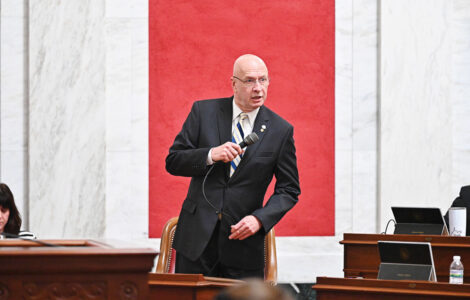
Senate President Craig Blair, R-Berkeley, left the podium and took to his desk to explain why he voted no on Grady's amendment but would vote yes on the bill.
"The world changes around us and I'm certain the world is going to change into the future," Blair said. "The way the bill was constructed -- until the amendment -- allowed that flexibility. I'm going to go up and vote proudly on this ... but we try to pass legislation that has longevity that lasts into the future and until the world changes around and we have to be able to adapt."