
W.Va. House makes additional changes to election law
Trending
CHARLESTON -- The West Virginia House of Delegates approved upping penalties for coerced voter registration and double voting, and also voted to eliminate a pathway to appointing candidates to ballot by party officials.
The House passed House Bill 4017 Tuesday, modifying certain election laws, early voting laws, and absentee voting laws. The bill passed in a 90-7 vote and now heads to the state Senate.
HB 4017 makes it a misdemeanor to coerce or offer payment to individuals to register to vote. Conviction on this new misdemeanor includes up to a $1,000 find and/or up to a year in jail. The bill includes penalties for voting either early or on Election Day after having already submitted an absentee ballot, making it a felony with up to a $10,000 fine and between one and 10 years in prison.
The bill also allows the Secretary of State's Office and county clerks to accept new voter registrations or updated voter registrations either by the close of business on the final day to register or by midnight that same day if the resident uses the online registration form available at GoVoteWV.com. The bill makes further technical corrections to early voting statutes.
Seven out of 11 Democratic lawmakers voted against the bill. Opponents of the bill believe that the proposed law could have unintended consequences for voter registration drives where sometimes bottle water or food is handed out or other trinkets, such as pens and other small items. Concerns were also raised about the bill affecting high school voter registration drives by the Secretary of State's Office, which awards schools for registering a certain percentage of eligible students.
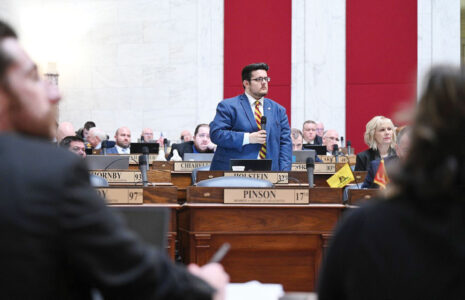
"I would urge the body to slow down and be careful of what we're doing here," said House Minority Leader Sean Hornbuckle, D-Cabell. "It's not just about giving someone money and having them register a whole bunch of folks."
House Judiciary Committee Chairman Tom Fast, R-Fayette, said the bill itself does not define what coercion is or what payment would constitute.
"It just means what it says: payment," Fast said.
The House also passed 4350, relating to appointment of candidates after the candidate filing period. The bill passed 79-18 and is on its way to the Senate. Seven Republicans crossed the aisle to vote against the bill along with all 11 House Democratic members.
The bill would prohibit state political party executive committees from being able to fill party candidate vacancies on a primary or general election ballot unless no person in any party has filed for the elected seat.
"I think all candidates -- it doesn't matter if it is an incumbent and it doesn't matter if it is someone challenging an incumbent -- deserves to know who their opponents will be, number one," said Del. Josh Holstein, R-Boone, the lead sponsor of the bill. "Number two, if they will have an opponent; and number three, when the candidate filing period closes, the candidates that have filed have followed the process that is set out for us, which is a pretty lengthy period."
State Code allows party executive committees -- or party chairs if either empowered or the committee fails to act -- to fill ballot vacancies after the candidate filing period closes. West Virginia's candidate filing period for the 2024 primary began Jan. 8 and ended at midnight Saturday.
By law, state parties have until Friday, Feb. 9, to appoint a candidate; or state party chairs have until Tuesday, Feb. 13. The only two statewide races that have no party candidates are state treasurer and agriculture commissioner, where no Democratic candidates filed. HB 4350 would have applied retroactively for the current candidate filing period, but that code section was removed in a committee substitute by the House Judiciary Committee last week.
"What it does is allow voters to have more choices," said Del. Mike Pushkin, D-Kanawha, who is also the chairman of the West Virginia Democratic Party. "I doubt anybody in here has heard from any of their constituents that voters have too many choices; there's too many candidates on the ballot."
Tuesday's two election bills add to the already two election bills passed by the House this session. House Bill 4205 would give the West Virginia legislature legal standing to bring actions against a governor, secretary of state, or other state officials who attempt to make unauthorized changes to state election laws and rules. House Bill 4428, would require candidates to live in the state or local election district for the office they are seeking.