
West Virginia tax revenues expected to be down compared to previous years
Trending
By STEVEN ALLEN ADAMS
Staff Reporter
CHARLESTON -- While West Virginia tax and revenue officials believe the state will still end the new fiscal year with a surplus, don't expect excess tax collections to grow to levels seen during the previous two fiscal years.
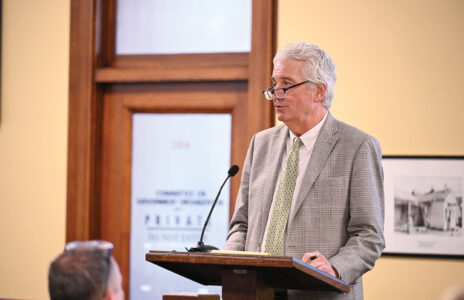
Officials with the state Department of Revenue briefed members of the Joint Standing Committee on Finance Monday morning on the second day of September legislative interim meetings at the Capitol.
"I've said that my favorite saying since I had this job was the state's finances are like turning an aircraft carrier," said Department of Revenue Cabinet Secretary Dave Hardy. "They don't turn fast; they turn very slowly. So, we are now entering a different time frame."
Fiscal 2024 in West Virginia started July 1. Year-to-date tax collections for July and August of $745.8 million were 4.7% more than the $715.2 million revenue estimate, giving the state a $30.5 million surplus. But tax revenues for the first two months of the new fiscal year are 16% below the first two months of the previous fiscal year.
Fiscal year-to-date personal income tax collections are only barely under the $287.4 million general revenue estimate for July and August, coming in at $286.6 million. The West Virginia Legislature passed House Bill 2526. The bill included a 21.25% across-the-board cut in personal income tax rates retroactive to the beginning of January.
"No question the tax cut is affecting our revenue. And before we entered this 36-month period of record revenue growth, July and August were always our slowest months," Hardy said. "What we see in July and August of 2023 is very consistent with what we saw in July and August of 2019. The numbers are larger, but the revenue streams tend to slow down in July in particular."
Revenue officials project the tax cuts and rebates in HB 2526 could return as much as $793 million by fiscal year 2025 and as much as $829 million by fiscal year 2026.
The bill also included rebates on vehicle tangible personal property taxes, machinery/equipment and inventory tangible personal property taxes for certain small businesses, and tax breaks for disabled veterans. The bill also included a formula for further cutting personal income tax rates between 1% and 10% beginning Jan. 1, 2025.
Hardy said personal income tax collections would need to decrease by more than 25% below the prior fiscal year's collections before the reduction in collections would hurt the base budget, which is $4.875 billion for the current fiscal year. While likely not breaking records again, Hardy believes the state will still pull in a large surplus.
"We're still on target to have a very, very good surplus for fiscal year '24," Hardy said. "Now, I say that two months in and we all know that things can happen. A lot of things happen and can happen in the next 10 months. But again, it always comes back to the base budget … we are on target as of this morning. We were $42 million above base budget as of last Friday for this fiscal year."
Both Gov. Jim Justice and previous governor Earl Ray Tomblin had to grapple with tax collections below the revenue estimates, causing mid-year budget cuts, employee hiring freezes, and fights with the Legislature over whether to cut further or raise taxes. During Justice's first year in office in 2017, the hole in the fiscal year 2018 general revenue budget was projected at nearly $500 million.
Also affecting tax revenues is severance tax collections for coal, oil and natural gas, which are down compared to the previous fiscal year. Year-to-date severance tax collections of $45 million were 28% below the $62.4 million estimate and 76% below collection this same time last year. Hardy said while production remains good, prices for coal and natural gas remain high.
"That's a number compared to a record because we had an all-time record of severance tax a year ago," Hardy said. "You might ask the question, what's going on with severance tax? It's not production. Coal production is up 5.9% and we're on target for 90 million tons of coal, and natural gas production is up 9.9%. So right now, production is great, it's all about the price."
West Virginia ended fiscal year 2023 at the end of June with $6.5 billion in tax collections for the general revenue fund, leaving the state with more than $1.8 billion in surplus tax dollars to appropriate.
Of that, $1.165 billion was appropriated in one-time funding placed in the surplus section in the back of the fiscal year 2024 budget. Another $231 million was deposited in the state's Rainy Day Fund, putting the fund at more than $1.1 billion.
Using remaining surplus tax dollars and making adjustments to the fiscal year 2024 revenue estimate, the state was able to spend $552 million in supplemental appropriations during an August special session. Combined with rollovers of remaining funds in various department line items, the estimated unappropriated balance available to the state is more than $157.6 million.