Macksburg receives grant for first centralized sewage system
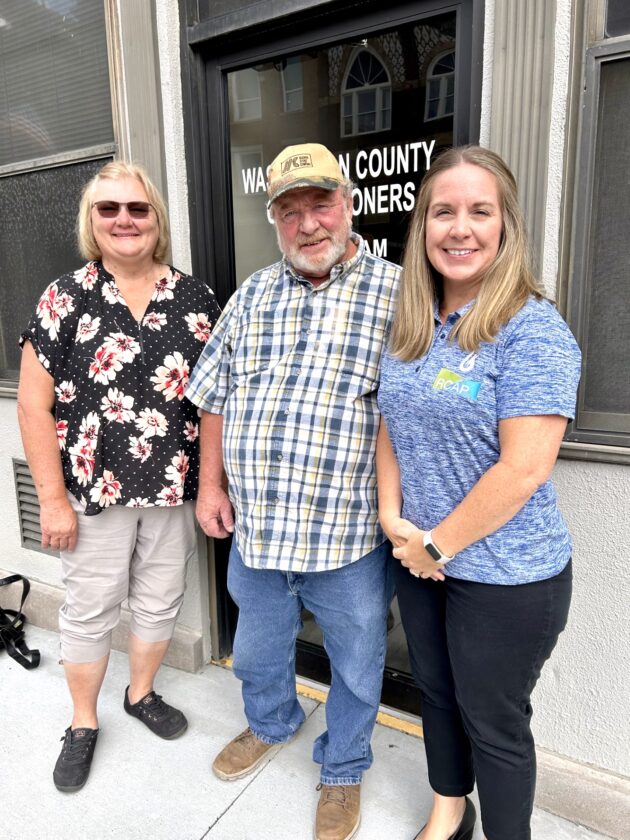
From left are Macksburg Fiscal Officer Darla Haas, former Mayor Jerry Williams and Ohio Rural Community Assistance Program staff member Heidi Milner as they leave Washington County Commissioners’ offices Monday after an announcement about the village’s receipt of $3.3 million to help establish a centralized sewer system. (Photo by Nancy Taylor)
The Village of Macksburg is a giant step closer to realizing a dream its residents have had for more than a decade.
They received approval June 16 of a $3,364,988 state grant that will cover about 61% of a centralized sewage system for the village and outlying businesses within Washington County.
It’s not an upgrade or an expansion. It’s going to be the first sewage system Macksburg has ever had.
The Ohio Department of Development’s press release about Round 4 of funding for Ohio BUILDS’ state water infrastructure initiative describes the village’s current situation as “unsewered” and having “significant unsanitary conditions due to raw and partially treated sewage discharging to the receiving streams, street and ditches.”
The sewage now flows into Duck Creek.
On Monday, Washington County Commissioners formally announced the grant news, with several representatives of Macksburg attending the event.
“This is very exciting,” Commission President Kevin Ritter said in opening remarks.
There were many individuals and several agencies credited with the achievement Monday. They included Washington County Commissioners Kevin Ritter, James Booth and Charles Schilling; The Ohio Rural Community Assistance Program and RCAP field agent Heidi Milner; Buckeye Hills Regional Council; former and present mayors of Macksburg, Jerry Williams and Ted Dobbins; village fiscal officer Darla Haas; Chris Hunt of Hunt Engineering; and Macksburg residents themselves.
Commissioners started a countywide Safe Water Project two years ago and set aside American Rescue Plan Act money to use. They agreed to give $50,000 to Macksburg when RCAP’s Milner reached out to them to see if they could help. It was significant, since Macksburg for years had been stuck in the rut of having a very limited budget and no money to spare for environmental and engineering studies, permit fees, grant writing or any other costs that were involved in getting the project off the ground.
“We’ve talked about this for years,” Williams said. “Maybe 12 or 13 years. But the village basically thought it was a dead issue because there was no money. I just about gave up on it.”
RCAP provides consulting services to help rural communities (less than 10,000 population) with drinking water and wastewater treatment needs. Milner has a long background in development and has been with RCAP for a year. Macksburg was one her first assignments and she has been helping the village since then.
She says her philosophy for years has been, “Don’t be afraid to reach out and ask people to help. And if they can’t help with what you propose, ask them what else they could help with.”
Milner and Buckeye Hills got the right information to the right people after Haas went door-to-door in the village with an income survey that established 89% of the village meets the LMI, or Low-Moderate Income standard, established for Community Block Grant Development fund eligibility.
Milner said she was thrilled to see about 30 Macksburg residents turn out for a recent public hearing about CBGD funds. The full application is due July 1 and Macksburg is ready to go, with an Ohio Environmental Protection Agency Permit to Install and preliminary engineering completed. Milner, Williams and Haas all credit engineer Chris Hunt for doing much work at no cost when they were starting out and had little or no money to pay him.
The projected cost of the wastewater system is now $5.4 million and Milner estimates 75-80% of the total can be funded by grants.
“You could say,” Booth said Monday, “that our $50,000 is going to turn into $5.4 million.”
Lowell, New Matatoras, and now Macksburg have made major strides on drinking water and wastewater issues, Booth said, referring to the commission’s investment in Safe Water Project efforts.
“Obviously, they benefit when the county helps them get started.”
One other thing Booth likes about the commission’s use of ARPA funds to kick start such projects around the county: their investments really aren’t one-time deals. “These are things that are going to keep on being productive.”
Ohio BUILDS information says the Macksburg project will benefit 186 people. Those at Monday’s meeting in Marietta estimated that it will serve 80 homes and an estimated population that’s now around 120. But the numbers of current homes and residents are not the point of the grant investments, the commissioners and local development officials say.
The point is Macksburg is one of a number areas in the county that cannot reach any development potential until infrastructure is adequate.
“The area around Exit 16 has high traffic count, high visibility and a couple of large parcels,” Southeast Ohio Port Authority Director Jesse Roush said. “It’s an untapped resource.”
However, sewer infrastructure issues in the county are one of the obstacles to development and economic growth, he said.
“You have to enhance infrastructure before there’s development,” Schilling said. “This all ties into economic development.”
Milner adds that quality of life — the health, safety and recreational value brought by the coming improvement — add to development value as well. The State of Ohio agrees. “At Development, we’re working to build strong communities so that when people come to our state, we have the infrastructure and amenities to support them,” said Lydia Mihalik, director of Development.
The state is awarding $114 million in grant awards to support 70 critical water infrastructure projects in 58 counties in Round 4 of Ohio BUILDS.
Local News

Students tackle Fourth Amendment rights in Mock Trial Competition
West Virginia House, Senate make steady progress on bills as session reaches halfway mark

Capito praises Trump’s support for coal industry

Virginia Supreme Court rules US Marine’s adoption of an Afghan war orphan will stand

Trump’s EPA revokes scientific finding that underpinned US fight against climate change