
Public forum outlines negative impact of proposed income tax cuts
Trending
PARKERSBURG -- The West Virginia Center on Budget and Policy hosted a community forum about the proposed West Virginia state budget being considered by the Legislature Tuesday night at the Judge Black Annex.
The main focus was on Gov. Jim Justice's 50% personal income tax cut proposal.
"I have no problem telling you, the governor's tax plan will devastate West Virginia state budget," Seth DiStefano, policy outreach director at the West Virginia Center on Budget and Policy, said. "Period. And it will severely inhibit, or outright eliminate, the ability of West Virginia's families, and West Virginia citizens, to receive critical services."
Justice proposed HB 2526 during his State of the State address on Jan. 11. The bill was introduced on his behalf the next day and was quickly approved by the House Finance Committee. The bill has now been referred to the state Senate Finance Committee.
HB 2526 would phase in a 50% personal income tax cut, with a 30% cut retroactive to January of this year, returning $163 million to taxpayers. Another 10% cut would kick in beginning in July, returning $1.085 billion to taxpayers, with the final 10% cut kicking in July 2024, returning $1.229 billion to taxpayers when fully implemented.
DiStefano said West Virginia's personal income tax is one of the only progressive sources of revenue generation there is in the state. He said those who have more are expected to pay more than those who have less. He said by cutting the personal income tax, there is no way for it to look like anything other than a tax break for the wealthy.
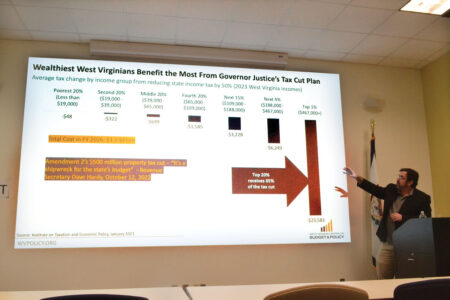
"When you cut the personal income tax in West Virginia, this is who wins," DiStefano said. "The wealthiest 20% of West Virginia households, people making more than $109,000 a year, receive 65% of the total tax cut."
DiStefano went on to say tax cuts don't work. He said it didn't matter whether it was Democrat or Republican sponsored tax cuts, they just don't have a history of doing the things promised.
"The promise is always, if you cut taxes we will get economic growth," DiStefano said. "If you cut taxes, it will lead to jobs. People are going to come here. It simply has not worked."
DiStefano said he doesn't see any way that taxes wouldn't get raised in other areas to compensate for the loss in personal income tax revenue. He said when that happens it's almost always the least wealthiest who end up paying for that.
"For instance, if the sales tax had to go up 2% to cover a portion of the personal income tax cut, I'm not going to feel that in the same way a single mom with a kid working two jobs to make $30,000 a year is," DiStefano said. "Because it takes a much larger percentage of her total income away."
DiStefano said he thinks there are better ways to help West Virginians. He said PEIA, health insurance provided to public employees and their families, needs a permanent fix, increase public employee pay by 10%, he said there could be a one-time child tax credit for $1,000 to be given to every child under the age of 17, invest in job training, or to offer free four-year in-state tuition.
DiStefano said the Center for Budget and Policy feels pretty strongly about getting members of the community back some of the money coming out of the coal and natural gas industries. He said a lot of the problems and struggles West Virginians face goes back to a century and a half of people in the community not getting their fair share of what comes out of the ground in West Virginia.
"Extraction industries are hard on communities," DiStefano said. "But you can fill a lot of potholes, you can pave a lot of roads, you can build a lot of water systems, for the amount of severance tax surplus that has been put aside since fiscal year 2022. … We think that's a fair thing to do."