
DHHR split bill passes W.Va. House, 95-3
Trending
CHARLESTON -- A bill to split West Virginia's largest department tasked with combating the state's health and social ills passed the House of Delegates Tuesday.
House Bill 2006 relating to reorganizing the Department of Health and Human Resources, passed 95-3. The bill now heads to the state Senate that already passed a similar bill on the first day of the session last month.
HB 2006 would terminate DHHR and split it into a Department of Human Services, a Department of Health and a Department of Health Facilities effective Jan. 1.
"It is the intent of the Legislature that the provisions of this act be construed to achieve the restructuring and reallocation of the powers, duties and functions of the Department of Health and Human Resources to the three new departments … in an orderly manner designed to maintain the delivery of services … without disruption," according to the bill's language.
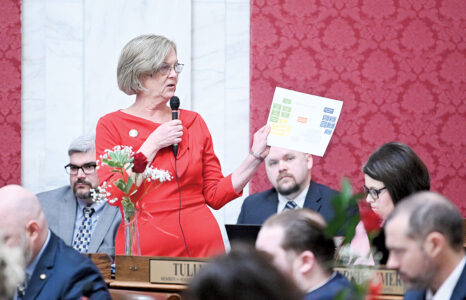
"The committee substitute for House Bill 2006 is the first step of many in addressing changes we need to make in state government to provide a voice for those not heard," said House Health and Human Resources Committee Chairwoman Amy Summers, R-Taylor.
The three departments would be served by one central Office of Shared Administration for administrative support for human resources, finances, information technology, administrative service, and communications, with all three departments entering into a memorandum of understanding. This model is similar to one used by the departments of Commerce, Tourism and Economic Development.
The new Department of Human Services would oversee the bureaus for Social Services, Medical Services, Child Support Enforcement, Family Assistance and Behavioral Health. While previously included within the Department of Human Services, a bill passed by the House Monday would make the Office of Drug Control Policy an agency within the Governor's Office.
The Department of Health would oversee the Bureau for Public Health, the Health Care Authority, the Center for Threat Preparedness and the offices of Emergency Medical Services, and Chief Medical Examiner.
The Department of Health also would oversee the Office of Inspector General, whose divisions would include the Office of Health Facility Licensure and Certification, the Board of Review, the Foster Care Ombudsman, the Olmstead Office, Investigations and Fraud Management, Quality Control, the Mental Health Ombudsman, the West Virginia Clearance for Access: Registry and Employment Screening and the Human Rights Commission.
The bill provides greater autonomy to the Office of Inspector General, making it an office appointed by the governor with the advice and consent of the Senate with a five-year term limit. The new departments are required to cooperate with the Office of Inspector General which has subpoena power.
The Department of Health Facilities would oversee all DHHR-owned hospitals, including Hopemont Hospital, Jackie Withrow Hospital, John Manchin Sr. Health Care Center, Lakin Hospital, Mildred Mitchell-Bateman Hospital, Welch Community Hospital and William R. Sharpe Jr. Hospital. DHHR also would be required to submit a long-term sustainability plan for each facility by Dec. 1.
The current DHHR was created in 1989 by merging the departments of Health and Human Services. HB 2006 enjoyed bipartisan support from Republican and Democratic House members who believe that splitting DHHR will help it better deliver services to West Virginia's most vulnerable citizens.
"The current Department of Health and Human Resources is a systemic, hot mess, and I certainly welcome reform," said Delegate Larry Kump, R-Berkeley. "I am not completely persuaded that separating it into three separate agencies is a fix, but I am persuaded that it is worth a try. I only hope that this is not the last step, but the first step to improving these services."
"I don't know if this is the right way either, but I like the fact that we're doing something different," said Delegate Joey Garcia, D-Marion. "I like the fact that we're going to try to make this better and we're not just going to say 'OK, let's just let it keeping going on.'"
House Health and Human Resources Committee Minority Chairman Mike Pushkin, D-Kanawha, cited the example of DHHR announcing last week that some certified kinship/relative caregivers and subsidized legal guardians of youth would have their payments delayed as DHHR switches over to a new computer system as a need to split DHHR up. He said adoptive families are having the same issues.
"People's checks are bouncing. People are not able to pay their bills. The folks who are stepping up in this state and opening up their homes to children who are in state custody, we're not taking care of them," Pushkin said. "If this bill helps that, then we should all vote for it. I believe it will."
The state Senate passed a similar bill on Jan. 11 when lawmakers gaveled in for the start of the 2023 legislative session. Senate Bill 226 passed 33-0. Both the House and the Senate passed a bill last year to split DHHR into two new departments, but Gov. Jim Justice vetoed that bill and ordered DHHR to conduct a top-to-bottom review of its operations.
"This is a good first start," said Deputy House Speaker Matthew Rohrbach, R-Cabell, who was the lead sponsor of the DHHR split bill last year. "Each and every one of your constituents are touched in one way or another by the functions of DHHR. This is an outstanding step to get this right. It is a work in progress, I'll agree with that, but this Legislature...is committed to getting this right."
The Virginia-based McChrystal Group was awarded a $1.08 million contract in June to conduct an organization assessment and strategic plan for DHHR. The report, released in November, recommended that agency leaders develop detailed action plans for department-wide objectives; the creation of three new deputy secretary positions; and investing in leadership development and improvements in communication.
DHHR is the state's largest department, with a $7.5 billion budget made up of both state and federal funding and more than 4,800 full-time employees as of January. But the department has struggled for years with addressing the state's health and social disparities.
According to the 2022 Annual Report released by the United Health Foundation and the American Public Health Association, West Virginia ranked 47th for least healthiest state. The state ranked 45th on its economic hardship index and for adverse childhood experiences, 50th for preventable hospitalizations, 43rd for teen births, 1st for high-risk HIV behaviors, 49th for smoking, 50th for drug deaths, and 49th for multiple chronic conditions.
"We will be required from this day forward to give our utmost attention to these programs that have failed too many," Summers said. "We invest billions of dollars from hardworking West Virginia taxpayers to care for those who need our help, and we must do better. I demand more accountability and transparency of our state government and I hope you do as well."