
Washington County K-9 more than an officer
Trending
MARIETTA – School can be stressful for a multitude of reasons and the Washington County Sheriff's Office hopes to help reduce some of the anxiety and worry.
Chief Deputy Mark Warden said they started seeing a connection between the school resource officer and the K-9 with them.
"It's multifaceted," Warden said. "He's a bomb dog at the (Washington County) Career Center, and when someone needs him, he can roll out. The other side is the relationship of the kids and staff with the dog and opening up pathways of communication."
So the three SROs in the county -- one at Warren, one at Fort Frye, and one at the career center -- would have a specially trained therapy dog to open up those pathways of communication.
He said the dogs would be used in everyday situations around the schools.
"I've been hearing from staff members that kids that have been reclused have opened up to the dog and officer, which opens up the communication," Warden said.
¯ ¯ ¯
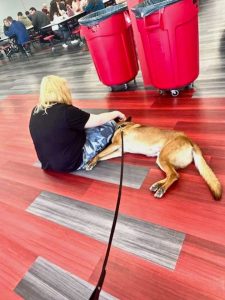
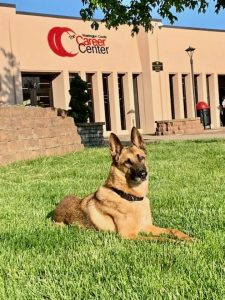
Although Brody is a bomb dog with the Washington County Sheriff's Office, students petting and talking to him are able to destress and decrease anxiety. (Photo submitted)
Deputy Mike Harlow is the SRO at the career center. He and his K-9 Brody were with the Ohio University Police Department, where Brody was a bomb dog.
Harlow said he knew about therapy dogs, but at first, didn't really pay attention to them.
"But right off the bat, when the (Career Center) kids saw him come in, he was swarmed by people wanting to pet him," he said. "At lunch time, he'd be out with the kids and they'd be able to come up and play with him."
He said the students would pet Brody, which would help them relax and feel safe.
"They've said countless times they feel safer with him in the building," Harlow said. "If someone would come in with a firearm, he would make them feel safer."
He said those who wouldn't normally open up to a police officer are able to open up to Brody.
"Seeing a police officer in the school is intimidating," he explained. "But everybody loves him and we make our rounds. He visits classes and interacts with the kids. He helped them calm down some before finals."
He said when the students were upset, "like a light switch," they would calm down after seeing him.
Harlow said Brody is an 8-year-old Belgian Malinois and this is probably going to be his last school year.
"They definitely want to make sure they have a dog in the school, because they've seen what a positive impact he's had in the five months I've been there," he added.
He noted since Brody became a part of the school environment, behavior issues have dropped significantly and the students and staff seem more upbeat and happy.
The dog plays a significant part in that, he said.
A therapy dog would have specialized training Brody doesn't have and any dog chosen would have to undergo extensive obedience training.
"It would have exposure to different environments ... get him out and get used to different environments," he said. "Get him used to being touched. Dogs are stimulated every time they are petting and if it's petted a hundred times a day, it wears him out."
He said Brody is the only K-9 in a school, but Deputy Ellen Reynolds and Deputy Matt Martin are working on proposals to get grant money for dogs at their schools. Reynolds is an SRO at Warren and Martin is an SRO at Fort Frye.
"Once they get settled, we can then try to get funding for the third dog," Harlow said. "It would be serving not just the schools, but we can put that service out in the community."
Brody is a bomb dog, but the two dogs purchased for Warren and Fort Frye would strictly be therapy dogs, he said.
When Brody retires, if the sheriff's office wants another bomb dog, the dog chosen would receive both bomb training and therapy training.
¯ ¯ ¯
Martin said it's a growing trend to have therapy dogs. He's spoken with the Franklin County Sheriff's Office which already has a plan in place.
The therapy dogs would be a much different breed than the K-9s currently used.
"They recommend a floppy-eared, hypoallergenic dog," he said. "The floppy ears make it more approachable. They don't appear as scary as a regular K-9 used by law enforcement."
He said allergies are becoming more prevalent, so the dog would need to be hypoallergenic.
Martin said having a K-9 in the school, if a student or staff is having a bad day or something is going on at home, they can relate to the dog better than someone "standing there in a uniform."
"It breaks down that barrier," he said.
He said he and Reynolds went to a conference regarding therapy dogs.
"There were instances where someone was involved as a victim of crime and they gave a statement to the dog, where they were standoffish with the officer," Martin explained. "It's kind of neat. Everyone has a bad day and then goes home and loves on a pet."
They are hoping to get funding, as the cost of the dogs range from $1,500 to $4,000, depending on the breeder and what level they are, he said. Some breeders breed specially for therapy or service dogs.
He said an F1 level dog would have a golden retriever parent and a poodle parent and they can't be guaranteed to be hypoallergenic. These puppies would be goldendoodles. With two goldendoodle parents, there's a greater chance to be hypoallergenic, he said.
They also do a temperament test with the puppies and if the dog doesn't pass, it wouldn't be used as a therapy dog.
Michele Newbanks can be reached at mnewbanks@mariettatimes.com.