
Trending
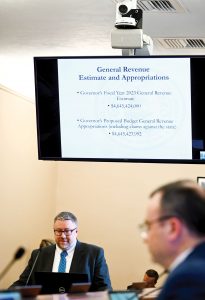
CHARLESTON -- The Senate Finance Committee signed off Monday on its version of Gov. Jim Justice's proposed budget for the next fiscal year with some changes while keeping the final price tag the same as the governor's.
Senate Bill 250, the budget bill for fiscal year 2023 beginning on July 1, was recommended for passage Monday afternoon by the committee in a voice vote with no debate.
SB 250 maintains the same total general revenue amount set by Justice in his budget presented to the Legislature on Jan. 12, the first day of the 60-day legislative session.
The governor's budget and SB 250 set a budget for fiscal year 2023 of $4.645 billion -- a 1.4 percent increase from a revised revenue estimate of $4.579 billion for the current fiscal year ending in June. It's also a 3.3 percent increase from the $4.495 billion fiscal year 2022 budget approved by the Legislature last year.
The increase in both budgets is due to a proposed 5 percent pay raise for state employees and educators, which has a cost of approximately $120 million. Another $41 million is required for inmate medical care due to court mandates and healthcare inflation.
While the final amounts are the same, SB 250 makes changes to the governor's budget by decreasing funding from some sections and increasing funding in other areas.
SB 250 makes $9.4 million in reductions for Justice's proposed budget. It decreases funding to the Teacher's Retirement Statement by $2.4 million and reduces funding for teacher unfunded liability by $6.6 million. The Senate version of the budge also reduces funding slightly to West Virginia State University by $300,000, and reduces the dollar amount to pay for claims against the state by $7,126.
Instead, the Senate Finance Committee took that $9.4 million in reductions and used those funds to make improvements in other areas of the budget. Of that amount, the Division of Tourism would receive an additional $2 million for brand promotion; $1.2 million would go to the Department of Human Resources' Division of Health for sexual assault intervention; $1 million would go to the Division of Natural Resources for equine enrichment; and $1.8 million would go to West Virginia State University for its land grant match and for its Healthy Grandfamilies program.
SB 250 also includes funding at the back of the budget should there be surplus tax revenue dollars available at the end of fiscal year 2022 ending June 30. The 10 surplus items have a $674.9 million price tag and are arranged in order of priority. Some of these include: $50 million for the Department of Environmental Protection; $12.2 million for the Division of Administrative Services; $4 million for the General Services Division; $4.2 million for the Division of Corrections and Rehabilitation.
The largest amount -- $600.5 million -- would go to the Department of Economic Development if surplus tax dollars are available.
Year-to-date tax collections for the current fiscal year beginning in July 2021 were $3.1 billion, which is 20.7 percent more than the $2.6 billion revenue estimate, giving the state a $530.6 million surplus for the remaining five months of the fiscal year 2022 ending in June.
That surplus tax collections number is expected to climb when February tax revenue numbers are released tomorrow. Some lawmakers believe the end-of-year tax revenue surplus could come close to $1 billion.
Half of any budget surplus at the end of the fiscal year goes into the Rainy Day Fund by statute, which is already sitting at more than $1 billion. At least one bill -- Senate Bill 487 now in the House of Delegates -- would cap the Rainy Day Fund and allow any remaining surplus to go into the general revenue fund at the end of a fiscal year.
Steven Allen Adams can be reached at sadams@newsandsentinel.com