
West Virginia Senate committee takes up its own bill limiting racial discussions
Trending
CHARLESTON - While a bill in the West Virginia House of Delegates dealing with concepts derived from Critical Race Theory didn't make it over the finish line last week, a state Senate committee took up a long-dormant bill Monday that would also limit discussions of CRT concepts.
The Senate Education Committee recommended Senate Bill 498 on Monday afternoon after approving a committee substitute and two amendments to the bill. A motion was made during the Senate's afternoon floor session to have the bill read a first time, setting the bill up for passage on Wednesday when bills must be passed and sent to the opposite chamber.
"I think this committee's done great work making it better, so I feel as if I can vote for it," state Sen. Charles Trump, R-Morgan, said. "We are doing better, we're striving to do better and we must continue to do so. I appreciate the work that this committee's done to improve this legislation, because I was unsure as I arrived here today how I was going to vote on it, but I will support the bill."
The bill was introduced Jan. 28 by Senate Education Committee Chairwoman Patricia Rucker, R-Jefferson, and put on the committee agenda Monday - one day after the deadline for bills to make it out of the committee in the house of origin.
SB 498 would prohibit public schools, public charter schools, private schools, the state Board of Education and Department of Education, and the Higher Education Policy Commission/West Virginia Community and Technical College System from requiring instruction or courses in concepts derived from CRT.
The bill prohibit the teaching that one race, ethnic group, or biological sex is morally or intellectually superior or inferior to another; or that one race, ethnic group, or biological sex is inherently racist, sexist, or oppressive either consciously or unconsciously.
Despite already prohibited by federal law, the bill would prohibit discriminating against someone based on their race, ethnicity, and biological sex. The bill prohibits teaching that an individual's moral character is derived from their racial, ethnic, or gender identity or that they bear responsibility for actions committed by those of similar backgrounds.
The bill would also prohibit making someone feel discomfort, guilt, anguish, or other forms of psychological distress because of their racial, ethnic, of gender identities. It would also prohibit labeling academic achievement, merit, or certain traits - such as hard work - as racist or sexists or created to oppress another racial or gender group.
The bill is similar to a bill that didn't make past the committee deadline in the House of Delegates. The House Judiciary Committee moved Friday evening to turn House Bill 4011, the Anti-Stereotyping Act, into a study resolution and bring it back for consideration during the 2023 legislative session in a 13-9 vote after it didn't make the deadline.
HB 4011 also stated that no person should be blamed for the action committed in the past by someone of the same race, sex, ethnicity, religion or national origin. The bill prohibited schools and county board of education officials from compelling students and staff to adopt any belief or concept that one race, sex, ethnicity, religion, or national origin is inherently superior or inferior to another.
While HB 4011 was limited to K-12 public education, SB 498 would apply to both K-12 public and private education as well as higher education. However, HB 4011 would have required public schools to post curriculum pertaining to non-discrimination, diversity, equity, inclusion, race, ethnicity, sex, and bias. SB 498 includes no curriculum transparency requirement.
SB 498 also includes clear language that exempts the discussions CRT concepts in theory in a college or university setting as part of an academic course as long as alternative theories are also included in the course.
"The bill also recognizes that state institutions of higher education prohibit discrimination and have an obligation to protect the right of free speech," said Hank Hager, counsel for the committee. "The bill … allows the discussion of the above concepts in theory, and also by allowing the role that race, ethnicity or biological sex has impacted historical or current events."
The committee substitute to SB 498 also creates a complaint procedure for K-12 education and a reporting procedure for higher education for instances of non-compliance
State Sen. Ron Stollings, D-Boone, also praised the work of the committee in improving the bill from the introduced version. However, he still had reservations about the bill's goals.
"These amendments have improved the bill, but I still think we're creating a lot of anxiety for our teachers and unnecessary work for our principals, county superintendents, and state superintendent," Stollings said. "Even though this is a better bill having been amended, it's still one not needed and creates anxiety among to teachers. We don't need added anxiety among our teachers."
State Sen. Eric Tarr, R-Putnam, said that he believes that national teachers' union groups, such as the National Education Association, are putting pressure on teachers across the country to teach CRT-derived concepts.
"I think this probably takes a lot of pressure off of teachers, especially when we have a National Education Association that is pressuring these concepts to be put into curriculum," Tarr said. "We have teachers that want to be able to follow just what we're putting into law."
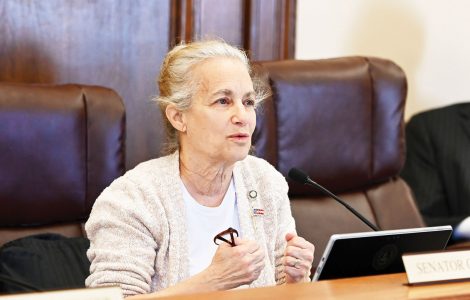
State Sen. Hannah Geffert, D-Berkeley, said she worried that legislation like SB 498 would discourage discussions of complicated issues, such as race and gender.
"I think we have to recognize how complex our history is, how individual relationships are so different than the big scheme of things that we always try to put everything under," Geffert said. "I do worry that we will lose understanding of that as we move forward."
Steven Allen Adams can be reached at sadams@newsandsentinel.com