West Virginia House Judiciary Committee discusses bill dealing with Critical Race Theory concepts
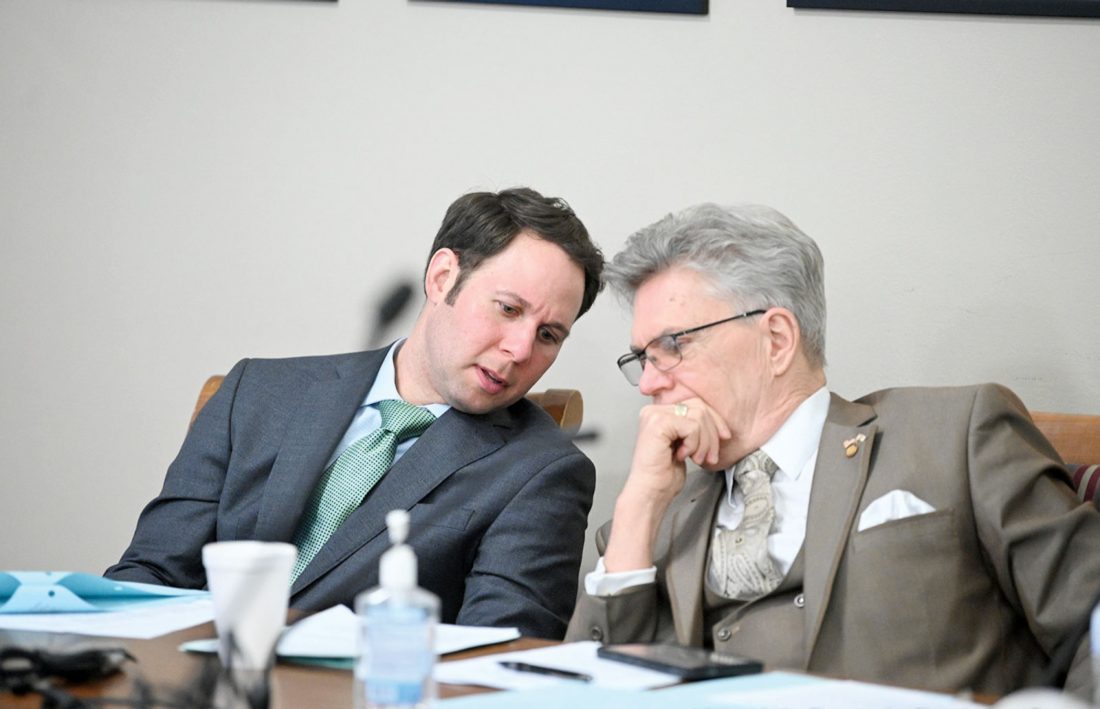
Del. Joe Garcia, left, raised concerns about whether HB 4011 would allow discussions of historical figures. (Photo courtesy of WV Legislative Photography)
CHARLESTON — With three days until the deadline when bills must be out of committees, lawmakers dived into a bill Thursday dealing with discussions of race and gender in West Virginia classrooms.
The House Judiciary Committee discussed House Bill 4011, the Anti-Stereotyping Act. The committee heard details of the bill for more than an hour, but put off any action on the bill until later today.
HB 4011 would require greater curriculum transparency for public schools pertaining to non-discrimination, diversity, equity, inclusion, race, ethnicity, sex, bias or any combination of those concepts. The bill also would prohibit the teaching and discussion of specific racial and non-discrimination topics often categorized under the name critical race theory, or CRT.
The bill states that no person should be blamed for the action committed in the past by someone of the same race, sex, ethnicity, religion or national origin. Schools and county board of education officials would be prohibited from compelling students and staff to adopt any belief or concept that one race, sex, ethnicity, religion, or national origin is inherently superior or inferior to another.
The House Education Committee recommended the bill for passage Feb. 3 after a contentious discussion that ultimately ended with Republicans on the committee moving to end further debate and vote on the bill. The House and Judiciary committees held a public hearing on the bill Feb. 9, where 23 out of 25 attendees spoke out against the bill.
Del. Lisa Zukoff, D-Marshall, asked how does someone determine if a teacher has compelled a student to learn something prohibited by the bill.
“Where it seems worrisome to me is it seems so broad,” Zukoff said. “How do you prove and how do you determine whether this has actually happened?”
Del. Mark Zatezalo, R-Hancock, asked about a complaint from opponents of the bill that it would prohibit the teaching or discussion of certain historical topics in the classroom, such as discussions of slavery, segregation, and civil rights. Counsel for the committee explained that there was nothing in the bill prohibiting the teaching of history.
“I didn’t hear anything that spoke to any degree whatsoever about history or the teaching of history,” Zatezalo said.
Del. Joe Garcia, D-Marion, pointed to a provision of the bill that would prohibit teachers or administrators from compelling students or employees from adopting a belief that “An individual’s moral character is necessarily determined, in whole or in part, by his or her race, sex, ethnicity, religion, or national origin.”
“I just find it weird,” Garcia said. “An individual might be Adolph Hitler and you cannot discuss Adolph Hitler’s moral character as it relates to the history of what happened in Nazi Germany.”
While the bill doesn’t mention Critical Race Theory (CRT) by name, the bill is aimed at prohibiting the teaching of concepts derived from CRT, such as the anti-racism philosophies found in the works of Ibrim X. Kendi and Robin DiAngelo. Examples include teaching that racism is systemic regardless of whether a child believes they are not racist, saying that race-blind standards are inherently racist, and calling white students “oppressors.”
Todd Gaziano, the chief of legal policy and strategic research and the director of the Center for the Separation of Powers at the conservative Pacific Legal Foundation, testified that HB 4011 is very narrowly tailored and said some legislation in other states are too broad and restrictive. HB 4011 is based on model legislation offered by the foundation.
“When I was advising on some of the language … we were extremely careful about making sure that this was well grounded in federal law, but particularly well grounded in the First Amendment,” Gaziano said. “Certainly, you could condemn Nazis. That’s not a whole race. Could you condemn slaveholders? You should condemn slaveholders.
“No one should have any problem with this (bill), but if you do, you have a problem with federal law,” Gaziano continued. “What you can’t say is … all whites, by virtue of being white, have certain moral failings. But that is what is being taught … there are school systems with curriculum that say because of the virtue of the color of your skin you are an oppressor.”
According to PEN America, a group that fights for free speech and expression, these bills often go too far in curtailing speech in classrooms and intimidate teachers from teaching complicated history or current events topics. Calling them “educational gag orders,” PEN America researchers Jeffrey Sachs and Jonathan Friedman said there are 103 bills being considered by states so far this year.
“From book bans to educational gag orders, schools and universities are being threatened today to a degree that has no recent parallel,” Sachs and Friedman explained in a report last week. “There is a willingness, and even eagerness, to bring the weight and power of government to bear on controlling classroom speech. And as is always the case in such times, students will be the ones to pay the price.”
Steven Allen Adams can be reached at sadams@newsandsentinel.com
Local News
West Virginia Senate Education Committee begins discussion of Hancock County Schools emergency funding bill

Road crews staying ‘busy, busy, busy’ clearing snow

Warming centers report steady use in wake of storm
Picture This: Cold Shoulder

Government offices, events across Mid-Ohio Valley disrupted by snow