
Director: Child Protective Services ‘at breaking point’
Trending
By STEVEN
ALLEN ADAMS
Staff Reporter
CHARLESTON -- The Child Protective Services division within the West Virginia Department of Health and Human Resources is facing multiple issues driven by the opioid crisis, including staff vacancies, an overflowing foster care system, drug addicted infants, and a slow-to-respond child abuse hotline that contributed to the deaths of five children last year.
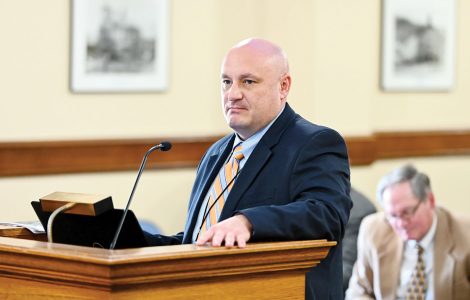
"We're already pretty much at our breaking point and I don't know how much further that rubber band can stretch before it snaps," said Jeff Pack, commissioner for DHHR's Bureau for Social Services, to members of the West Virginia Legislature's Joint Committee on Children and Families on Tuesday afternoon during the last day of December interim meetings.
Pack, who joined DHHR in August and was previously a member of the House of Delegates and chairman of the House Health and Human Resources Committee, said he never realized how bad things were until he became commissioner.
"I didn't understand how difficult my job would be when I left (the Legislature) and went to (DHHR)," Pack said.
According to Pack's testimony, there are 400 Child Protective Service (CPS) workers in the field, with seven vacancies in adult protective service (11 percent vacancy rate) and 15 vacancies in social services (26 percent vacancy rate). Statewide CPS vacancy rates increased from 17 percent in January 2020 to 27 percent in October.
"That's as high as I can remember," Pack said. "The numbers for November will be out on the 10th and I expect they won't look significantly better than what they look right now."
Pack said some of that is due to adding new positions, but most are due to ongoing vacancies driven in part by low pay, high caseloads, and overall burnout. Vacancies vary by judicial district, creating problem areas around the state.
"Candidly, that's untenable," Pack said. "I don't know how we continue to operate at that particular rate."
One of the issues is DHHR's Child Abuse and Neglect Hotline, 1-800-352-6513. The call center is located in Fairmont and refers child abuse cases to social workers and law enforcement. However, sometimes there is a delay between when the call comes in and when the information makes its way to the appropriate authorities, including days.
Rebecah Carson, director of DHHR's Central Intake Unit, said some of the changes made at the hotline - including more supervision, recorded phone lines, and direct lines of contact to the State Police - should help prevent similar issues in the future.
"That issue should be resolved, or it should be," Carson said. "I haven't had any further concerns or complaints or anything like that that would make me think we're not following our protocols."
Sometimes cases are not referred at all if Hotline officials determine the referral doesn't rise to the level of child abuse.
Sarah Peters, a dental hygienist at Greenbrier Valley Pediatric Dentistry in Lewisburg, recounted an incident in August 2020 where she noticed a large bruise on a child patient's arm. She took photos of the bruise and also noted that the child was scared of their father and observed the father being verbally abusive to the child's younger sibling in the parking lot. She called the hotline.
"I was not through with my description and the (call center employee) never asked for the photograph," Peters said. "She just abruptly said 'I think I have all the information I need. Thank you.' And the call ended."
In a letter to Peters, DHHR said the complaint did not rise to the legal definition of child abuse. Four months later, the child in question and four other siblings were murdered by their mother, who set the house on fire and shot herself according to an investigation reported by WV MetroNews.
"This county was rocked to its core," said Mike Spradlin, a retired West Virginia State Police trooper and Greenbrier County resident since 1974, choking up as he gave the committee details of the murder/suicide investigation and the ages of the deceased children. "Excuse me, I have grandkids that age.
"I'm not here throwing rocks at CPS. My daughter worked for CPS," Spradlin continued. "But we need to know what probable cause is … if it had been someone showing up to the police station (with the photo) it would have been probably cause to proceed. That bruise would have been probable cause to proceed. We just want answers. We want an explanation and to improve system."
Driving most of the strain on CPS is the opioid crisis. According to data released in November by the U.S. Centers for Disease Control, more than 1,600 West Virginians have died from drug overdoses in a 12-month span, a 62 percent spike between April 2020 and April 2021 - the second highest rate in the nation behind Vermont.
Drug use is not only affecting people, but also the next generation of West Virginians. According to DHHR Deputy Cabinet Secretary Jeremiah Samples, 6.6 percent of the babies born in West Virginia in 2020 had neonatal abstinence syndrome (NAS), a condition caused by drug withdrawal after the baby was exposed to narcotics in the womb.
Another 14.2 percent of babies born in West Virginia were born with Intrauterine Substance Exposure (IUSE) or exposed to drugs. Samples said the average cost to taxpayers per case of NAS or IUSE is $2 million from the time of birth until the child reaches adult age.
"It's an enormous expense, so you start to look at that percentage of kids born with NAS or drug-exposed and then look at the broader DHHR budget … you really start to see what could be a growing tsunami of expense that going to be very difficult for the state to sustain unless we can bring that number down," Samples said.
According to 2018 data, 2018 data, 54 percent of child removals from homes are due to parental substance abuse. While removals for adult substance abuse have risen at a constant rate since 2012, removals for child behavior or neglect have decreased over the same time. As of November, 6,796 children are in the state's foster care system.