
West Virginia officials warn against skipping COVID boosts
Trending
CHARLESTON -- Nearly 550,000 West Virginians age 50 and older are considered fully vaccinated against COVID-19 but less than 49,000 people statewide have received booster doses.
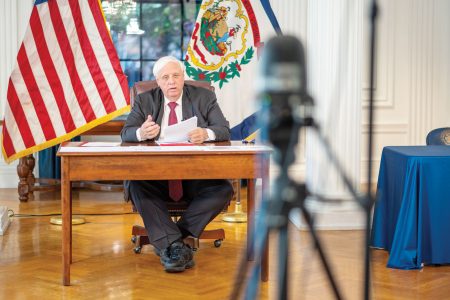
Gov. Jim Justice and state coronavirus czar Dr. Clay Marsh urged residents to get an additional shot during Wednesday's online pandemic briefing.
"We know that about 25 percent of people in our hospitals today have been fully vaccinated," Marsh said. "And so that really tells us that the potency of the vaccines are waning in these people and we absolutely need to get boosted."
As he tends to do, Justice put it more bluntly.
"To be hesitant and to be putting off your booster and to be out playing in the sunshine, a bunch of you are going to die," he said.
A person is considered fully vaccinated two weeks after receiving their second Pfizer or Moderna vaccination or the single Johnson and Johnson shot. But Marsh said the two-dose vaccines are most beneficial for two to four months.
"And then after about four months, we see a fairly marked reduction in potency," he said. "So after six months from the first vaccine, we're seeing very much diminished potency."
But studies from Israel suggest the Pfizer booster is effective for much longer, Marsh said.
Federal regulators have authorized additional doses for people age 65 and older, those with preexisting medical conditions and people working in high-risk environments. While Pfizer is seeking authorization for boosters for anyone 18 and older, Marsh said the criteria now -- which include obesity, being a current or former smoker and certain mental health conditions -- mean just about anyone is eligible six months after their second shot or two months after the Johnson and Johnson dose.
"Given the criteria that the CDC's released, then we believe that every West Virginian who wants a vaccine, a booster, is eligible to get one," he said.
James Hoyer, head of West Virginia's joint interagency vaccine task force, said if anyone is confused about their eligibility or unsure where to get a booster, they should call the state's hotline at 1-833-734-0965.
The state has an adequate supply of booster doses and Pfizer inoculations for children age 5-11. More precise numbers on that age group, recently approved for vaccination by federal authorities, should be available later this week, but Hoyer said the initial response is similar to when vaccines became available to 12- to 17-year-olds, about 40 percent.
"It's not nearly what it needs to be," he said.
Marsh and Hoyer noted the state's Rt number -- which measures the rate at which the virus is spreading -- had crept up from 0.83 about a week ago to 0.92 Wednesday.
"We know that when our Rt value goes above 1 and stays above 1 for a consistent period of time, we will see a surge in cases, and then a follow-on delayed surge in hospitalizations, followed by a delayed surge in deaths," Hoyer said.
Marsh said as temperatures drop and more people head inside, the risk of the virus spreading increases. But he's concerned that people are losing focus and perhaps not considering the virus a serious threat.
"We could see another substantial surge, and we could lose a lot more people, and our hospitals, at this point, have been stretched as much as they can be stretched," Marsh said.
Justice also touched on some non-COVID issues, including criticizing John Kerry, President Joe Biden's special envoy climate, over his remarks that the U.S. wouldn't be using coal by 2030 and thanking Sen. Joe Manchin, D-W.Va., Sen. Shelley Moore Capito, R-W.Va., and Rep. David McKinley, R-W.Va., for voting to pass the recent federal infrastructure package. He added that he understood the no votes by Reps. Alex Mooney and Carol Miller, both R-W.Va., based on concerns that it could lead to an unnecessary and expensive social spending bill, which the governor dismissed as an attempt to win votes in the mid-term elections.
Evan Bevins can be reached at ebevins@newsandsentinel.com.