
Exploration of history reveals shades of John Gray
Trending
(EDITOR'S NOTE: In June, Alan Hall, now retired director of the Public Library of Steubenville and Jefferson County, and his wife, Barb, were the guests of the Noble County Historical Society in Caldwell, Ohio, for its exhibit about John Gray, 1764-1864. Gray is Hall's fourth-great-grandfather who died at the age of 104, making him the last verified veteran of the American Revolution. Hall and his brother, Kent, had been providing the historical society with research and artifacts about Gray and a recently acquired 1866 tin-type photo of him that was made part of its collection in addition to a portrait Hall's mother commissioned in the 1970s. Hall assembled his mother's research about Gray to be placed with the society. He and his mother conducted research from 1960 until her death in 1981 and established a new lineage so she could join the Daughters of the American Revolution. Gray is the subject of a mural in the courthouse there, and his house still exists near the family cemetery where he is buried.)
***
My story starts with a phone call this past February from the folks at the Noble County Historical Society in Caldwell, Ohio. For several years, they were aware that I am a descendant of John Gray (1764-1868), a famous man in their community. He lived his final 40 years in their county, and upon his death at age 104 in 1868, he was the last verified veteran of the American Revolutionary War.
The phone call was to inform me that a documented tintype of John Gray, taken in 1864 at his age of 100, was available for purchase. I told them that my wife and I would be pleased to assist them with the purchase so that the photo would become part of their "John Gray Collection" in Caldwell. I also promised to provide them with all of the research and documentation that my mother and I had developed about John Gray over the years to assist them in answering questions that the Noble County Historical Society receives on a regular basis.
The story of John Gray, and the years of research that my mother put into developing his American life, is a story in itself.
John Gray was the oldest of eight children, his father was born in Antrim County, Ireland, in 1739. He migrated to the British colonies and married Rosanna St. Clair, setting up his family at the Mt. Vernon Estate, owned and operated by George Washington. The Gray household is shown on the Dogue Creek Farm of Mount Vernon. His father joined the American Revolution at its beginning and died in service of his country in January 1777 at the Battle of White Plains, N.Y.
At the age of 13, John had to assume the responsibility of keeping his family and mother together and fed on the farm. At the age of 17, John Gray volunteered and joined the American Army to serve in the Militia on Feb. 24, 1781, in Fairfax County, Va., marching to Fredericksburg to receive his arms and ammunition and on to Richmond and Williamsburg to fight in the American Revolution. He served under Maj. Dennis Ramsey and Capt. Robert Sanford. His service slowed in the late spring, but continued from June 1781 until Oct. 19, 1781, when he was present at the surrender of Cornwallis and the British at Yorktown. He was under the command of Capt. James Neal as he returned to Fairfax County.
He rejoined his family at Mount Vernon and served as an employee of George Washington on his estate, caring for his family as his seven other brothers and sisters grew up and established lives in Virginia.
In 1784, John Gray headed west, settling in Morgantown, then-Virginia, and married his first wife, Nancy Dowell. Their first child named William was born in 1788, and their second child was Mary (my ancestor) born in 1796. Another son, Isaac, was born in 1798. The family moved to the Moundsville area in 1795 and lived in the Ohio River Valley around Dilly's Bottom and the Flats of Grave Creek with the youngest son remaining with his father and second wife until 1829 when they moved on the Federal Trail westward to a new farm near Hiramsburg, Ohio, just north of the village of Caldwell. William Gray moved to the Cuyahoga County Cleveland area where he remained the rest of his life. Mary Gray, my ancestor, met a man from Southwestern Pennsylvania, and they married and continued down the Ohio River where they settled at New Matamoras, Ohio. His son Isaac eventually relocated to Illinois.
John Gray's second wife, Nancy Ragan, died, and he remarried Catherine Bond and remained on his farm at Hiramsburg for the remaining 40 years of his life. His third wife had three daughters, with one still living in his home when he died at age 104 in 1868.
As was common in those days with the lack of communication and travel, John Gray lost touch with his children even with his daughter living only 40 miles away. There were many American Revolutionary veterans living in the Ohio Country in the early 19th century, and military gatherings and picnics were common in the 1830s. John Gray was a well-known farmer in Brookfield Township which had been in Morgan County, until Ohio's last county -- Noble County -- was formed in 1851 and absorbed his township.
A little boy named James McCormick Dalzell lived in John Gray's township and enjoyed visiting the old man and hearing his stories of George Washington and the American Revolution. Dalzell served in the Civil War, and his writing skills and poetry outlined the war. Upon returning to Noble County, he wrote the story of John Gray from his earlier visits and renewed visits when the old man was 100 years old, and in 1868 published the story of John Gray, making him famous for being the "last veteran of the American Revolution."
John Gray never received land for a pension for his military service, in part because it was less than six months total. In 1832, Congress passed legislation awarding pensions to American Revolutionary veterans, but John didn't apply. By 1866, he was poor with his family all gone except for a stepdaughter so Dalzell worked with U.S. Rep. John Bingham of Cadiz to allow Congress to award John Gray a $500 per-year pension for the final two years of his life.
In 1888, 20 years after Gray died, James Dalzell had become a state legislator and attorney in Caldwell, and he published his autobiography and papers of the Civil War, as well as a Chapter 3 in his book about "Washington's last soldier -- John Gray," a reproduction of his 1868 work. And so the old man from Hiramsburg became famous.
And now the next story.
My grandfather, Roy Grover Heddleston, was 9 years old in 1901 when the Heddleston family of New Matamoras all gathered that summer for a family reunion at Uncle Clem's big house in the village. Bazil Meeks and Mary Gray Meeks had produced a large extended family, and their daughter had married a Heddleston which had done the same. My grandfather's dad took him by the hand, and they went over to the five elderly family members who had been placed on wood chairs for photos, and told Roy to ask them about their grandfather, John Gray.
The stories abounded even though their mother had not lived in Hiramsburg in John Gray's elderly days, but they all had read the stories of John Gray in the little book that had been produced by James Dalzell. The little boy named Roy was fascinated with the stories of the American Revolution, and in 1912 he had graduated from Muskingum Normal College and became the sixth-grade teacher at the New Matamoras Schools, a position he held for 40 years, with the stories of the American Revolution enhanced with the reality of John Gray.
His daughter, and my mother, Flossie Heddleston Hall, loved to hear about John Gray. She was so proud of her ancestor, and any family gathering found Flossie with her three-ringed binder notebook ready to take any notes or stories about her family tree and certainly John Gray. By 1960, she had become frustrated by the failing memories of her family, or simply no information about John Gray. She also was frustrated by the lacking lineage and documentation to John Gray to the point she was not allowed to join the Daughters of the American Revolution without proof that she was descended from John Gray.
In the 1960s, there were no computer searching capabilities for libraries, and the "little book" that mom's family kept mentioning didn't seem to exist anymore. She wrote letters to large libraries asking if they "had the book about John Gray," and finally the State Library of Ohio responded that "yes, we have the book, but it is in the archives and you have to come here and look at it."
In the summer of 1965, Flossie Hall and family went to Columbus, and she and the 11-year-old boy (that was me) went to the 11th floor Reference Department of the State Library of Ohio, and mom spent the whole day copying some of the pages into her notebook. One of the librarians kept me busy showing off the library and putting me on a step stool to look out the windows at the "tall buildings" of downtown Columbus. I guess I should have told her that 55 years later I will be on the board of this library.
The 54 pages of information about John Gray, gleaned from personal interviews by James Dalzell, provided some genealogical information, but more so great information about the old man living into the 19th century in America. John Gray was literate thanks to a four-mile walk as a boy to a man who taught school in his house, and John could read books and recite the U.S. Constitution word for word. He built a crude boat at Morgantown, Va., and descended the rivers to the flats of Grave Creek at Moundsville to join the frontier life of the Ohio River Valley. He fished and caught wildlife to support his family and harvested corn in his fields.
John Gray moved a couple of times to Dilly's Bottom, earning his labors by farming, marrying three times due to the death of his wives. For 78 years, he was a member of the Methodist Church, and remained sober with a daily walk with God. He said that his life was formed by the "pure honesty" of George Washington upon whose estate he was reared from 1764-1784 when he headed westward.
Dalzell said that John Gray "never tired of talking about Gen. Washington and his dear Virginia home," but he loved the land north and west of the Ohio River where he settled. In 1829, he followed the Federal Trail inland landing at Hiramsburg where he would remain the rest of his life in the little log cabin he constructed surrounded by his fields of grain. In his final interview at age 103, he made quotes that are often resounded in Ohio history books: "A plug of tobacco, of course, for without a dog or tobacco I should feel lost. My dog today is named 'Nice' but my favorite dog was at Mount Vernon and was named 'Lade.'
Upon his death in 1868 at age 104, it was said that John Gray's hand that had held Washington's hand is now gone from the Earth. "A truly great, heroic man; great in his simplicity and humility, heroic in the performance of simple known duty without expectation or hope of recognition or reward."
He did leave one irritation for descendants: In his interviews he stated that his life had extended beyond those of his children, which was incorrect. His biological children outlived him, but they, like him, had relocated well beyond Hiramsburg and the lack of travel and communication caused him to be unaware of his children and their whereabouts. For the next century, his descendants worked and researched to overcome that statement to complete their family tree.
It took more research, and another decade from my mother's sincere research in 1960, and a history of a county in Illinois to make the necessary documentation to allow mom to join the DAR, and for her boys to join the Sons of the American Revolution.
Arguments started at the turn of the 20th century as to whether John Gray was indeed the "last Revolutionary War veteran" to survive; but military websites today add the word "verified" to the sentence to overcome the two men from New York who try to steal the significance of John Gray's long life. Ask anyone in Caldwell, Ohio, and John Gray is still the "last."
My mother commissioned a painting of John Gray, to be done by the artist that painted him on a mural in the Noble County Court House. Mom died in 1981, but the painting was retained as an important part of her work. In 2015, my brother and I donated the portrait to the Noble County Historical Society for their museum so everyone could enjoy the work. Of course, as a librarian and with the growing information available online through libraries, I was assembling a mass of information about John Gray.
The phone call regarding the tintype photo of John Gray triggered my desire to assemble all my John Gray information for the folks in Caldwell who said that they receive a lot of requests for John Gray information from other descendants of William, Mary, and Isaac -- the children of John. So on June 9, I delivered a 170-page binder of everything mom and I had assembled about John Gray, leaving it in a binder for future additions. Dalzell said it best in his book (now available in reprint) about my ancestor, "Sleep on, but not forever, weary mortal, No bugle call shall rouse thee for the fray; All earth's great ones, unnamed in song or story, With golden crowns, are waiting thee, John Gray."
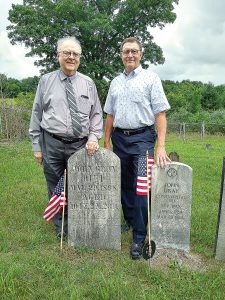
Today John Gray rests in McElroy Cemetery on John Gray Road, the 1956 memorial is in front of the Noble County Administrative Building on state Route 821, and the monument adorns the Noble County Courthouse lawn in downtown Caldwell.
In the Noble County Historical Society Museum is the John Gray display -- and in the office is the 170-page binder containing everything Flossie Hall researched, assembled and readied for "another descendant's interest."