
Healthcare tech at WVU-P offers hands-on education
Trending
PARKERSBURG -- Students at West Virginia University at Parkersburg going into healthcare technology fields have training options that utilize state-of-the-art equipment that gives them opportunities for practical hands-on experience.
Students can train at WVU-P in a variety of fields including the Patient Care Technician program and the Surgical Technology program.
Students who already have their associate's degree in nursing can work on their bachelor's degree through online classes at WVU-P through the RN-BSN program.
The idea is to get hands-on experience learning how to handle and use the equipment as well as with clinical rotations in facilities around the area.
The Patient Care Technician certificate prepares a student for employment as a Patient Care Technician in a variety of settings including the hospital, a physician's office and free-standing clinics.
Sherry McCay, patient care technician instructor, said students learn to take care of the patients, take vital signs, EKGs and more. McCay said they gain the foundation where they can move into the surgery technology and nursing programs.
By the end of the program they become certified EKG technicians and phlebotomists, technicians who obtain patient's blood specimens by venipuncture and micro-collection. They also do clinicals and rotations at different facilities around the area.
The program begins in August and the student will graduate in May.
"Many are using this as a stepping stone to move into other programs," McCay said.
Amy West, Surgical Technology Program director/assistant professor at WVU-P, said a 16-month associate degree for surgical technology is available for 20 students a year.
Through a combination of classroom presentations, campus laboratory practice and clinical experiences, the student will develop a knowledge of the surgical environment, instrumentation, procedures and supplies necessary to ensure safe care of the surgical patient.
The surgical technologist is the one behind the scenes who no one sees, West said.
"We are setting up that surgery before it starts, preparing the case, getting everything set up and getting everything the surgeon needs before the patient comes in," she said. "We gown and glove the doctor, drape the patient, hand the instruments to the doctor during the surgery.
"The patients don't always know we are there."
West said they have just ordered a new Science LapSim Laparoscopic Virtual Reality Simulator which should be in by August to begin with classes then. WVU-P will be the only school in the state with such a simulator. Laparoscopy is a minimally invasive procedure that requires only small incisions.
"Students can do simulations in being able to hold a camera for the doctor during cases," West said of the new simulator.
It will also help students do anatomy reviews to make sure they know where everything is.
"We're excited," West said.
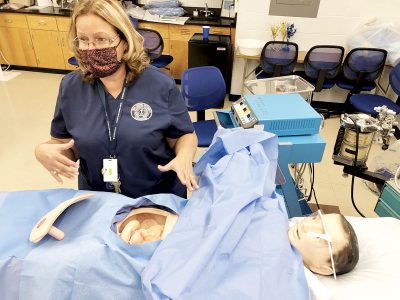
A simulation lab includes high-fidelity manikins, life-size patient models, for students doing mock surgeries. Students learn how and where to hold the camera, become familiarized with other pieces of equipment used and more.
Once students go through the program they are eligible for the National Board of Surgical Technology and Surgical Assisting exam, a national program enabling students to work in all 50 states if they pass it.
The program runs from August to December of the following year. Clinical experiences are offered under faculty and mentor supervision at Camden Clark Medical Center, Marietta Memorial Health Systems, Thomas Memorial, Charleston Area Medical Centers and other selected community agencies.
Students usually go on three to four clinical rotations during the course of the program.
"They get a lot of clinical experiences," West said.
The university brought back the program in 2018 and it has had two graduating classes with 100 percent board pass rates on boards.
Students who have their associate nursing degree, and are working, can also work towards getting the bachelor's degree through the RN-BSN program.
Rose Beebe, RN-BSN Director, said the program is a bachelors program for working nurses with an associate's degree. They can continue to work as an RN and go through coursework online.
"They do the work while they are off," Beebe said. "It is a 120-credit hour program."
Students can take nine additional courses over five semesters as part-time students or three semesters as a full-time student.
"They can still work, meet family commitments and more while getting their bachelor's."
Contact Brett Dunlap at bdunlap@newsandsentinel.com