
Baldwin selected as next West Virginia Senate Minority Leader
Trending
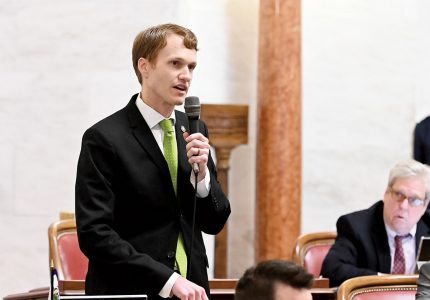
CHARLESTON -- The Democratic members of the West Virginia Senate united around state Sen. Stephen Baldwin to be their new minority leader as the caucus navigates the next two years with fewer members.
Baldwin, a 38-year-old Presbyterian pastor from Greenbrier County, was selected Sunday night by his fellow Democratic senators to succeed Senate Minority Leader Roman Prezioso, D-Marion, who retired from the Senate.
Speaking by phone Monday, Baldwin said he decided to step up and lead over the last couple of years, but he was surprised and humbled that his caucus felt confident in his leadership to promote him to head of the caucus.
"It's really humbling. It's a real honor," Baldwin said. "We've got a tremendous team in our caucus. They're all more talented and have received more professional accolades than I will. They're really high quality, professional people who are really good at what they do. So it's a real honor to get to be part of that team and just try and make sure everybody's in a position to succeed."
Baldwin is the third senate minority leader since the Republicans took the majority in the Senate in 2014. First elected to the House of Delegates in 2016, he was appointed by Gov. Jim Justice in 2017 to replace former Greenbrier County state senator Ron Miller, who resigned to take a role in the Justice administration advising on agricultural issues. Baldwin won election to the Senate in 2018 and is in the middle of his first full term.
The pastor of Roncerverte Presbyterian church since 2007, Baldwin is married to Kerry and they have a son named Harrison. Much like his service to his church and earlier service to his community as a member of the Greenbrier County Board of Education, Baldwin said he plans to lead his caucus by being a servant.
"The congregation I serve views public service as part our calling and part of our ministry," Baldwin said. "I think it's important to our community and important to our state to try and approach public service that way. I'm a pastor to Republicans, I'm a pastor to Democrats, and a pastor to independents. So that's going to be my approach. I'm a peacemaker."
The Senate Democratic Caucus is the smallest it's been since Republicans took the majority in both chambers of the Legislature in 2014. The 34-seat Senate was tied 17-17 after the 2014 midterm elections until former Wyoming County state senator Daniel Hall switched from Democrat to Republican, giving the Republicans a one-seat advantage.
After the 2018 election, the Senate had 20 Republicans and 14 Democratic members. But a red wave hit the state in 2020, giving the Republicans 23 seats and a supermajority. Republicans won four open seats, one Republican defeated a Democratic incumbent, and three seats saw no Democratic challengers. The aftermath left Senate Democrats with just 11 members.
While the caucus still needs to develop its priorities and philosophy, Baldwin plans to focus on two goals to start. First, to develop the caucus into a true loyal opposition, fighting for the interests of their constituents for the best ideals of West Virginia's Democrats. Second, to continue to push public policy ideas that the caucus believes will benefit the state.
Baldwin is quick to recognize that Republicans hold all the cards and can easily block any bills brought forward by the Democratic caucus. Baldwin said they will work with the Republicans to get legislation through, but that doesn't mean the caucus isn't prepared to stand up and fight for what they believe in.
"We don't have power," Baldwin said. "Republicans control every aspect of government in West Virginia. The power that we have is the power of conscience. We want to work with the majority when we can, but when we think they've gone astray, then we're going to stand up and say so."
Still, Baldwin said there is more that unites both parties than divides them. He sees agreement on multiple public policy fronts, including an effort to expand high-speed broadband internet across the state.
"I would guess that our top one, two, and three priorities are broadband," Baldwin said. "And I would say that the top three priorities of the supermajority are probably broadband as well. So, that's a great area in which it ought to be non-partisan. We ought to all be working together on solutions, because they're not easy but we all know we need to do it."
Steven Allen Adams can be reached at sadams@newsandsentinel.com