
Trending
CHARLESTON -- With the coronavirus pandemic continuing early voting and election day on Tuesday, Nov. 3, state and county election officials making sure polling locations in all 55 counties have the poll workers needed to run elections.
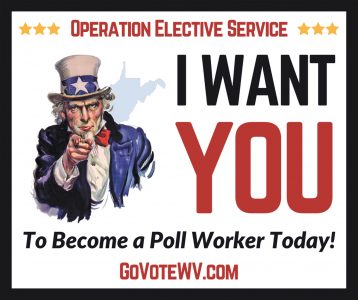
Leading up to the June 9 primary election, the Secretary of State's Office launched Operation Elective Service. Modeled after the Selective Service military draft and the iconic Uncle Sam recruitment posters, the goal is to help staff up polling precincts for the elections.
According to Matthew Gallagher, special projects coordinator for the West Virginia Secretary of State's Office, approximately 9,000 poll workers are needed for the early voting period between Wednesday, Oct. 21, and Saturday, Oct. 31, as well as the Nov. 3 election. There are more than 1,700 voting precincts in the state.
West Virginia's elections have traditionally been ran by older poll workers, but the COVID-19 pandemic has made it harder for older poll workers. According to data from the Department of Health and Human Resources, the vast majority of deaths due to COVID-19 have been in people between the ages of 70 and 89.
The average age of the more than 317 people who have died from COVID-19 is 79.
The virus also affects people with pre-existing medical conditions. According to the U.S. Centers for Disease Control and Prevention, the following medical conditions put people at greater risk when infected with COVID-19: cancer, chronic kidney disease, COPD, obesity, serious heart diseases, sickle cell disease, type 2 diabetes, and people who are immunocompromised.
Operation Elective Service encourages West Virginians who are not at high risk for greater COVID-19 complications to sign up as alternate poll workers. These poll workers are on standby if there are shortages of poll workers in the county they reside in. Gallagher said that more than 1,667 residents signed up for Operation Elective Service between Sept. 11-13.
"We are extremely proud that so many West Virginians have responded so positively to our request for poll workers," Gallagher said. "We want to make sure counties have enough alternates to fill in, should poll workers decide it is best to stay at home because of COVID-19."
Poll workers must be registered voters in the county they live in. Poll workers are also paid to attend trainings with county clerk staff and are paid for working the polls and must be available to work the entirety of Election Day, when polls open at 6 a.m. and close at 7:30 p.m. The amount of pay for poll workers varies depending on the county.
Those interested in being alternate poll workers can go visit their county clerk's office or go to GoVoteWV.com and click on the "Become A Poll Worker" button. From there, voters can fill out the form. Once submitted, someone from the county clerk's office will contact the voter and schedule training.
Those prohibited from being poll workers include candidates for office; their parents, children, siblings, or spouses; and anyone already prohibited by law.
Steven Allen Adams can be reached at sadams@newsandsentinel.com