
West Virginia University at Parkersburg’s 9/11 memorial goes virtual
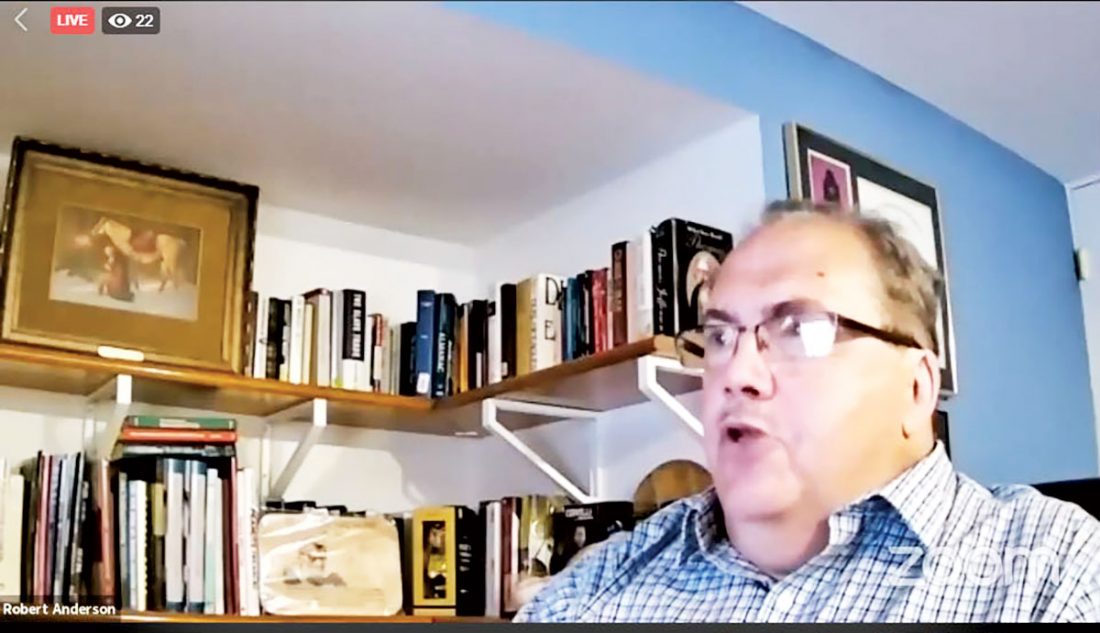
West Virginia University at Parkersburg history Professor Rob Anderson is shown in a screen shot as he outlines the historical context of the Sept. 11, 2001, terrorist attacks during an online memorial ceremony organized by the college. (Image Provided)
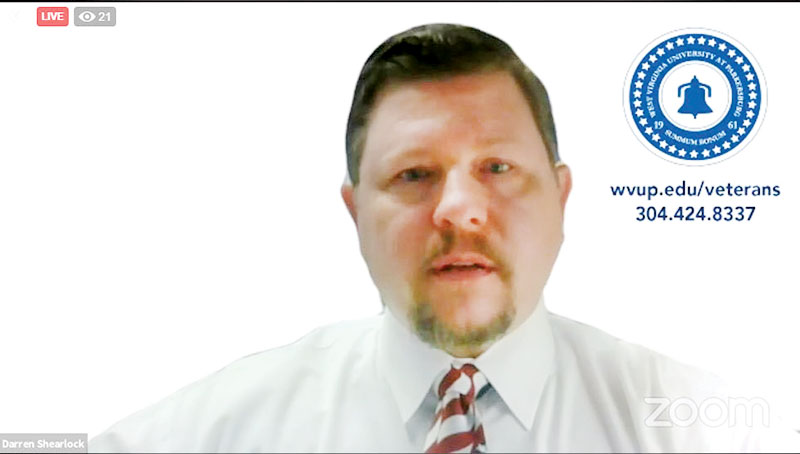
West Virginia University at Parkersburg veterans advocate Darren Shearlock is shown in a screen shot as he recounts his memories of the Sept. 11, 2001, terror attacks during an online memorial ceremony organized by the college Friday. (Image Provided)
West Virginia University at Parkersburg history Professor Rob Anderson is shown in a screen shot as he outlines the historical context of the Sept. 11, 2001, terrorist attacks during an online memorial ceremony organized by the college. (Image Provided)
West Virginia University at Parkersburg veterans advocate Darren Shearlock is shown in a screen shot as he recounts his memories of the Sept. 11, 2001, terror attacks during an online memorial ceremony organized by the college Friday. (Image Provided)
Trending
PARKERSBURG -- Members of the West Virginia University at Parkersburg community came together virtually Friday to recognize the 19th anniversary of the Sept. 11 terrorist attacks.
"I'm very proud to be part of an institution that after all these years is committed to remembering," WVUP President Chris Gilmer said.
With most classes being conducted online, faculty and staff presented an online observance that began with history Professor Rob Anderson providing a historical context for the attacks.
The radical Muslim Taliban filled the political power vacuum when the Soviet Union withdrew from Afghanistan after 10 years of battling insurgents, who had been sponsored by the United States "within the context of the Cold War," Anderson said. The Taliban harbored individuals like Osama bin Laden, who sponsored terrorism targeting supposed threats to the Muslim world, he said.
"Obviously to bin Laden, the United States was the target," Anderson said. "He wanted a huge strike against the United States, to hit symbolic structures of America's economic power, political power and military power."
That led to the hijacked airliners on Sept. 11 being flown into the twin towers of the World Trade Center in New York and the Pentagon in Washington, D.C. A fourth plane, believed to be headed for the U.S. Capitol, crashed in a field near Shanksville, Pa., when passengers learned of the other attacks and attempted to retake control.
"By this point, word was starting to spread and passengers … on United 93 recognized that this was not what they would have said, at the time, was a typical hijacking," said Anderson, who was then an adjunct professor at Penn State Altoona, an hour or so from Shanksville.
Nearly 3,000 people died in the attacks.
"This obviously changed America forever and would ignite the War on Terror, which has lasted now for over 18 years," Anderson said.
Lead campus police officer Al Collins said some of the changes were temporary, pointing to the political divisions before the attacks and in recent years.
"Everybody came together at the time," he said. "It changed us for about eight years. … We've got to get back to where everybody matters, we take care of everybody … and we're on the same team again."
Collins was at WVUP when the attacks happened, as was program specialist Kim McFee. She said the fear of that day was extended when her husband at the time became an air marshal as America tried to grapple with the security threats exposed by the attacks.
"I lived in fear for those six months" he was traveling in that capacity, McFee said.
Darren Shearlock, WVUP's veterans advocate, was a staff sergeant in the U.S. Army, preparing to transfer from Ft. Bragg in North Carolina to a recruiting post in Atlantic City. He heard about the plane hitting the first tower on the radio and saw the second plane hit while filling out paperwork to rent a truck.
"I said to myself, 'This isn't an accident. We're actually at war,'" he said.
Shearlock described returning to Ft. Bragg and seeing two soldiers, ages 18 and 20, manning machine gun pits at the gate.
"Just looking at their face, you could see that they were terrified, because they now have a machine gun with live ammunition and are looking at every American that's coming through (there), that they might be the next enemy," he said.
Needing to pick up a last bit of paperwork from his boss, Shearlock asked for his recruiting orders to be canceled so he could remain with his unit.
"He looked at me and says, 'Sgt. Shearlock, if you're right and we're really at war with somebody that can do this, then we need people to recruit more military, because this is going to be a huge fight,'" he said.
Shearlock went on to Atlantic City and worked as a recruiter for a year before his duties shifted again, taking him to Iraq, Jordan, Kuwait and Western Africa.
"It was a lot of deployments overseas," lasting six months to a year and often with him unable to tell his family exactly where he was going, he said.
Evan Bevins can be reached at ebevins@newsandsentinel.com.