
Judge throws out cases challenging West Virginia’s school re-entry metrics
Trending
CHARLESTON -- In the first legal test of Gov. Jim Justice's state of emergency powers, a Kanawha County court rejected a parent's lawsuit challenging the state's ability to close down in-person learning using metrics and a color-code system to limit the spread of the COVID-19 coronavirus.
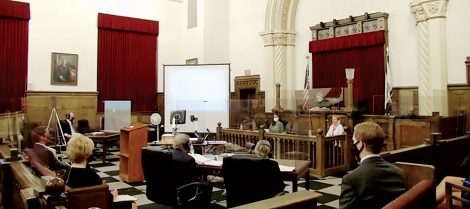
Kanawha County Circuit Judge Tod Kaufman ruled Friday morning in favor of a motion by attorneys for Justice, the Board of Education and the Department of Health and Human Resources to dismiss the case brought by Charleston attorney and parent Alex McLaughlin.
Kaufman also denied a motion for a preliminary injunction by McLaughlin to prevent enforcement of the County Alert System metrics and map developed by DHHR and used by the Department of Education to determine what school can open each week for in-person learning. Schools in the green, yellow and gold can reopen at the discretion of county superintendents, but schools in the orange and red have to close and switch to distance learning.
The color codes are determined based on a seven-day rolling average of virus cases per 100,000 based on a county population of 16,000 or more residents, or on a 14-day rolling average of cases per 100,000 people based on counties with populations less than 16,000. Color codes for green, yellow and gold counties are also determined based on the percent of positive cases in the county.
McLaughlin, who represented himself, filed suit against the state on Sept. 4, asking the court for the injunction to block enforcement of an executive order requiring county public school systems and private schools to abide by the County Alert System. McLaughlin is a single parent who has two children in Sacred Heart Elementary, a Catholic grade school.
McLaughlin pulled one of his children -- a daughter -- from Kanawha City Elementary School after the school re-entry metrics were released showing Kanawha County could not re-open for in-person learning, but Sacred Heart soon followed suit and also went to distance learning. McLaughlin argued it's unfair to hold public schools to different standards than summer camps and daycares and it was discriminatory to close schools and not restaurants and bars.
"She's been denied the access to go to school where she would have a place for education, have an opportunity for social interaction and she would have a teacher supervising her and making sure she is following along on the same page turning in her work and doing her work," McLaughlin said.
McLaughlin said Justice and school officials have infringed on his children's right to a "thorough and efficient system of free schools" as guaranteed by the West Virginia Constitution.
"The constitutional issue is the right to education; he's infringed on the right to education," McLaughlin said. "He's done it in a way that discriminates against education. He hasn't set up identical or neutral rules that all businesses and all buildings should follow in order to be allowed to go in and occupy them. They're discriminatory."
The metrics, developed by health officials in DHHR and Dr. Clay Marsh, the state coronavirus czar and the vice president and executive dean of Health Sciences at West Virginia University, also came under fire from McLaughlin.
Kaufman asked McLaughlin why he didn't think Marsh had the expertise to develop the metrics and comment on them.
"You just don't think a public health person could give any guidance on that," Kaufman asked.
"I would think he ought to have cited some science to support it. He didn't," McLaughlin said. "It is just the opinion of a critical care physician saying, 'I believe that being together for eight hours makes schools a bigger risk than restaurants and bars where they're only assembling for an hour or so.' He did not cite any science for that."
"He is certainly qualified to even just say that," Kaufman said.
Attorney Ben Bailey, representing Justice, said the governor used appropriate authority given to him by state code for issuing executive orders during a state of emergency, including orders determining when it is safe to reopen schools.
"The governor … put a plan in place to reopen the schools and to reopen them carefully," Bailey said. "The biggest single indicator of the risk of spread of COVID in schools, like in nursing homes, is the community spread. The more COVID in a community, the greater the risk. The map takes into account the number of cases … a thorough and efficient school has to be safe."
Kelli Talbott, a senior deputy attorney general representing the state Board of Education, argued that McLaughlin had no case against the state because neither of his two children are in the public school system. A recent executive order also allows private and Christian schools to re-open in orange counties as long as all students and staff are tested for COVID-19.
"There's no question that a safe and secure school environment is part of the constitutional mandate for a thorough and efficient education," Talbott said. "But we cannot ignore that at the present time as we're here today, his children are not enrolled in the public schools. That is a critical fact as far as this case goes."
Kaufman said Justice's executive order does not discriminate and is broad-based. Kaufman told McLaughlin that he has suffered no injury in order to bring a case against the state.
"Education is a right that extends to the parents as well the children," McLaughlin responded. "Parents have a responsibility and a right to educate their children as they see fit. It is a responsibility that resides in me."
Steven Allen Adams can be reached at sadams@newsandsentinel.com.