
WVU choral director designs mask for singing
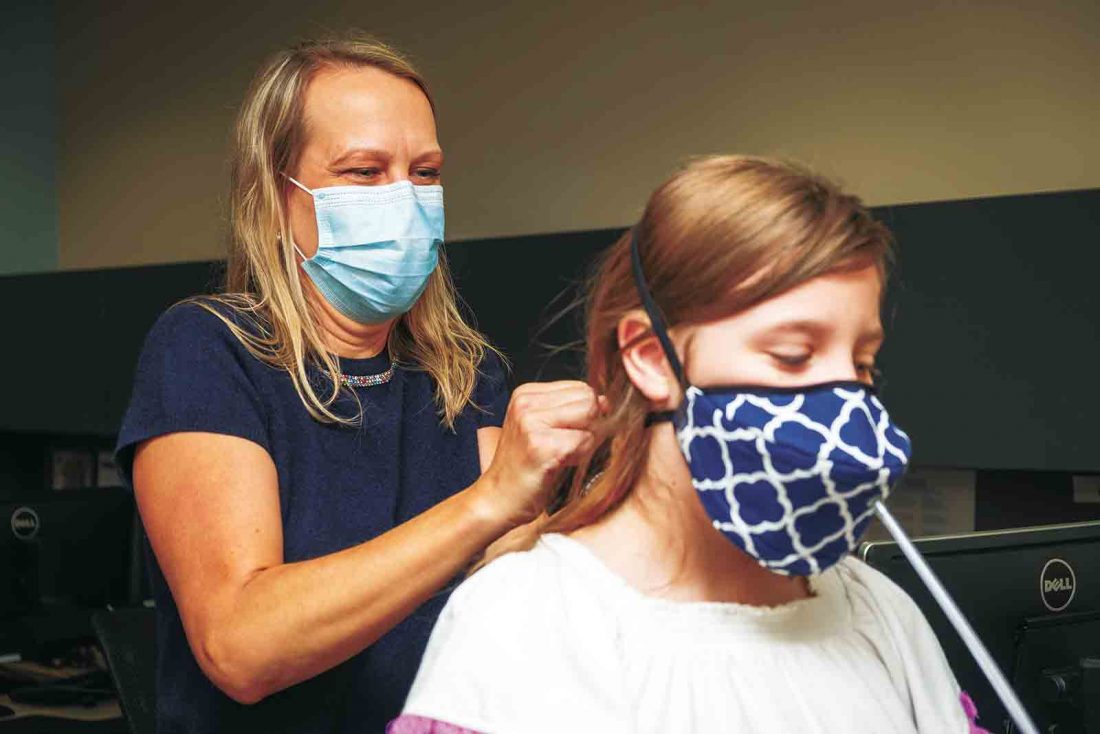
Kym Scott, director of choral activities at West Virginia University, helps Thessaly Troilo, 10, with a performance mask during testing. (Photo by Chris Young)
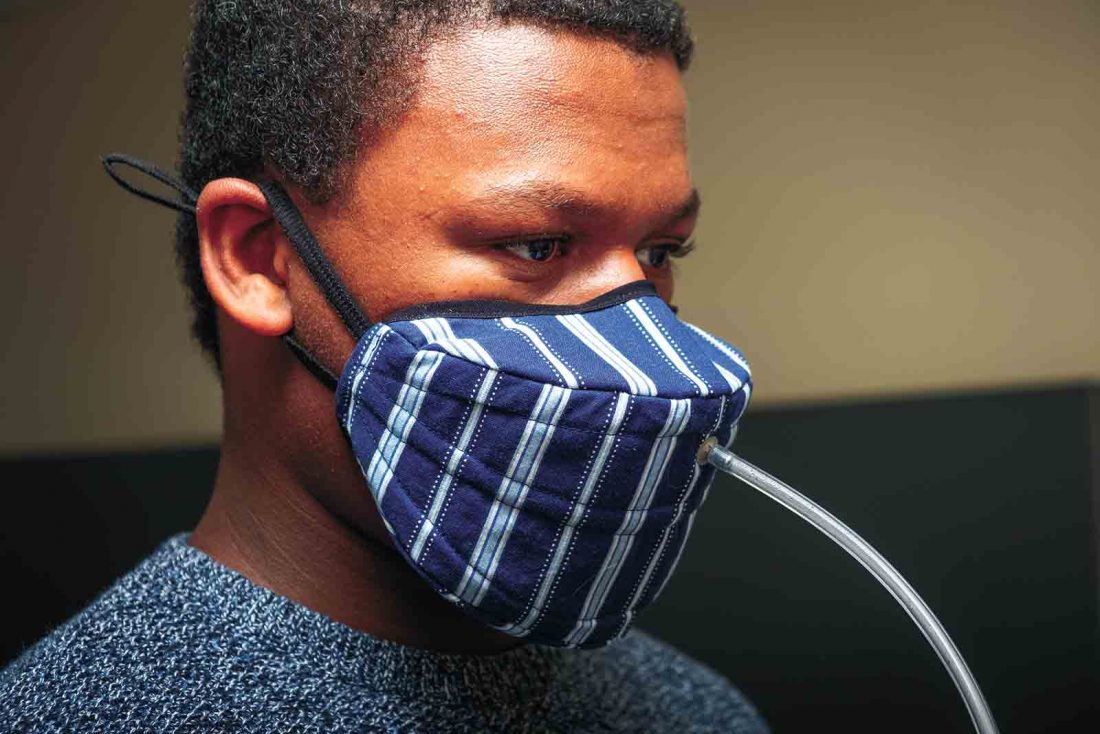
Juwan Johnson, a vocal performance senior, tests a mask developed by Kym Scott, director of choral activities at West Virginia University, that allows more comfort and ability to project while singing. (Photo by Chris Young)
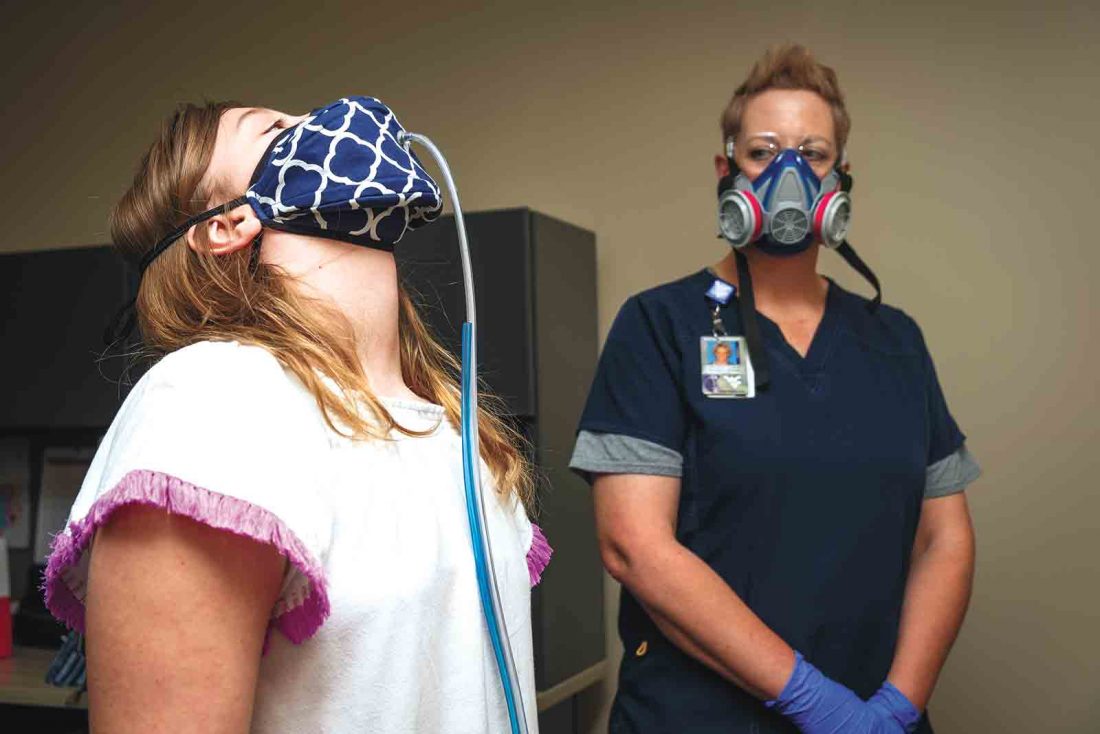
Thessaly Troilo, 10, tests a performance mask as Veronica Cyphert, a medical surveillance coordinator in occupational medicine at West Virginia University, watches. (Photo by Chris Young)
Kym Scott, director of choral activities at West Virginia University, helps Thessaly Troilo, 10, with a performance mask during testing. (Photo by Chris Young)
Juwan Johnson, a vocal performance senior, tests a mask developed by Kym Scott, director of choral activities at West Virginia University, that allows more comfort and ability to project while singing. (Photo by Chris Young)
Thessaly Troilo, 10, tests a performance mask as Veronica Cyphert, a medical surveillance coordinator in occupational medicine at West Virginia University, watches. (Photo by Chris Young)
Trending
MORGANTOWN -- A choral director designed a face mask for her students at West Virginia University.
Kym Scott, director of choral activities at WVU, recognized the limitations of singing and performing in masks from the onset of the pandemic, so she tapped into her prior life as a fashion designer to solve a problem unforeseen by non-entertainers.
Scott needed to figure out how to teach singing to her students. Ear-loop disposable face masks and over-the-ear cloth coverings didn't work.
"I originally commented that if we were going to have to sing in those masks, I would rather do everything online," Scott said. "Singing in a mask is so difficult."
A former wedding dress designer, Scott knows about sewing and designs. Never did she anticipate both of her professional worlds marrying in harmony due to a deadly virus.
She developed a "performer's mask," which projects a few inches away from the face and has a sturdy, lightweight framework that keeps the wearer from sucking in the fabric.
"It sits very close to the face to eliminate as much air coming in and out of the mask," Scott, an assistant professor in the School of Music, said. "Yet your nose and mouth are far enough away that you can take in good breaths."
The ideas kept flowing. Scott developed a second mask, which she calls the "teacher's mask," designed for teachers and public speakers.
"Personally, I was struggling with wearing cloth masks and having conversations with people, finding the sound very muffled," she said. "It can be difficult to understand. So I thought, if I'm going to be teaching and speaking with a mask on all day, I need to create something that'll get me past those challenges."
The teacher's mask is a smaller, compared to the performer's mask.
Scott said she's already received inquiries from church ministers and people who do public speaking. She's even fielded requests from people with asthma or respiratory issues, who believe they can benefit from a mask that allows more room for breathing.
And one of the best perks of Scott's creations eliminates a pet peeve for the bespectacled. Glasses don't fog.
The masks are outfitted with wires at the top that closely rest to the face, preventing air and moisture from rising and landing on lenses.
Early in the development stage, Scott consulted with researchers at the WVU Center for Inhalation Toxicology, or iTOX. Over the course of the pandemic, iTOX has collaborated with hospitals and the West Virginia National Guard and has tested the effectiveness of face coverings in its state-of-the-art Inhalation Facility.
Scientists found Scott's masks offer a level of protection greater than a surgical mask, which has gaps along the sides.
Researchers conducted a fit test, which evaluates how well a mask protects the person wearing the mask.
Scott's masks scored a 4 on the fit test. Typical face coverings such as disposable or over-the-ear cloth masks tend to score a 1 or 2. A score of 100 is necessary to pass a N95 mask.
"What a fit factor of 4 means is that for every four small particles outside the mask, only one is getting in," said Karen Woodfork of iTOX, a teaching associate professor of physiology and pharmacology. "Nothing is 100 percent but that is significant and can make a person feel much safer."
People must still social distance and wash your hands, but the mask is a level of protection that isn't seen in average, over-the-counter, two-layer cloth and cotton masks, she said.
Woodfork said the mask contains a layer of cotton on the outside, a layer of non-woven polypropylene as as a filtration material and another layer of cotton on the inside.
Though Scott initially envisioned her masks to enhance the classroom experience, they will likely serve a purpose beyond the college campus.
Hannah Bush, assistant professor of music therapy in the School of Medicine, hopes to utilize the masks out in the community in places such as nursing homes, daycares and public schools for therapy sessions.
"As a music therapist, I utilize music to work on non-musical goals, such as utilizing singing to work on breath support and speech enunciation, and even utilizing scenes to elevate mood and bring positivity," Bush said. "A lot of us feel better after we sing and participate in live music interventions."
But Bush, too, has found that common disposable and surgical masks have been less than desirable in music therapy settings.
"The performance mask allows the extra space for singing," Bush said. "But we also know that it's stopping those aerosols."
Creative Arts students, including singing and theater majors, will be given a performer's mask as part of their welcome-back-to-school package, Scott said. Frostburg State University in Maryland is already using them and other universities and high schools across the country and Canada have sent inquires to Scott, she said.
Scott is hoping this is the encore.
"In an ideal situation, we won't need to use these a year from now," Scott said. "But I can see these masks being practical in other professions -- maybe in the medical field or even construction sites. There are worksites where you need to yell instructions and information to other people and this could show that the audio can be better while containing droplets. It's got a lot of potential uses."