
WVU-P panel discusses coronavirus

Jillian Jeffrey answers questions during a Coronavirus Forum at West Virginia University at Parkersburg on Tuesday. (Photo by Brett Dunlap)
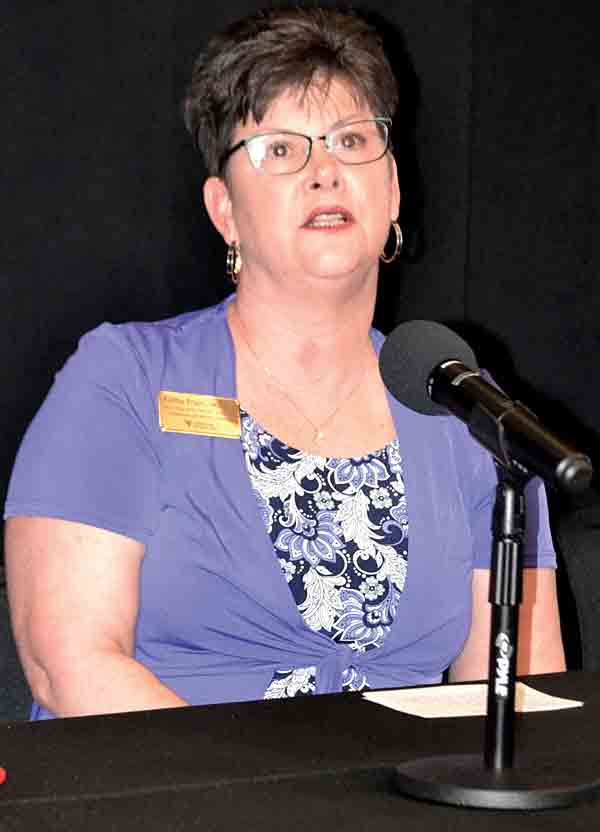
Kathy Frum answers questions during a Coronavirus Forum at West Virginia University at Parkersburg on Tuesday. (Photo by Brett Dunlap)

Dr. Seyoum Bage answers questions during a Coronavirus Forum at West Virginia University at Parkersburg on Tuesday. (Photo by Brett Dunlap)
Jillian Jeffrey answers questions during a Coronavirus Forum at West Virginia University at Parkersburg on Tuesday. (Photo by Brett Dunlap)
Kathy Frum answers questions during a Coronavirus Forum at West Virginia University at Parkersburg on Tuesday. (Photo by Brett Dunlap)
Dr. Seyoum Bage answers questions during a Coronavirus Forum at West Virginia University at Parkersburg on Tuesday. (Photo by Brett Dunlap)
Trending
PARKERSBURG -- West Virginia University at Parkersburg held a Coronavirus Forum on Tuesday with around 70 people from around the college and the community attending and able to ask questions of local health officials.
The panel consisted of Jillian Jeffrey, regional epidemiologist, Mid-Ohio Valley Health Department; Dr. Seyoum Bage, infectious disease medicine, WVU Medicine Camden Clark Medical Center; and Kathy Frum, MSN, RN, chairperson of the Nursing & Health Sciences Division, WVU Parkersburg. WVU Parkersburg President Chris Gilmer acted as moderator and spoke about precautions they will be taking at the college if the coronavirus spreads further and impacts the local area.
''I had a number of messages and e-mails already from people watching remotely because there are already people apprehensive about coming into public settings,'' Gilmer said. ''We have brought these people here today in an abundance of concern for your health and safety.''
Jeffrey said Tuesday there have been no confirmed cases of the COVID-19 so far in West Virginia.
''Right now we are focusing on prevention,'' she said. ''We want to make sure that you are washing your hands frequently.
''If you are sick you should stay home. If you are coughing or sneezing you should wash your hands after that. If you are out in the community you should wash your hands afterwards. We want you to focus on everything you can do to keep yourself healthy right now.''
So far no travel restrictions have been put in place within the United States, Jeffrey said. They are advising people to continually wash their hands if they are out in public or around sick people. If you are in public, avoid touching your eyes, nose or mouth.
''If you are out in the community around people who are sick, you should maintain six feet away from anyone who is coughing or sneezing. That is called social distancing,'' she added. ''Just focus on those basic preventive measures to keep yourself healthy.''
Frum talked about washing your hands thoroughly with soap and water.
''What is happening with the soap is it is lathering and bumping that bacteria or whatever off of your hands and you're doing the friction for 20 seconds and rinsing your hands in a downward fashion,'' she said. ''You will see (a nurse) get a paper towel and dry our hands off, get another paper towel and turn the faucet off and get another paper towel to open the door.''
That is done because the virus can live on inanimate objects for a little while and can be on the faucets and doors.
''Washing your hands is probably the best thing you can do,'' she said.
Bage said the situation with the virus nationwide remains "fluid" as things might change. Right now, the United States is considered a low risk for the virus, but that could change, he said.
Audience members asked questions about how the virus is transmitted, how serious it is compared to a cold or the flu, will it become commonplace in a year or so, what precautions/how often should they clean surfaces in classrooms.
The virus is transmitted through droplets, like any cold or flu virus, and can stay alive on surfaces for a few hours on hard surfaces, Bage said, adding it can be transferred by people touching those surfaces and then touching their faces.
The panel recommended people clean their mobile phones and computers regularly.
''You should be cleaning high touched surfaces regularly,'' Jeffrey said of technology, handrails, chair armrests, desktops, restrooms. ''It is anything that is frequently touched.''
There is a list of recommended cleaning supplies on the Centers for Disease Control website. For many surfaces the CDC recommends a third cup of bleach to a gallon of water.
''Regular cleaning will prevent different illnesses from being transmitted,'' Jeffrey said.
Bage said there is a lot of speculation going on now. They don't know how long the virus will last, whether it will die out after one season.
''There are a lot of unknowns,'' he said.
Gilmer reiterated that it was probably best to hope for the best outcome, but be prepared for the worst.
''Hope the crisis doesn't come, but be prepared for it being as bad as it can in case it does,'' he said.
Someone asked the panel about tests conducted on at least five people in the state where two have come back negative for the virus by the CDC. The person wanted to know where in the state these people might be.
Jeffrey didn't know where the tests were conducted, but steps are in place to protect the people involved.
Bage said the symptoms are similar to the seasonal flu, cough, fever, headache, nausea. People can treat those symptoms as they normally would with over-the-counter medications. If it persists they may need to seek out medical help.
If people need to go to the doctor, they should call ahead so the doctor's office knows what they might be dealing with and whether you have a travel history, Jeffrey said.
Bage said the virus incubation can take 10-14 days. The duration of the symptoms is determined case to case.
People are most contagious when they are ill, but they do not have to have symptoms showing to be contagious, the panel said. A person needs to be tested twice over 24 hours with negative results before they are determined to not be contagious anymore.
The university is putting precautions in place should it need to move classes online.
''We will be prepared to do that,'' Gilmer said, adding WVU-P has a stockpile of supplies to clean and sanitize the college.
''We are taking every precaution we can think of to promote the health and safety of the university,'' Gilmer said.
The panel recommended that the CDC website had the most up-to date-information on the virus and recommends people check there regularly.
People can watch the entire presentation by going to wvup.edu/live.
The Centers for Disease Control coronavirus website is cdc.gov/coronavirus/2019-ncov/summary.html.