West Virginia House of Delegates adopts amendments to intermediate court of appeals bill
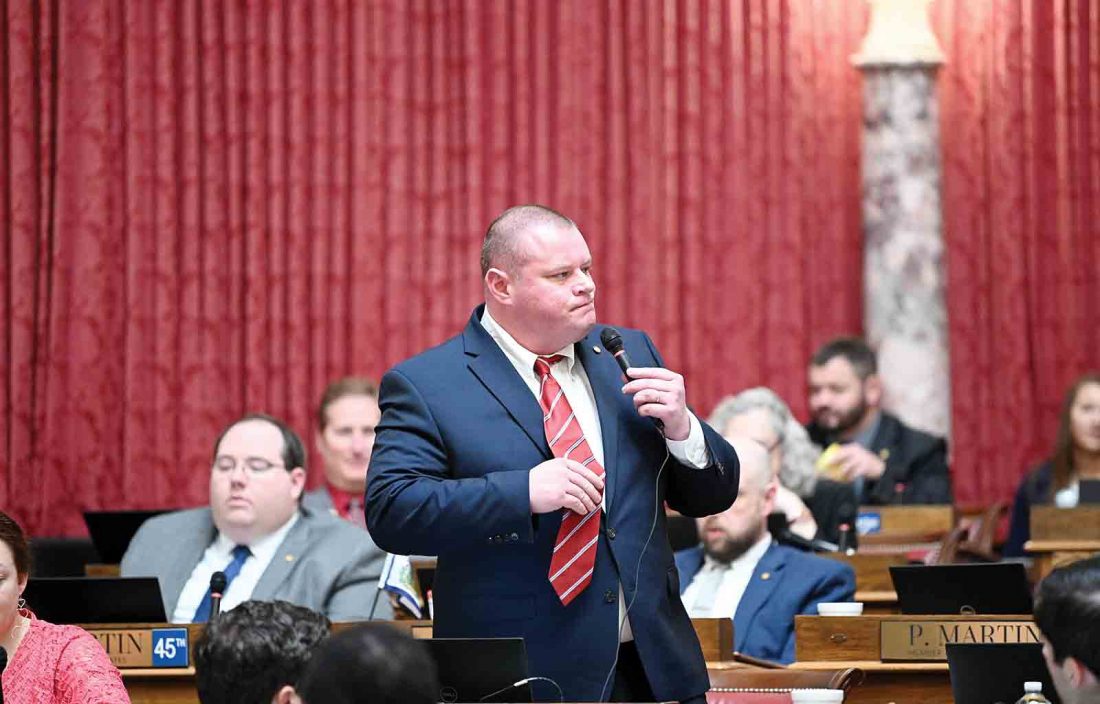
Delegate Brandon Steele, R-Raleigh, speaks against an amendment to a bill establishing the intermediate court of appeals. (Photo courtesy of WV Legislative Photography)
CHARLESTON — The House of Delegates adopted several amendments to a bill creating an intermediate court of appeals in West Virginia.
Senate Bill 275, which establishes the court between the lower courts and the West Virginia Supreme Court, is up on third reading today.
The legislation creates two three-judge districts to hear appeals of circuit court criminal and civil cases, guardianships and conservatorships, family court cases and decisions made by administrative law judges, the Health Care Authority and Workers’ Compensation Board of Review starting Jan. 1, 2023.
Fiscal notes estimate an intermediate court system could cost as much as $8.5 million to start up and $7.2 million in its first full year, but delayed implementation would not have an impact on the fiscal 2021 general revenue budget being discussed in the House and Senate.
The Supreme Court has operated under a rule since 2011 that all appeals are a matter of right and has issued written decisions in all appeals. Prior to 2011, the Supreme Court only heard appeals at its discretion. Lawmakers hope the intermediate court takes pressure off the circuit and family courts, while allowing the Supreme Court to focus on important cases that could affect how laws are interpreted.
The House adopted three amendments to SB 275 Thursday. The first by Delegate Lisa Zukoff, D-Marshall, would require the intermediate court to also hear abuse and neglect, foster care and cases involving juveniles. In 2018, circuit courts heard more than 8,000 juveniles cases, including more than 5,000 abuse and neglect cases. The amendment was adopted 51-48.
Zukoff said her amendment would allow the intermediate court to hear cases involving the termination of parental rights, the transfer of foster children from one facility to another, the transfer of juvenile offenders to adult offender status and other cases involving the rights of children and their parents or guardians.
“I think it’s important that children and family matters have as much as an expeditious system for appeals as everyone else in the system,” Zukoff said. “Because of the great number we have of these foster care cases, I believe it has really stressed the courts.”
House Judiciary Committee Chairman John Shott, R-Mercer, spoke against Zukoff’s amendment. Shott said keeping child welfare cases out of the intermediate court would allow them to move faster to the Supreme Court. Shott also said adding the child welfare cases would increase the cost of the new court.
“These cases need to be disposed of as quickly as possible to bring some stability and finality to the family unit,” Shott said. “It does bring into the equation some issue of delay. The court may be able to take them up as quickly as the Supreme Court can take them up, but it also opens up an opportunity for the losing party to appeal to the next level.”
The second amendment, which was adopted 51-48, removed the two physical locations for the districts, which were set in Clarksburg and Beckley. The amendment from Delegate Chad Lovejoy, D-Cabell, instead would allow the administrative office of the Supreme Court to schedule intermediate court cases in any location in the district convenient to the litigants.
While the Zukoff amendment could cost the state more money to set up, the Lovejoy amendment could save the state money by not setting up two physical locations for the new court. Lovejoy’s amendment is similar to the original Senate bill.
“The better way is the way the Senate sent it to us,” Lovejoy said. “If we’re going to create this new court, we should require it to do its business in all our communities…all of our constituents need access to this court.”
Delegate Brandon Steele, R-Raleigh, originally offered the amendment in the House Judiciary Committee to create two physical locations. Speaking against the Lovejoy amendment, Steele said allowing the court to meet throughout the district would create uncertainty.
“What we’ve done…is create certainty as to where the physical offices are located,” Steele said. “By creating these physical locations, we’re trying to spread out the development of jurisprudence in this state.”
The final amendment, offered by Steele, would require the attorney general to represent the state in all appeals to the intermediate court. The amendment was adopted 54-45, though several delegates who work in county prosecutor offices spoke against the amendment.
“These cases become personal for us,” said Delegate Joe Canestraro, D-Marshall, an assistant prosecutor in Marshall County. “I don’t think we should set in stone some amendment that the attorney general should appear as counsel for the state. If anything, I think the amendment should read that the prosecutor should appear as counsel for the state in the intermediate court of appeals. The reason I believe that is we’re the ones who worked on the case the whole time.”
Steven Allen Adams can be reached at sadams@newsandsentinel.com
Local News

Trump signs order to pay TSA employees after Congress fails to agree on DHS funding
Rubio pushes postwar plan for Strait of Hormuz after meeting G7 allies skeptical about Iran strategy
Israel says it faces first incoming missile from Yemen as war in Middle East intensifies

Mid-Ohio Valley Faith Calendar
Downtown Parkersburg churches plan Good Friday Stations of the Cross Walk