
Shawna Roberts describes quest for Ohio’s District 6 seat
Trending
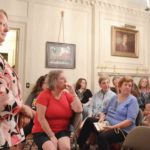
MARIETTA -- More than two dozen people spent two hours Tuesday night questioning and listening to a candidate challenging four-term U.S. Rep. Bill Johnson, R-Ohio, in the mid-term election to represent District 6.
Shawna Roberts said it's her first run for office. After the November 2016 election that put Donald Trump in the White House and the Republicans in control of both chambers of Congress, she said, she got involved with political and social action groups and protested in Washington, D.C.
"By the end of October 2017, nobody had stepped up to challenge Johnson, and my group, Indivisible, was concerned that nobody was going to run against him. I decided at a meeting I would do it," she said.
Topics brought up at the meeting ranged from energy policy to broadband access for rural areas and public education to the cost of college.
Roberts was emphatic about the need for universal access to broadband, comparing it to the need for electricity in the 1930s "to allow people to fully participate in development." The rural electrification program that gave rise to co-ops that still exist is a model that could be used to bring broadband internet connections to every household, she said.
Those connections are needed, she said. "If we had that connection, you could have employment, you could have jobs, businesses in rural areas. I've met FFA kids who want internet so they can do direct-to-consumer sales from family farms," she said.
Johnson, she said, has been in office since 2010, and although broadband was part of the infrastructure program established during the Obama recovery period, the mapping and connectivity program has not been funded by Congress.
In a statement emailed to The Times, Johnson said in part that he is working to address the broadband divide.
"Specifically, I have authored H.R. 4810, the MAPPING NOW Act which directs the National Telecommunications and Information Administration (NTIA) to resume the National Broadband Map to accurately identify areas that lack broadband coverage (as many communities that I represent do). We need to know where upgrades are needed nationally before we can target these unserved and underserved communities. The 'Omnibus' helped advance these goals, and included $625 million to build out rural broadband services. Additionally, the House passed Farm Bill takes further steps to bridge the digital divide," the statement read.
"It doesn't take eight years to come up with something like this," she said. "We're the richest country in the world, and we should be able to afford it."
Steve Porter, an education advocate in the audience, said broadband access also is essential to equality in education. "In college, if students have an assignment but don't stay on campus, they're out of luck if they don't have broadband at home," he said.
Speaking about energy, Roberts said that although oil and natural gas extraction is an important industry in southeast Ohio now, the district needs to prepare for the future. Other places, she said, using the example of Georgetown, Texas, have converted to renewable energy and attracted companies that are interested in being socially responsible.
"It can be done, it's going to take a while, and oil and gas and coal can co-exist with geothermal, solar and wind," she said. "We're like a brood mare farm in 1918 with 300 head, when cars were beginning to take over . For a long time, horses and cars co-existed. The world is going to make that shift to renewables; it's not going to sit still, and if we don't work with people, we will be behind and we will be in trouble," she said. Meanwhile, the coal industry workers need consideration, she said.
"We need to protect the miners," she said. "They've worked hard and powered the country, and we need to make sure their pensions are protected, and if people get laid off that they don't have to worry about their homes and their families."
The discussion turned to the election landscape, and Roberts in response to a question said she had a budget of about $50,000, while Johnson has over $1 million in cash.
The Federal Election Commission database showed Johnson with $1,474,232 cash on hand as of June 30, and Roberts with $2,671.
As the two-hour session began to break up, members of the audience got out their checkbooks.
Roberts said she thinks she has strong support in Marietta and northern areas of the district, especially suburban areas in the Mahoning Valley where women feel motivated to vote against Republicans.
Jenn Miller, a woman in the audience who later said she had moved to Marietta six years ago to care for her MS-stricken mother, said her daughter is a millennial who the day after Brett Kavanaugh was approved by the Senate for a seat on the U.S. Supreme Court, "got together with her friends and grabbed girls from the university, and they all went to register to vote.
"They're saying no more, they're tired of being told what to do by old white men, nobody wants to go back to the 1950s," she said. "I am a sexual assault survivor, a domestic abuse survivor, I talk to young women, my mother and my grandmother fought for women's rights, so how can I not continue that. I offer you my services, anything you need."
Roberts was born and raised in suburban Chicago, moved to California with her husband and graduated from San Jose State University in the 1980s and worked as a technical writer before establishing a beekeeping business with her husband. The couple moved to Belmont County in 2002 and now has five children. He works as a truck driver in the oil and gas industry, and she is a full-time mother.
District 6 is over 50,000 square miles, a long swath of Eastern Ohio from Youngstown to Ironton.
Election Day is Nov. 6.
***
About Shawna Roberts
* Name: Shawna Roberts
* Party: Democratic
* Office sought: House of Representatives, Ohio Congressional District 6
* Residence: Belmont County
* Family: Husband, five children
* Political experience: None
* Funds raised: $6,241.45
* Spent: $4,423.03
* Cash on hand: $2,671.24