Civil War letter hints at underwater telegraph line in Ohio River
-
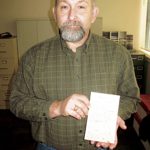
- Photo by Jess Mancini Brian Kesterson, a local Civil War history expert, holds the letter Clarkson Fogg wrote from Camp Lightburn in 1861 in which he talks about “a submarine telegraph line” installed in the Ohio River at Point Pleasant. No proof is available, but it implies a submerged telegraph line, high tech by Civil War-era standards, was installed at Parkersburg, he said.
-
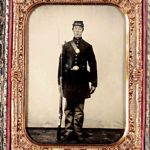
- Photo Provided The actual Civil War era photo of Clarkson Fogg, who served in the 4th Va. Infantry, later the 4th W.Va. Infantry. Fogg was killed in the Battle of Vicksburg in 1863.
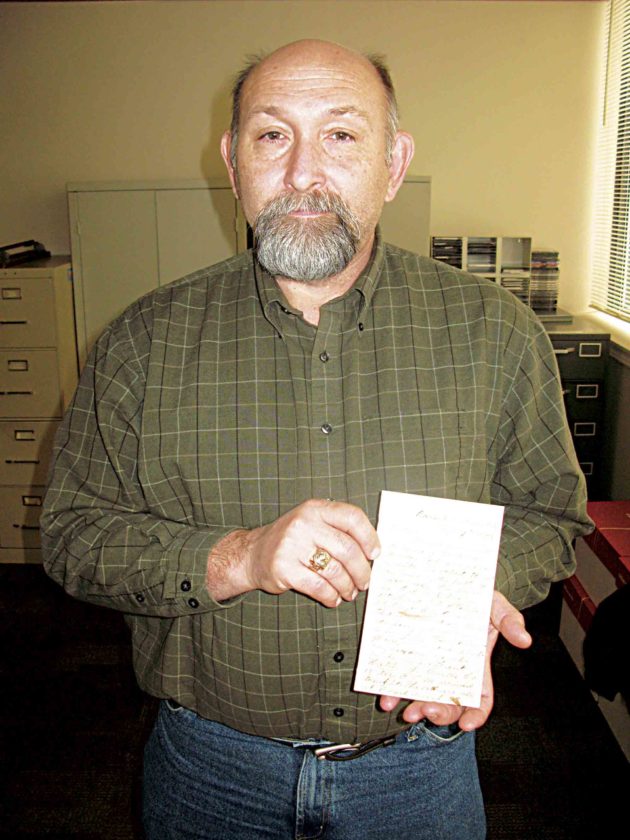
Photo by Jess Mancini Brian Kesterson, a local Civil War history expert, holds the letter Clarkson Fogg wrote from Camp Lightburn in 1861 in which he talks about “a submarine telegraph line” installed in the Ohio River at Point Pleasant. No proof is available, but it implies a submerged telegraph line, high tech by Civil War-era standards, was installed at Parkersburg, he said.
PARKERSBURG — A local Civil War expert hopes a discovery in a soldier’s letter could shed light on whether an underwater telegraph line was laid in the Ohio River at Parkersburg.
A submerged line under the Ohio River, which would have been high-tech in the era of the Civil War, would have been easier to guard and nearly impossible for Confederate saboteurs to cut, said Brian Kesterson, a Parkersburg Civil War historian with national recognition for his books.
Kesterson earlier this month was doing research for a book about Jackson County and the Civil War when he took a break and read letters he acquired in the 1990s from Clarkson Fogg. Fogg served in the 4th Va. Infantry, which later became the 4th W.Va., a Union regiment charged with protecting transportation and communication lines along the Ohio River.
In a letter dated Nov. 19, 1861, while Fogg was stationed at Camp Lightburn in Point Pleasant, he wrote to his parents that “a submarine telegraph line was stretched across the bend of the Ohio this Sunday last.”
“I’ve spoken with Ray Swick about the possibility that an line was across the Ohio in Parkersburg, but there isn’t any proof,” Kesterson said. “I remembered reading about a telegraph line across the Ohio, but couldn’t remember where.”
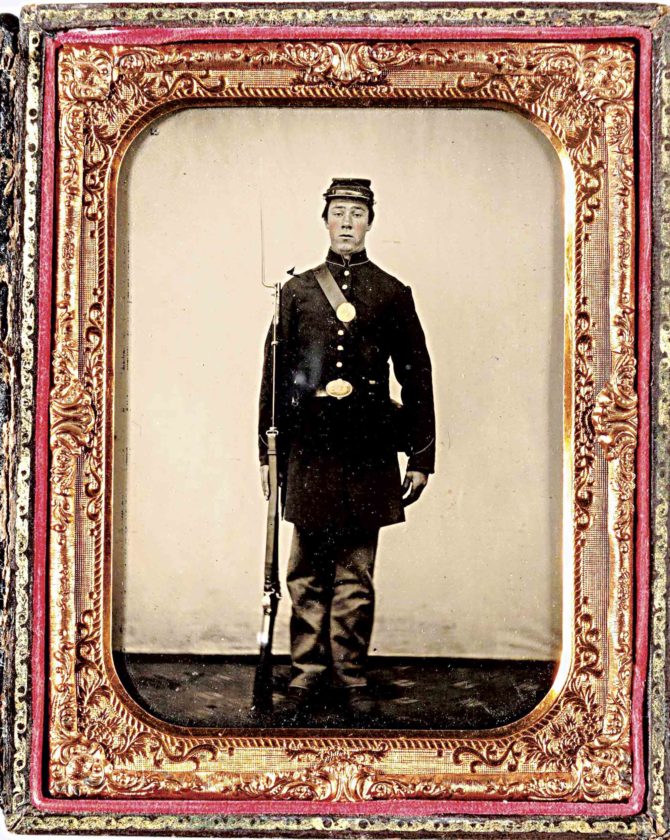
Photo Provided The actual Civil War era photo of Clarkson Fogg, who served in the 4th Va. Infantry, later the 4th W.Va. Infantry. Fogg was killed in the Battle of Vicksburg in 1863.
While the Fogg letter from Point Pleasant isn’t proof a submerged line was installed at Parkersburg, it opens up the possibility in light of Parkersburg’s roll in the war, Kesterson said. Thousands of Union soldiers were temporarily garrisoned in Parkersburg, an embarkation point to other theaters in the war, and communications between Parkersburg and points east including Clarksburg were vital, he said.
“This is just conjecture at this point,” Kesterson said. “We don’t have the proof.”
Fogg writes about how command had established communications from Gallipolis and other points west to Clarksburg, Kesterson said. Telegraph lines followed the railroad tracks, so the lines would have gone upriver to Parkersburg then east to Clarksburg, he said.
In his early 20s, Fogg was mustered into the Union army in 1861. He came from Salem Central, Ohio, west of Middleport, Kesterson said.
He rose in the ranks to become a non-commissioned officer, but was killed in 1863 at Vicksburg, Kesterson said. Fogg led a charge across a field when he and his men became pinned down by enemy fire, Kesterson said.
Fogg had found a shovel left by a Confederate soldier and raised it up to shield him while he looked from behind it to see the enemy troops, Kesterson said. A rifle ball pierced the shovel, striking Fogg squarely in the head, Kesterson said.
“He died instantly,” Kesterson said.
The last letter his parents received about their son was how he died a hero, Kesterson said.
Kesterson acquired the Fogg letters from an antiques collector in Middleport, who split up more than 90 correspondence from Fogg. The collection Kesterson has was purchased from the Horse Soldier, a shop in Gettysburg.
Other letters went elsewhere, he said.
“All these letters are scattered to the wind,” Kesterson said.
The significance of the Fogg letters is, besides opening up the possibility that submerged lines were used in Parkersburg, is they and others from soldiers are accounts of history and can fill gaps of knowledge, according to Kesterson said.
Many times such letters, stored for decades in attics or boxes, are thrown away. The person may not know how valuable the artifacts are, Kesterson said.
“So much of our history has been lost for the sake of ignorance,” he said.
Local News

Students tackle Fourth Amendment rights in Mock Trial Competition

West Virginia House, Senate make steady progress on bills as session reaches halfway mark

Capito praises Trump’s support for coal industry
Virginia Supreme Court rules US Marine’s adoption of an Afghan war orphan will stand

Trump’s EPA revokes scientific finding that underpinned US fight against climate change