
Highmark hosts hands-only CPR training for employees
Trending
PARKERSBURG - Employees at Highmark West Virginia were reminded of the importance of keeping up their CPR skills on Wednesday.
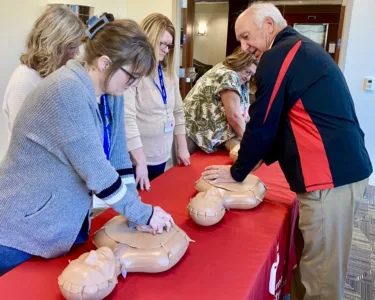
The American Heart Association set up a hands-only CPR training station at the downtown Parkersburg offices of Highmark West Virginia to give basic training to employees following their annual Thanksgiving employee lunch.
On an annual basis around 340,000 people will suffer sudden cardiac arrest, with only 10% surviving, said Tom Mossoti, community CPR manager for the American Heart Association of the Eastern United States.
Hands-Only CPR involves just chest compressions.
"By doing CPR we want to move that needle to move that survival rate up into the teens," he said. "The state of Washington's survival rate is in the high teens.
"We are working here to get that survival rate up."
"The role of doing the compressions is to keep the blood pumping," Mossoti said. "By pushing down on the chest it will keep blood pumping and keep that oxygenated blood circulating.
"That blood gets to the brain and keeps the brain alive."
After four minutes without oxygen, the brain will start to lose its functionality, he said, adding after seven minutes there will be permanent brain damage.
On average, emergency medical responders can arrive in 8-10 minutes, he said adding in rural areas such as this region, it can be 15-20 minutes or longer, depending on distances.
"If we wait for paramedics to arrive without intervention, that individual will likely suffer permanent brain damage, if they survive at all," Mossoti said. "Our role is to push fast and hard in the center of the chest and keep the blood pumping.
"Just doing that will double or triple their chance of survival. That is pretty powerful."
People would need to do 100-120 compressions per minute.
"Doing compressions is not going to start the heart back up," Mossoti said. "The defibrillator is what is going to start the heart back up."
"We are not giving breaths," Mossoti said. "We hope that just by doing compressions people are more receptive to getting involved.
"Just by doing that, they double or triple that person's chance of survival."
Chest compressions should continue until emergency medical personnel arrive or someone shows up with an automated external defibrillator, attach it and administer the shock. Many modern devices in office buildings or retail locations have instructions on how to attach and operate the device, and have monitors that will not allow an unnecessary shock to be administered.
Mossoti said it is important for people to have basic CPR training, they will be more likely to get involved if someone suffers cardiac arrest in the workplace. And, it is important for a workplace to have people already certified, if possible, in doing CPR and someone who can operate the AED as part of an emergency response plan.
"They will be much more receptive to get involved and aren't going to hesitate," he said. "They will have that confidence because they will know what to do."
If someone suffers cardiac arrest, the heart stops and is not pumping blood.
"If we wait 15 minutes (for EMS) to arrive it is likely the person will not survive,” Mossoti reiterated.
President of Highmark West Virginia Jay Sheehy said Wednesday's educational demonstrations and practice are part of helping the community in numerous ways.
"Being trained in different things, such as CPR, is an important way we can support others in the community and in our own families," he said. "My people here asked for this training."
Officials with the American Heart Association said that if something happens at work or in a family setting people will then have to respond to help someone they know or see on a regular basis, so the stakes of life and death become more personal to everyone.
West Virginia leads the nation in chronic illness and obesity, which leads to cardiac issues, Sheehy said.
"We are addressing these issues, but also just being able to help friends and family members in the community," he said. "Our mission statement is to give back to the community and improve the overall health of the people in West Virginia.
"We all have family members with different conditions. I got CPR training early on. Our employees think the same way. They have family members they care about with conditions, whether it is cardiac or diabetes, where they want to help them stay healthy."