
Invasive tree species creating knotty problem across United States

A Bradford pear is cleared away by Victor Elam, refuge manager at the Ohio River Island National Wildlife Refuge in Williamstown, at the bird and butterflies trail next to the Visitor Center. (Photo Provided)
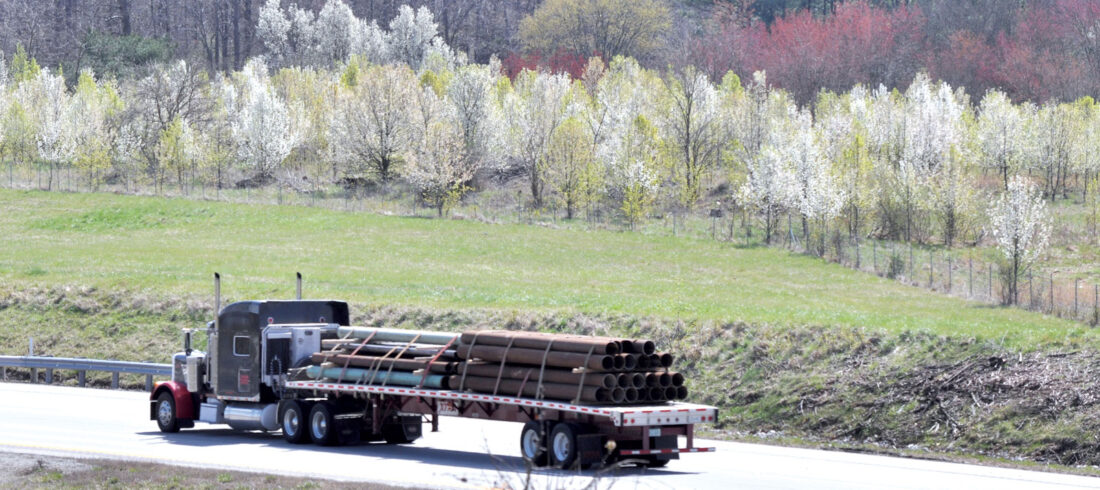
A patch of Bradford pear trees grows along U.S. 50 northbound north of the DuPont Road ramp. The invasive trees choke out native vegetation that is food for wildlife. (Photo by Art Smith)
A Bradford pear is cleared away by Victor Elam, refuge manager at the Ohio River Island National Wildlife Refuge in Williamstown, at the bird and butterflies trail next to the Visitor Center. (Photo Provided)
A patch of Bradford pear trees grows along U.S. 50 northbound north of the DuPont Road ramp. The invasive trees choke out native vegetation that is food for wildlife. (Photo by Art Smith)
Trending
WILLIAMSTOWN -- White-flowering trees along the road look nice, but their appearance is deceiving.
Callery pears, also known as Bradford pear trees and other varieties, were brought to this country in hopes of developing a more resilient tree.
Instead the invasive species that was a popular landscaping addition chokes out the native species and vegetation that wildlife depends on for food and can cause economic and environmental harm.
The proliferating trees are a problem in the region, the East Coast and are spreading.
"It's a problem as far west as Kansas, as far as I know," said Victor Elam, refuge manager at the Ohio River Islands National Wildlife Refuge in Williamstown, where the organization has been removing trees on the islands it manages.
The ornamental Callery pear was brought in from Asia in the early 20th century. It has wreaked havoc, according to J.J. Barrett, WVU Extension agent in Wood County.
"The genie is out of the bottle," he said.
Once established, the trees grow faster than the other vegetation and block the sunlight to the plant growth below, Marcus McCartney, the Ohio State Extension Service agent in Washington County, said. The trees become dominant over time, he said.
"They start taking over," McCartney said.
Callery pears produce leaves much earlier than other native species, Elam said. The leaves that grow early in the spring shade the ground below, blocking sunlight from reaching early-emerging wildflowers that bees depend on and other vegetation animals depend on for food, he said.
"Their populations are dwindling as a result," Elam said.
While the intention of importing the trees was noble, the experiment backfired as the species' impact on the native vegetation was not foreseen, he said.
"It's a problem of unintended consequences," Elam said.
A solution so far is to remove the tree by cutting them, Elam said. That, too, is difficult because shoots will emerge from the stumps and new trees will grow, he said.
The freshly cut stumps must be immediately treated with a herbicide to kill the roots, Elam said. The refuge uses a systemic herbicide such as glyphosate that can be painted on the stump to kill the roots, he said.
The refuge removes about 200 trees a year, he said. The refuge was established more than 30 years ago to protect and restore the habitat for the native wildlife on the environs of the 24 islands on more than 360 miles of the upper Ohio River and is part of a nationwide system of refuges established in 1903.
"We have been cutting down Callery pears for a few years now," Elam said.
Large patches of the trees can be seen while driving on rural roads, Barrett said. A large nearby patch is on U.S. 50 north of the Blennerhassett Bridge on the right side of the road while nearing the Fifth Street exit, Barrett said.
The problem is not unlike multiflora rose, Barrett said. Multiflora rose, native to Asia, was introduced in the United States in the 1860s. The United States Department of Agriculture in the 1930s encouraged multiflora rose to control erosion and as a natural fence for farm animals, but it, too, proliferated out of control.
The state of Ohio has made it illegal to sell Callery trees effective Jan. 1, 2023. Pennsylvania and South Carolina also ban the sales and other states discourage residents from planting the trees.
Virginia in March started an exchange program as an incentive to remove up to three Callery pear trees for an equal number of native trees as replacements for free.
The West Virginia Extension Service classifies Callery-Bradford pears as Level 1, highly invasive.
According to the Ohio Department of Agriculture, the Bradford pear is a cultivar of the Callery pear, Pyrus calleryana. Insect pollinated, they produce sterile fruits because they do not self-pollinate.
But varieties began to cross pollinate and proliferate. Among the more commonly used cultivars, in addition to the Bradford are Cleveland Select, Autumn Blaze, Chanticleer and Whitehouse, the department said.
"New cultivars of Pyrus calleryana were bred to reduce the tree's tendency to split in snow or high winds. The Bradford pear cultivar, other P. calleryana cultivars and P. betulifolia or Asian pear, can hybridize and produce fertile fruit. In addition to this, fertile pear varieties are commonly used as the rootstock when grafting," an advisory from the department said. If the grafted crown is damaged the fertile rootstock can then dominate, producing fertile fruit. These factors and others may have contributed to the trees seeding out into natural areas and becoming an invasive problem."
Several species of trees are available to replace the pear trees, McCartney said. Among those are red bud, dogwood and serviceberry, he said.
The extension services in Wood and Washington counties have information and resources available about the trees.
Jess Mancini can be reached at jmancini@newsandsentinel.com.