
A Story of Survival: Mid-Ohio Valley woman reflects on victory over ovarian cancer

Kayla Gossett is a survivor of ovarian cancer. (Photo Provided)
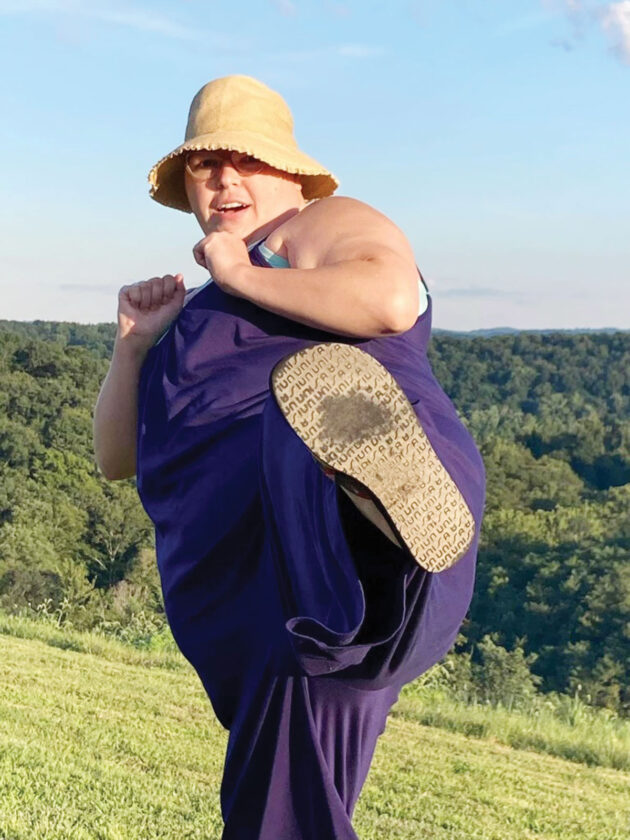
Kayla Gossett is a survivor of ovarian cancer. (Photo Provided)

Kayla Gossett is a survivor of ovarian cancer. (Photo Provided)
Kayla Gossett is a survivor of ovarian cancer. (Photo Provided)
Kayla Gossett is a survivor of ovarian cancer. (Photo Provided)
Kayla Gossett is a survivor of ovarian cancer. (Photo Provided)
Trending
PARKERSBURG -- Receiving a cancer diagnosis can be one of the most difficult experiences of a person's life.
There are many questions and variables surrounding cancer, and the disease can make every day feel like an uphill battle.
The toll it can take on both one's physical and mental health cannot be understated, and according to Kayla Gossett, a survivor of stage 2-3 ovarian cancer, a person's mental health and well-being is just as critical as physical health.
Gossett was diagnosed in December 2021 at age 34, but was experiencing symptoms including severe abdominal pain beginning around 2017.
"I would have to rock for a couple hours just to ease it," she recalled.
The pain would happen randomly, and it began to get worse after a couple of years. It started happening more frequently no matter what she did. She didn't have insurance at the time, and she was terrified of going to the doctor, so she'd hoped it would pass with time.
"I was always so scared that I would get really bad news," she said.
Gossett was hired at Highmark in 2021 and got insurance, but wasn't able to see a doctor until September of that year, and the symptoms worsened.
"I started gaining weight but it wasn't fat," she said. "There was fluid around my lungs."
When the time for her appointment came, a CT scan was done, and they found a giant mass in her abdomen.
The mass was to be removed in December of 2021, but the day of the procedure, the doctors determined that further testing needed to be done. The mass was not removed until February of 2022 after she had to go to the emergency room. They removed roughly five liters of fluid from her abdomen that day. Two days later, they performed surgery and removed eight more liters and gave her draining tubes.
"There were about 15 to 18 liters of fluid drained in total," Gossett said.
In April, she began to have chemotherapy treatments once every three weeks. Her last treatment was Sept. 9, 2022.
"On Oct. 6, the oncologist said I was cancer-free," Gossett recalled.
She'll be treated with a maintenance drug called Avastin once every three weeks to prevent the cancer from coming back, likely for the rest of her life.
Gossett also struggled with her port, which is a type of implant used to aid in receiving infusions. Her port flipped, so she had to get a PICC (peripherally inserted central catheter) line, which requires more maintenance. Gossett had surgery to fix the port, but it ended up tilted and became unusable toward the end of her chemotherapy treatments. Fortunately, she no longer needs it with Avastin.
"They asked me, 'would you like to have your port removed?' and I said 'yes, please!,'" she recalled with a chuckle.
Maintaining her health is a top priority for Gossett, and she is continuously making the effort to keep herself healthy with regular doctors appointments, a medication and vitamin regimen and therapy.
"I have a lot of doctors visits and CT scans every few months. I had low Vitamin D and calcium, and my general practitioner said it's probably because the abdominal surgery to remove mass caused malabsorption of those vitamins. Now I'm on a vitamin regimen," she added.
She plans to start going to the gym regularly once she regains her energy.
However, while taking care of the physical body is crucial to staying healthy, nurturing mental health is integral as well.
Gossett largely faced her battle with cancer alone. She had the support of some loved ones like her mother and best friend, but the fear of being burdensome prevented her from asking for more help.
"I went through quite a bit of depression," Gossett recalled. "All before I had the surgery I was basically alone. But when I had the surgery, I wasn't able to go up and down the stairs for about three weeks, so I stayed with my mom and she took care of me. I had that time to reflect and just look at everything from the outside.
"I could not have done any of it without my mom and her husband," she added. "And I couldn't have done it without my best friend. She said if I ever needed anything, she would be there."
Gossett also credits her church family with a significant part of her journey to recovery and the healing she's gone through.
"My church family has been exactly what I needed," she said, adding they raised over $500 in Merle Norman certificates so that she could buy a wig, and they helped her with bills, along with offering emotional and moral support.
"I have never felt so wanted," Gossett said. "There are people who care about you and will stay with you no matter what. And you want to hold onto those people," she added.
Gossett received her transfusions and treatments at WVU Medicine's Camden Clark Medical Center, and she pointed out some steps they took to offer her more help.
They have a social worker who comes and sees patients ever so often to check in and offer support and additional services. For instance, they discussed testing for other markers of genetic cancers, as well as seeing a therapist.
"Going through cancer changes you --it changes everything," Gossett said. "Therapy and talking about it definitely helped. You want someone who's going to listen. You definitely don't want to be alone with your own thoughts," she added. "You need to surround yourself with the people you love and not be afraid to ask for help. And you want to take advantage of what the hospital has because they want to help you."
When asked what messages she'd like to share with the community, Gossett had two critical points: be persistent in taking care of your health and find your village.
"If you think something is wrong with your body, definitely have it checked out. Be persistent about it. I wasn't, and had I been, it might not have gotten as far as it did," she said, adding advocating for yourself and your well-being is crucial, and a solid support system can help greatly.
"When it comes to cancer, it can be scary, and doing the majority of it alone, emotionally and mentally you need somebody to be there with you -- family, best friend, partner -- you need somebody in your corner saying, 'We got you. No matter what it is, it's you and me. We're going to kick this in the butt. You're gonna get through this,'" she added.
"You need your village," she declared. "Find it and get rid of the ones who pretend to be your village because they will drag you down and they will not improve your mental health. And you need your mental health to get through this."
Gossett also had one more message for the community.
"Going through anything healthwise like cancer, your body will not be the same afterwards. Even when it's hard, we need to be kind to ourselves because we went through something that was very difficult on our bodies and we can't expect it to be exactly as it was before. We have to understand how our new body works and what it needs in this new stage. And when you find it hard to be kind to yourself, go to your village and talk to them and they will be there to lift you up and remind you of how strong and amazing you are."
Cancer affects people from all walks of life, and it can be devastating, but, as Gossett points out, it's crucial to have hope.
"Having cancer and feeling like it could be the end kind of changes your outlook on life a little bit," she said. "The whole time I knew I was gonna be okay though. I knew that God was with me."
Maddie Harris can be reached at mharris@newsandsentinel.com