
‘Strollin’ Colon’ exhibit raises awareness of cancer screenings
Trending
PARKERSBURG -- People were reminded of the importance of colon screenings at the WVU Medicine Camden Clark Medical Center on Wednesday.
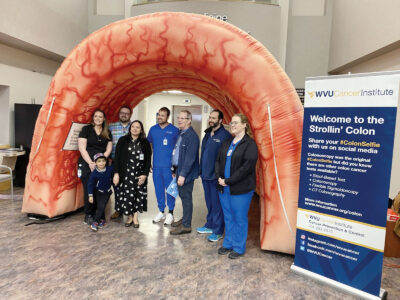
The Strollin' Colon inflatable exhibit was on display at Camden Clark's Medical Office Building B.
WVU Medicine Camden Clark Medical Center has joined the WVU Cancer Institute and the West Virginia Mountains of Hope State Cancer Coalition to promote the statewide Colorectal Cancer Awareness campaign throughout the month of March.
The 10-by-12-foot inflatable colon demonstrates what a healthy colon looks like along with what it looks like when colon cancer and other conditions are present.
Officials with Camden Clark wanted to increase awareness efforts for people to learn more about colon cancer screening and options available locally.
Health care providers and staff from the WVU Medicine Camden Clark Regional Cancer Center and Digestive Diseases Services were present to share information and answer questions.
"Colon cancer is preventable by screening," Gastroenterologist Dr. Mohamed Barakat said. "There are many ways to be screened for colon cancer.
"The gold standard is the colonoscopy. I can use a special device to visualize the colon. I can see polyps before they turn into cancer and remove them and mitigated the progression to cancer."
Some smaller cancers can be removed through a colonoscopy and save the colon from surgery, he said.
The typical screening age is now 45 for average risk patients who traditionally do not have a significant family history of colon cancer, polyps or any other genetic mutations. Those with that family history could start colonoscopies in their early 20s if they have those increased risks.
Screening options can include a colonoscopy, a take-home stool testing kit and a CT colonography which is not available locally. If a positive comes up on one of the other tests, the person will need to have a colonoscopy.
"A colonoscopy hits two birds with one stone," Barakat said.
If colon cancer is found, it can be treated through radiation, chemotherapy and/or surgery depending on how far along it might be.
Dr. Jeff Ryckman, radiation oncology, and Dr. Sumaira Shafi, medical oncology, said the sooner colon cancer can be detected the less severe the treatment options are.
"The most important thing about this is the earlier things are caught the less we have to do for it," Ryckman said. "The earlier we are able to catch things, the easier it is to treat and more likely it is to be curative."
Shafi said some treatments have the possibility of preventing the cancer from coming back.
"One goal is to treat the cancer and the more important goal is to prevent it from happening again," she said, adding there are now tests that can detect cancer cells in the blood.
Officials said many people will make excuses about not doing a colonoscopy because of time, what is involved and more. The sooner it is detected, the better.
They want to avoid having to do intensive treatments if they can, Shafi said.
"The lesser the disease the lesser the treatment," she said. "In my opinion, the sooner we pick it up the easier it is to treat them and it is easier for the patients to handle the treatments."
The hardest part is getting people to show up for the screenings.
The earlier they catch it, the more tolerable the treatments are, Ryckman said.
"I have seen how hard cancer treatments are on patients," he said. "I'd be damned if I let it go if there was an available screening process and how easier the treatments would be if it was caught earlier.
"We don't want to do any more than we have to."
Brett Dunlap can be reached at bdunlap@newsandsentinel.com